False Witnesses in the Garden

Throughout the ages society has been plagued by people that are willing to provide a false testimony. More severe than telling a lie, these people stand up and swear something exists that does not, something happened that did not, or something is happening that really is not. “Deuteronomy 17:6: At the mouth of two witnesses, or three witnesses, shall he that is worthy of death be put to death; but at the mouth of one witness he shall not be put to death.”, and “Deuteronomy 5:20: Neither shalt thou bear false witness against thy neighbour.”. Bearing false witness against your neighbour is the ninth commandment, and so often it is reduced to “don’t lie”. Lying is a poor character trait to have, but to bear false witness is to alter the course of history, and to make people act on false information potentially changing the outcome of their future. There are a few examples of this I would like to explore in scripture that have often been over looked.

Act 6:8 And Stephen, full of faith and power, did great wonders and miracles among the people.
Act 6:9 Then there arose certain of the synagogue, which is called the synagogue of the Libertines, and Cyrenians, and Alexandrians, and of them of Cilicia and of Asia, disputing with Stephen.
Act 6:10 And they were not able to resist the wisdom and the spirit by which he spake.
Act 6:11 Then they suborned men, which said, We have heard him speak blasphemous words against Moses, and against God.
Act 6:12 And they stirred up the people, and the elders, and the scribes, and came upon him, and caught him, and brought him to the council,
Act 6:13 And set up false witnesses, which said, This man ceaseth not to speak blasphemous words against this holy place, and the law:
Act 6:14 For we have heard him say, that this Jesus of Nazareth shall destroy this place, and shall change the customs which Moses delivered us.
Act 6:15 And all that sat in the council, looking stedfastly on him, saw his face as it had been the face of an angel.

Here we see people who could not compete with the wisdom and spirit Stephen was speaking with, so they set up false witnesses against him. These false witnesses claimed Stephen was speaking against the law of God, saying Jesus would destroy the temple, and change what Moses had delivered to the people from Yahweh God. If they had to “set up” false witnesses, then it is clear Stephen was actually not saying these things. As we read on, Stephen gives his testimony.

Act 7:37 This is that Moses, which said unto the children of Israel, A prophet shall the Lord your God raise up unto you of your brethren, like unto me; him shall ye hear.
Act 7:38 This is he, that was in the church in the wilderness with the angel which spake to him in the mount Sina, and with our fathers: who received the lively oracles to give unto us:
Act 7:39 To whom our fathers would not obey, but thrust him from them, and in their hearts turned back again into Egypt,

Act 7:40 Saying unto Aaron, Make us gods to go before us: for as for this Moses, which brought us out of the land of Egypt, we wot not what is become of him.
Act 7:41 And they made a calf in those days, and offered sacrifice unto the idol, and rejoiced in the works of their own hands.
Act 7:42 Then God turned, and gave them up to worship the host of heaven; as it is written in the book of the prophets, O ye house of Israel, have ye offered to me slain beasts and sacrifices by the space of forty years in the wilderness?
Act 7:43 Yea, ye took up the tabernacle of Moloch, and the star of your god Remphan, figures which ye made to worship them: and I will carry you away beyond Babylon.

Stephen was not denying what Moses taught, but actually reaffirming what Moses taught, and how it was delivered to him, declaring Jesus to be the one like him who would come. The beginning of the church was actually at Mount Sinai. The truth is hard to hear, and when he spoke of the idolatry they were guilty of, it enraged them even more. They killed the prophets that Yahweh God had sent them, most recently betraying the Just one, the son of God, Moses spoke of.

Act 7:51 Ye stiffnecked and uncircumcised in heart and ears, ye do always resist the Holy Ghost: as your fathers did, so do ye.
Act 7:52 Which of the prophets have not your fathers persecuted? and they have slain them which shewed before of the coming of the Just One; of whom ye have been now the betrayers and murderers:
Act 7:53 Who have received the law by the disposition of angels, and have not kept it.

What is interesting is the false witnesses were claiming that Stephen was teaching against Moses and the law of Yahweh, and he turned it around on them to say they have received the law by the disposition of angels and have not kept it. The false witnesses prevailed though, and Stephen was stoned to death with Saul, the future Apostle Paul, looking on in approval before his conversion.

Act 7:54 When they heard these things, they were cut to the heart, and they gnashed on him with their teeth.
Act 7:55 But he, being full of the Holy Ghost, looked up stedfastly into heaven, and saw the glory of God, and Jesus standing on the right hand of God,
Act 7:56 And said, Behold, I see the heavens opened, and the Son of man standing on the right hand of God.
Act 7:57 Then they cried out with a loud voice, and stopped their ears, and ran upon him with one accord,
Act 7:58 And cast him out of the city, and stoned him: and the witnesses laid down their clothes at a young man’s feet, whose name was Saul.
Act 7:59 And they stoned Stephen, calling upon God, and saying, Lord Jesus, receive my spirit.
Act 7:60 And he kneeled down, and cried with a loud voice, Lord, lay not this sin to their charge. And when he had said this, he fell asleep.

Paul would experience the same sort of treatment from false witnesses. Later in the book of Acts, Paul had made many enemies and was being accused of the same things Stephen was accused of.

Act 21:18 On the following day Paul went in with us to James, and all the elders were present.
Act 21:19 After greeting them, he related one by one the things that God had done among the Gentiles through his ministry.
Act 21:20 And when they heard it, they glorified God. And they said to him, “You see, brother, how many thousands there are among the Jews of those who have believed. They are all zealous for the law,
Act 21:21 and they have been told about you that you teach all the Jews who are among the Gentiles to forsake Moses, telling them not to circumcise their children or walk according to our customs.

Act 21:22 What then is to be done? They will certainly hear that you have come.
Act 21:23 Do therefore what we tell you. We have four men who are under a vow;
Act 21:24 take these men and purify yourself along with them and pay their expenses, so that they may shave their heads. Thus all will know that there is nothing in what they have been told about you, but that you yourself also live in observance of the law.

From this we see Paul met with James and the elders and told them all of the good things Yahweh God was doing , but they informed Paul that the believing Jews heard he was telling the Jews living among the gentiles (people from the nations), that he was promoting lawlessness, and telling the people to forsake Moses. In order to dispel this rumour, they told Paul to take a vow. We see the definition of the Nazarite vow in the book of Numbers, which there is some debate as to whether or not this is the vow Paul took here.

Num 6:1 And the LORD spake unto Moses, saying,
Num 6:2 Speak unto the children of Israel, and say unto them, When either man or woman shall separate themselves to vow a vow of a Nazarite, to separate themselves unto the LORD:
Num 6:3 He shall separate himself from wine and strong drink, and shall drink no vinegar of wine, or vinegar of strong drink, neither shall he drink any liquor of grapes, nor eat moist grapes, or dried.
Num 6:4 All the days of his separation shall he eat nothing that is made of the vine tree, from the kernels even to the husk.
Num 6:5 All the days of the vow of his separation there shall no razor come upon his head: until the days be fulfilled, in the which he separateth himself unto the LORD, he shall be holy, and shall let the locks of the hair of his head grow.
Num 6:6 All the days that he separateth himself unto the LORD he shall come at no dead body.
Num 6:7 He shall not make himself unclean for his father, or for his mother, for his brother, or for his sister, when they die: because the consecration of his God is upon his head.
Num 6:8 All the days of his separation he is holy unto the LORD.

We have a difficult situation to overcome. Was Paul really teaching against the law of Moses, and then took the Nazarite vow, or another vow, as a false witness to hide what he was really teaching, or were people acting as false witnesses against Paul, misrepresenting what he taught? Here is what they said, “Thus all will know that there is nothing in what they have been told about you, but that you yourself also live in observance of the law. ”. Therefore, the only two options we have are one, Paul took the Nazarite vow to deceive people into thinking he believed things he did not, or two, Paul walked orderly and kept the law of God. I am suggesting the second option.

Paul speaks in his letter to the Roman’s that the law of God is just and good. Maybe this is why Peter gives us a warning in his epistle about Paul, and that his teaching is sometimes hard to understand.

Rom 7:11 For sin, taking occasion by the commandment, deceived me, and by it slew me.
Rom 7:12 Wherefore the law is holy, and the commandment holy, and just, and good.

Here is Peter’s advice regarding Paul’s teachings:

2Pe 3:14 Therefore, beloved, since you are waiting for these, be diligent to be found by him without spot or blemish, and at peace.
2Pe 3:15 And count the patience of our Lord as salvation, just as our beloved brother Paul also wrote to you according to the wisdom given him,
2Pe 3:16 as he does in all his letters when he speaks in them of these matters. There are some things in them that are hard to understand, which the ignorant and unstable twist to their own destruction, as they do the other Scriptures.
2Pe 3:17 You therefore, beloved, knowing this beforehand, take care that you are not carried away with the error of lawless people and lose your own stability.

2Pe 3:18 But grow in the grace and knowledge of our Lord and Savior Jesus Christ. To him be the glory both now and to the day of eternity. Amen.

One last example of bearing false witness comes from a story that is not found in the sixty-six book Bible. In the Greek Septuagint, which is a third century BC Greek translation, this story is found in the thirteenth chapter of Daniel. It is also included in the fourth century Latin Vulgate, translated by the early church father Jerome, as well as the King James Authorized Version. This is a good story that unfortunately, most have missed out reading in the modern church. I recommend reading the entire chapter, but here are some key verses to understand the story.

Dan 13:1 There dwelt a man in Babylon, called Joacim:
Dan 13:2 And he took a wife, whose name was Susanna, the daughter of Chelcias, a very fair woman, and one that feared the Lord.
Dan 13:3 Her parents also were righteous, and taught their daughter according to the law of Moses.

Dan 13:4 Now Joacim was a great rich man, and had a fair garden joining unto his house: and to him resorted the Jews; because he was more honourable than all others.
Dan 13:5 The same year were appointed two of the ancients of the people to be judges, such as the Lord spake of, that wickedness came from Babylon from ancient judges, who seemed to govern the people.
Dan 13:6 These kept much at Joacim’s house: and all that had any suits in law came unto them.
Dan 13:7 Now when the people departed away at noon, Susanna went into her husband’s garden to walk.
Dan 13:8 And the two elders saw her going in every day, and walking; so that their lust was inflamed toward her.
Dan 13:9 And they perverted their own mind, and turned away their eyes, that they might not look unto heaven, nor remember just judgments.

Dan 13:16 And there was no body there save the two elders, that had hid themselves, and watched her.
Dan 13:17 Then she said to her maids, Bring me oil and washing balls, and shut the garden doors, that I may wash me.
Dan 13:18 And they did as she bade them, and shut the garden doors, and went out themselves at privy doors to fetch the things that she had commanded them: but they saw not the elders, because they were hid.
Dan 13:19 Now when the maids were gone forth, the two elders rose up, and ran unto her, saying,
Dan 13:20 Behold, the garden doors are shut, that no man can see us, and we are in love with thee; therefore consent unto us, and lie with us.
Dan 13:21 If thou wilt not, we will bear witness against thee, that a young man was with thee: and therefore thou didst send away thy maids from thee.
Dan 13:22 Then Susanna sighed, and said, I am straitened on every side: for if I do this thing, it is death unto me: and if I do it not I cannot escape your hands.
Dan 13:23 It is better for me to fall into your hands, and not do it, than to sin in the sight of the Lord.

The two judges had Susanna trapped. They swore to both bear false witness against her if she would not comply with their demands. She was doomed to be put to death, and the elders were ready to do so once she was brought up before them by the false witnesses. She cried out to Yahweh God and a young Daniel stood up to talk some sense into the situation.

Dan 13:45 Therefore when she was led to be put to death, the Lord raised up the holy spirit of a young youth whose name was Daniel:
Dan 13:46 Who cried with a loud voice, I am clear from the blood of this woman.
Dan 13:47 Then all the people turned them toward him, and said, What mean these words that thou hast spoken?
Dan 13:48 So he standing in the midst of them said, Are ye such fools, ye sons of Israel, that without examination or knowledge of the truth ye have condemned a daughter of Israel?
Dan 13:49 Return again to the place of judgment: for they have borne false witness against her.
Dan 13:50 Wherefore all the people turned again in haste, and the elders said unto him, Come, sit down among us, and shew it us, seeing God hath given thee the honour of an elder.
Dan 13:51 Then said Daniel unto them, Put these two aside one far from another, and I will examine them.

Daniel examined them separately to see if their stories lined up.

Dan 13:52 So when they were put asunder one from another, he called one of them, and said unto him, O thou that art waxen old in wickedness, now thy sins which thou hast committed aforetime are come to light.
Dan 13:53 For thou hast pronounced false judgment and hast condemned the innocent and hast let the guilty go free; albeit the Lord saith, The innocent and righteous shalt thou not slay.
Dan 13:54 Now then, if thou hast seen her, tell me, Under what tree sawest thou them companying together? Who answered, Under a mastick tree.
Dan 13:55 And Daniel said, Very well; thou hast lied against thine own head; for even now the angel of God hath received the sentence of God to cut thee in two.
Dan 13:56 So he put him aside, and commanded to bring the other, and said unto him, O thou seed of Chanaan, and not of Juda, beauty hath deceived thee, and lust hath perverted thine heart.
Dan 13:57 Thus have ye dealt with the daughters of Israel, and they for fear companied with you: but the daughter of Juda would not abide your wickedness.
Dan 13:58 Now therefore tell me, Under what tree didst thou take them companying together? Who answered, Under an holm tree.

Daniel exposes their attempt to bring false witness against the women, pointing out one was a Canaanite, and they had corrupted the house of Israel, but were not going to be able to corrupt the house of Judea as easily. So these false witnesses suffered the fate they had intended for the woman.

Dan 13:61 And they arose against the two elders, for Daniel had convicted them of false witness by their own mouth:
Dan 13:62 And according to the law of Moses they did unto them in such sort as they maliciously intended to do to their neighbour: and they put them to death. Thus the innocent blood was saved the same day.
Dan 13:63 Therefore Chelcias and his wife praised God for their daughter Susanna, with Joacim her husband, and all the kindred, because there was no dishonesty found in her.
Dan 13:64 From that day forth was Daniel had in great reputation in the sight of the people.

Unfortunately, there are many times the victims of false witnesses do not get justice as in the case of Susanna in the book of Daniel. Stephen was a good example of that, as well as Jesus.

Mat 26:59 And the chief priests and the elders and all the sanhedrin sought false witness against Jesus, in order to put Him to death.
Mat 26:60 But they found none; yea, though many false witnesses came, they found none. But at last two false witnesses came up
Mat 26:61 and said, This one said, I am able to destroy the temple of God and to build it in three days.

All through history we have examples of people bearing false witness, putting people to death unjustly, and deceiving entire nations to act wickedly against other nations, or groups of people. This is the weight of the commandment saying “Neither shalt thou bear false witness against thy neighbour”. It is no different today, and I suggest being on guard for people or entities that may be in the midst of changing history based on the testimony of false witnesses.

Information from Ezra We Stopped Reading, and Hope in the Resurrection of the Dead

The book of Revelation in the Bible is often neglected in Christianity due to its supposed difficulty and plain weirdness. Also, many people have made a lot of money trying to explain the visions John had and wrote down in the book. People often try to set dates for events, that are always wrong, which also contributes to churches staying away from the book, simply because they are afraid to appear apocalyptic. I don’t ever intend on setting dates or trying to make money from scaring people; however, I would like to offer some missing information that early believers had access to, and for various reasons it has been removed from the common knowledge of the church today.

One source that sheds more light on future events is found in the writings of Ezra. Ezra is a second temple period priest and scribe that can be read about in your sixty-six book bible in the books of Nehemiah and Ezra. The Greek name for Ezra is Esdras, and more is written about Ezra in the books Esdras 1 and 2. Esdras 1 is found in the Greek Septuagint, a Greek translation of the Hebrew bible, completed sometime in the third century BC. Esdras 1 and 2 are found in early English translations, including the 1611 King’s James version. Esdras 2 was considered to be a later Christian work until fragments were found in the caves of Qumran. By exposing this book, I am hoping more people will take time to read it, as it is relevant for today. There are many messianic prophecies in this book that expand what we get in our redacted sixty-six book Bible.

2Es 13:1 And it came to pass after seven days, I dreamed a dream by night:
2Es 13:2 And, lo, there arose a wind from the sea, that it moved all the waves thereof.
2Es 13:3 And I beheld, and, lo, that man waxed strong with the thousands of heaven: and when he turned his countenance to look, all the things trembled that were seen under him.
2Es 13:4 And whensoever the voice went out of his mouth, all they burned that heard his voice, like as the earth faileth when it feeleth the fire.
2Es 13:5 And after this I beheld, and, lo, there was gathered together a multitude of men, out of number, from the four winds of the heaven, to subdue the man that came out of the sea
2Es 13:6 But I beheld, and, lo, he had graved himself a great mountain, and flew up upon it.
2Es 13:7 But I would have seen the region or place whereout the hill was graven, and I could not.
2Es 13:8 And after this I beheld, and, lo, all they which were gathered together to subdue him were sore afraid, and yet durst fight.
2Es 13:9 And, lo, as he saw the violence of the multitude that came, he neither lifted up his hand, nor held sword, nor any instrument of war:
2Es 13:10 But only I saw that he sent out of his mouth as it had been a blast of fire, and out of his lips a flaming breath, and out of his tongue he cast out sparks and tempests.
2Es 13:11 And they were all mixed together; the blast of fire, the flaming breath, and the great tempest; and fell with violence upon the multitude which was prepared to fight, and burned them up every one, so that upon a sudden of an innumerable multitude nothing was to be perceived, but only dust and smell of smoke: when I saw this I was afraid.
2Es 13:12 Afterward saw I the same man come down from the mountain, and call unto him another peaceable Multitude.
2Es 13:13 And there came much people unto him, whereof some were glad, some were sorry, and some of them were bound, and other some brought of them that were offered: then was I sick through great fear, and I awaked, and said,
2Es 13:14 Thou hast shewed thy servant these wonders from the beginning, and hast counted me worthy that thou shouldest receive my prayer:
2Es 13:15 Shew me now yet the interpretation of this dream.

In this vision Ezra is shown a man that comes out of a sea and goes on a mountain with thousands of heaven. There was an army that tried to subdue the man, which were consumed by fire from his mouth, with only dust and the smell of smoke left. Then the man came down from the mountain and called a peaceable multitude toward him. Now here is the interpretation that was given to Ezra about the vision:

2Es 13:25 This is the meaning of the vision: Whereas thou sawest a man coming up from the midst of the sea:
2Es 13:26 The same is he whom God the Highest hath kept a great season, which by his own self shall deliver his creature: and he shall order them that are left behind.
2Es 13:27 And whereas thou sawest, that out of his mouth there came as a blast of wind, and fire, and storm;
2Es 13:28 And that he held neither sword, nor any instrument of war, but that the rushing in of him destroyed the whole multitude that came to subdue him; this is the interpretation:
2Es 13:29 Behold, the days come, when the most High will begin to deliver them that are upon the earth.
2Es 13:30 And he shall come to the astonishment of them that dwell on the earth.
2Es 13:31 And one shall undertake to fight against another, one city against another, one place against another, one people against another, and one realm against another.
2Es 13:32 And the time shall be when these things shall come to pass, and the signs shall happen which I shewed thee before, and then shall my Son be declared, whom thou sawest as a man ascending.
2Es 13:33 And when all the people hear his voice, every man shall in their own land leave the battle they have one against another.
2Es 13:34 And an innumerable multitude shall be gathered together, as thou sawest them, willing to come, and to overcome him by fighting.
2Es 13:35 But he shall stand upon the top of the mount Sion.
2Es 13:36 And Sion shall come, and shall be shewed to all men, being prepared and builded, like as thou sawest the hill graven without hands.
2Es 13:37 And this my Son shall rebuke the wicked inventions of those nations, which for their wicked life are fallen into the tempest;
2Es 13:38 And shall lay before them their evil thoughts, and the torments wherewith they shall begin to be tormented, which are like unto a flame: and he shall destroy them without labour by the law which is like unto me.

If we compare these passages in Revelation, we get a similar situation. Notice the similarities with the angels following, and the sword coming from his mouth, destroying nations. I would suggest the symbolism of the sword in revelation and the fire in Ezra coming from his mouth represents the Word. “Psa 147:18 He sendeth out his word, and melteth them: he causeth his wind to blow, and the waters flow.”, and “he shall destroy them without labour by the law which is like unto me”, from verse 38 above.

Rev 19:11 And I saw heaven opened, and behold a white horse; and he that sat upon him was called Faithful and True, and in righteousness he doth judge and make war.
Rev 19:12 His eyes were as a flame of fire, and on his head were many crowns; and he had a name written, that no man knew, but he himself.
Rev 19:13 And he was clothed with a vesture dipped in blood: and his name is called The Word of God.
Rev 19:14 And the armies which were in heaven followed him upon white horses, clothed in fine linen, white and clean.
Rev 19:15 And out of his mouth goeth a sharp sword, that with it he should smite the nations: and he shall rule them with a rod of iron: and he treadeth the winepress of the fierceness and wrath of Almighty God.

Isaiah also has similar language concerning the breath of his lips that will destroy the wicked.

Isa 11:1 And there shall come forth a rod out of the stem of Jesse, and a Branch shall grow out of his roots:
Isa 11:2 And the spirit of the LORD shall rest upon him, the spirit of wisdom and understanding, the spirit of counsel and might, the spirit of knowledge and of the fear of the LORD;
Isa 11:3 And shall make him of quick understanding in the fear of the LORD: and he shall not judge after the sight of his eyes, neither reprove after the hearing of his ears:
Isa 11:4 But with righteousness shall he judge the poor, and reprove with equity for the meek of the earth: and he shall smite the earth with the rod of his mouth, and with the breath of his lips shall he slay the wicked.
Isa 11:5 And righteousness shall be the girdle of his loins, and faithfulness the girdle of his reins.

Jude, quoting the book of Enoch, also describes a similar scene.

Jud 1:14 It was also about these that Enoch, the seventh from Adam, prophesied, saying, “Behold, the Lord comes with ten thousands of his holy ones,
Jud 1:15 to execute judgment on all and to convict all the ungodly of all their deeds of ungodliness that they have committed in such an ungodly way, and of all the harsh things that ungodly sinners have spoken against him.”

Ezra continues to prophesy. The righteous blood of the innocent slain will be avenged. The souls of the just complain continually.

2Es 15:1 Behold, speak thou in the ears of my people the words of prophecy, which I will put in thy mouth, saith the Lord:
2Es 15:2 And cause them to be written in paper: for they are faithful and true.
2Es 15:3 Fear not the imaginations against thee, let not the incredulity of them trouble thee, that speak against thee.
2Es 15:4 For all the unfaithful shall die in their unfaithfulness.
2Es 15:5 Behold, saith the Lord, I will bring plagues upon the world; the sword, famine, death, and destruction.
2Es 15:6 For wickedness hath exceedingly polluted the whole earth, and their hurtful works are fulfilled.
2Es 15:7 Therefore saith the Lord,
2Es 15:8 I will hold my tongue no more as touching their wickedness, which they profanely commit, neither will I suffer them in those things, in which they wickedly exercise themselves: behold, the innocent and righteous blood crieth unto me, and the souls of the just complain continually.
2Es 15:9 And therefore, saith the Lord, I will surely avenge them, and receive unto me all the innocent blood from among them.

Let’s compare to Revelation, where the just cry out, and then to the first book in the Bible, Genesis, where the blood of Abel cries out after the first recorded murder:

Rev 6:9 And when he had opened the fifth seal, I saw under the altar the souls of them that were slain for the word of God, and for the testimony which they held:
Rev 6:10 And they cried with a loud voice, saying, How long, O Lord, holy and true, dost thou not judge and avenge our blood on them that dwell on the earth?

Gen 4:9 And the LORD said unto Cain, Where is Abel thy brother? And he said, I know not: Am I my brother’s keeper?
Gen 4:10 And he said, What hast thou done? the voice of thy brother’s blood crieth unto me from the ground.
Gen 4:11 And now art thou cursed from the earth, which hath opened her mouth to receive thy brother’s blood from thy hand;
Gen 4:12 When thou tillest the ground, it shall not henceforth yield unto thee her strength; a fugitive and a vagabond shalt thou be in the earth.

Before the destruction of Babylon, we see quite possibly the queen of heaven, the goddess of love, war and sex, riding the beast that supports her, drunk with the blood of the saints and the martyrs of Jesus. What is interesting is the Greek word translated to saints is Strong’s G53, hagnos, which means pure from every fault, immaculate and clean. No human could ever identify that way unless they were babies, or still in the womb. I would add this to the innocent blood crying out from the ground.

Rev 17:3 And he carried me away in the Spirit into a wilderness, and I saw a woman sitting on a scarlet beast that was full of blasphemous names, and it had seven heads and ten horns.
Rev 17:4 The woman was arrayed in purple and scarlet, and adorned with gold and jewels and pearls, holding in her hand a golden cup full of abominations and the impurities of her sexual immorality.
Rev 17:5 And on her forehead was written a name of mystery: “Babylon the great, mother of prostitutes and of earth’s abominations.”
Rev 17:6 And I saw the woman, drunk with the blood of the saints, the blood of the martyrs of Jesus. When I saw her, I marveled greatly.

G53
ἁγνός
hagnos
Thayer Definition:
1) exciting reverence, venerable, sacred
2) pure
2a) pure from carnality, chaste, modest
2b) pure from every fault, immaculate
2c) clean

Next, the description of destruction below also parallels the visions John had in his revelation written in the book of Revelation. The mountains will get brought down and Babylon will be destroyed.

2Es 15:37 And there shall be great fearfulness and trembling upon earth: and they that see the wrath shall be afraid, and trembling shall come upon them.
2Es 15:38 And then shall there come great storms from the south, and from the north, and another part from the west.
2Es 15:39 And strong winds shall arise from the east, and shall open it; and the cloud which he raised up in wrath, and the star stirred to cause fear toward the east and west wind, shall be destroyed.
2Es 15:40 The great and mighty clouds shall be puffed up full of wrath, and the star, that they may make all the earth afraid, and them that dwell therein; and they shall pour out over every high and eminent place an horrible star,
2Es 15:41 Fire, and hail, and flying swords, and many waters, that all fields may be full, and all rivers, with the abundance of great waters.
2Es 15:42 And they shall break down the cities and walls, mountains and hills, trees of the wood, and grass of the meadows, and their corn.
2Es 15:43 And they shall go stedfastly unto Babylon, and make her afraid.
2Es 15:44 They shall come to her, and besiege her, the star and all wrath shall they pour out upon her: then shall the dust and smoke go up unto the heaven, and all they that be about her shall bewail.

Compare to Revelation:

Rev 18:2 And he cried mightily with a strong voice, saying, Babylon the great is fallen, is fallen, and is become the habitation of devils, and the hold of every foul spirit, and a cage of every unclean and hateful bird.
Rev 18:3 For all nations have drunk of the wine of the wrath of her fornication, and the kings of the earth have committed fornication with her, and the merchants of the earth are waxed rich through the abundance of her delicacies.
Rev 18:4 And I heard another voice from heaven, saying, Come out of her, my people, that ye be not partakers of her sins, and that ye receive not of her plagues.
Rev 18:5 For her sins have reached unto heaven, and God hath remembered her iniquities.

Now as we move further into the prophecy given to Ezra, we see Asia and Africa being mentioned, with terrible tribulation:

2Es 16:1 Woe be unto thee, Babylon, and Asia! woe be unto thee, Egypt and Syria!
2Es 16:2 Gird up yourselves with cloths of sack and hair, bewail your children, and be sorry; for your destruction is at hand.
2Es 16:3 A sword is sent upon you, and who may turn it back?
2Es 16:4 A fire is sent among you, and who may quench it?
2Es 16:5 Plagues are sent unto you, and what is he that may drive them away?
2Es 16:6 May any man drive away an hungry lion in the wood? or may any one quench the fire in stubble, when it hath begun to burn?
2Es 16:7 May one turn again the arrow that is shot of a strong archer?
2Es 16:8 The mighty Lord sendeth the plagues and who is he that can drive them away?
2Es 16:9 A fire shall go forth from his wrath, and who is he that may quench it?
2Es 16:10 He shall cast lightnings, and who shall not fear? he shall thunder, and who shall not be afraid?
2Es 16:11 The Lord shall threaten, and who shall not be utterly beaten to powder at his presence?
2Es 16:12 The earth quaketh, and the foundations thereof; the sea ariseth up with waves from the deep, and the waves of it are troubled, and the fishes thereof also, before the Lord, and before the glory of his power:
2Es 16:13 For strong is his right hand that bendeth the bow, his arrows that he shooteth are sharp, and shall not miss, when they begin to be shot into the ends of the world.
2Es 16:14 Behold, the plagues are sent, and shall not return again, until they come upon the earth.
2Es 16:15 The fire is kindled, and shall not be put out, till it consume the foundation of the earth.
2Es 16:16 Like as an arrow which is shot of a mighty archer returneth not backward: even so the plagues that shall be sent upon earth shall not return again.
2Es 16:17 Woe is me! woe is me! who will deliver me in those days?
2Es 16:18 The beginning of sorrows and great mournings; the beginning of famine and great death; the beginning of wars, and the powers shall stand in fear; the beginning of evils! what shall I do when these evils shall come?
2Es 16:19 Behold, famine and plague, tribulation and anguish, are sent as scourges for amendment.
2Es 16:20 But for all these things they shall not turn from their wickedness, nor be always mindful of the scourges.
2Es 16:21 Behold, victuals shall be so good cheap upon earth, that they shall think themselves to be in good case, and even then shall evils grow upon earth, sword, famine, and great confusion.

2Es 16:22 For many of them that dwell upon earth shall perish of famine; and the other, that escape the hunger, shall the sword destroy.
2Es 16:23 And the dead shall be cast out as dung, and there shall be no man to comfort them: for the earth shall be wasted, and the cities shall be cast down.

Victuals (food and provisions), “2Es 16:21 Behold, victuals shall be so good cheap upon earth, that they shall think themselves to be in good case, and even then shall evils grow upon earth, sword, famine, and great confusion.”

Here is some language for the believer to be aware of: “2Es 16:68 For, behold, the burning wrath of a great multitude is kindled over you, and they shall take away certain of you, and feed you, being idle, with things offered unto idols. 2Es 16:69 And they that consent unto them shall be had in derision and in reproach, and trodden under foot” So do not be deceived by the iniquity of this world or you will be trodden under foot.

2Es 16:66 What will ye do? or how will ye hide your sins before God and his angels?
2Es 16:67 Behold, God himself is the judge, fear him: leave off from your sins, and forget your iniquities, to meddle no more with them for ever: so shall God lead you forth, and deliver you from all trouble.
2Es 16:68 For, behold, the burning wrath of a great multitude is kindled over you, and they shall take away certain of you, and feed you, being idle, with things offered unto idols.
2Es 16:69 And they that consent unto them shall be had in derision and in reproach, and trodden under foot.
2Es 16:70 For there shall be in every place, and in the next cities, a great insurrection upon those that fear the Lord.
2Es 16:71 They shall be like mad men, sparing none, but still spoiling and destroying those that fear the Lord.
2Es 16:72 For they shall waste and take away their goods, and cast them out of their houses.
2Es 16:73 Then shall they be known, who are my chosen; and they shall be tried as the gold in the fire.

2Es 16:74 Hear, O ye my beloved, saith the Lord: behold, the days of trouble are at hand, but I will deliver you from the same.
2Es 16:75 Be ye not afraid neither doubt; for God is your guide,
2Es 16:76 And the guide of them who keep my commandments and precepts, saith the Lord God: let not your sins weigh you down, and let not your iniquities lift up themselves.

2Es 16:77 Woe be unto them that are bound with their sins, and covered with their iniquities like as a field is covered over with bushes, and the path thereof covered with thorns, that no man may travel through!
2Es 16:78 It is left undressed, and is cast into the fire to be consumed therewith.

In verse 75 we are not to be afraid because Yahweh God is the guide to those who keep his commandments and precepts. We have the same language in these passages of Revelation:

Rev 12:17 And the dragon was wroth with the woman, and went to make war with the remnant of her seed, which keep the commandments of God, and have the testimony of Jesus Christ.

Jesus also speaks of similar events to his disciples on the Mount of Olives.

Mat 24:4 And Jesus answered and said unto them, Take heed that no man deceive you.
Mat 24:5 For many shall come in my name, saying, I am Christ; and shall deceive many.
Mat 24:6 And ye shall hear of wars and rumours of wars: see that ye be not troubled: for all these things must come to pass, but the end is not yet.
Mat 24:7 For nation shall rise against nation, and kingdom against kingdom: and there shall be famines, and pestilences, and earthquakes, in divers places.
Mat 24:8 All these are the beginning of sorrows.
Mat 24:9 Then shall they deliver you up to be afflicted, and shall kill you: and ye shall be hated of all nations for my name’s sake.

Mat 24:10 And then shall many be offended, and shall betray one another, and shall hate one another.
Mat 24:11 And many false prophets shall rise, and shall deceive many.
Mat 24:12 And because iniquity shall abound, the love of many shall wax cold.
Mat 24:13 But he that shall endure unto the end, the same shall be saved.
Mat 24:14 And this gospel of the kingdom shall be preached in all the world for a witness unto all nations; and then shall the end come.

“Mat 24:13 But he that shall endure unto the end, the same shall be saved.” So we must endure to the end, which means there will be hardships and things that obviously must be endured. There is no need to fear though, because we have a great hope in the resurrection as Paul states. Paul also warns us to wake up and stop sinning.

1Co 15:12 Now if Christ is proclaimed as raised from the dead, how can some of you say that there is no resurrection of the dead?
1Co 15:13 But if there is no resurrection of the dead, then not even Christ has been raised.
1Co 15:14 And if Christ has not been raised, then our preaching is in vain and your faith is in vain.
1Co 15:15 We are even found to be misrepresenting God, because we testified about God that he raised Christ, whom he did not raise if it is true that the dead are not raised.
1Co 15:16 For if the dead are not raised, not even Christ has been raised.
1Co 15:17 And if Christ has not been raised, your faith is futile and you are still in your sins.
1Co 15:18 Then those also who have fallen asleep in Christ have perished.
1Co 15:19 If in Christ we have hope in this life only, we are of all people most to be pitied.
1Co 15:20 But in fact Christ has been raised from the dead, the firstfruits of those who have fallen asleep.

1Co 15:21 For as by a man came death, by a man has come also the resurrection of the dead.
1Co 15:22 For as in Adam all die, so also in Christ shall all be made alive.
1Co 15:23 But each in his own order: Christ the firstfruits, then at his coming those who belong to Christ.
1Co 15:24 Then comes the end, when he delivers the kingdom to God the Father after destroying every rule and every authority and power.
1Co 15:25 For he must reign until he has put all his enemies under his feet.
1Co 15:26 The last enemy to be destroyed is death.
1Co 15:27 For “God has put all things in subjection under his feet.” But when it says, “all things are put in subjection,” it is plain that he is excepted who put all things in subjection under him.
1Co 15:28 When all things are subjected to him, then the Son himself will also be subjected to him who put all things in subjection under him, that God may be all in all.
1Co 15:29 Otherwise, what do people mean by being baptized on behalf of the dead? If the dead are not raised at all, why are people baptized on their behalf?
1Co 15:30 Why are we in danger every hour?
1Co 15:31 I protest, brothers, by my pride in you, which I have in Christ Jesus our Lord, I die every day!
1Co 15:32 What do I gain if, humanly speaking, I fought with beasts at Ephesus? If the dead are not raised, “Let us eat and drink, for tomorrow we die.”
1Co 15:33 Do not be deceived: “Bad company ruins good morals.”
1Co 15:34 Wake up from your drunken stupor, as is right, and do not go on sinning. For some have no knowledge of God. I say this to your shame.

Finally Paul describes the resurrection where mortality puts on immortality. Notice the similar language in 2nd Esdras. Is the last trump Paul speaks of the seventh trump in Revelation?

1Co 15:50 I tell you this, brothers: flesh and blood cannot inherit the kingdom of God, nor does the perishable inherit the imperishable.
1Co 15:51 Behold! I tell you a mystery. We shall not all sleep, but we shall all be changed,
1Co 15:52 in a moment, in the twinkling of an eye, at the last trumpet. For the trumpet will sound, and the dead will be raised imperishable, and we shall be changed.
1Co 15:53 For this perishable body must put on the imperishable, and this mortal body must put on immortality.
1Co 15:54 When the perishable puts on the imperishable, and the mortal puts on immortality, then shall come to pass the saying that is written: “Death is swallowed up in victory.”
1Co 15:55 “O death, where is your victory? O death, where is your sting?”
1Co 15:56 The sting of death is sin, and the power of sin is the law.
1Co 15:57 But thanks be to God, who gives us the victory through our Lord Jesus Christ.
1Co 15:58 Therefore, my beloved brothers, be steadfast, immovable, always abounding in the work of the Lord, knowing that in the Lord your labor is not in vain.

2Es 2:42 I Esdras saw upon the mount Sion a great people, whom I could not number, and they all praised the Lord with songs.
2Es 2:43 And in the midst of them there was a young man of a high stature, taller than all the rest, and upon every one of their heads he set crowns, and was more exalted; which I marvelled at greatly.
2Es 2:44 So I asked the angel, and said, Sir, what are these?
2Es 2:45 He answered and said unto me, These be they that have put off the mortal clothing, and put on the immortal, and have confessed the name of God: now are they crowned, and receive palms.
2Es 2:46 Then said I unto the angel, What young person is it that crowneth them, and giveth them palms in their hands?
2Es 2:47 So he answered and said unto me, It is the Son of God, whom they have confessed in the world. Then began I greatly to commend them that stood so stiffly for the name of the Lord.
2Es 2:48 Then the angel said unto me, Go thy way, and tell my people what manner of things, and how great wonders of the Lord thy God, thou hast seen.

Rev 11:15 And the seventh angel sounded; and there were great voices in heaven, saying, The kingdoms of this world are become the kingdoms of our Lord, and of his Christ; and he shall reign for ever and ever.
Rev 11:16 And the four and twenty elders, which sat before God on their seats, fell upon their faces, and worshipped God,
Rev 11:17 Saying, We give thee thanks, O Lord God Almighty, which art, and wast, and art to come; because thou hast taken to thee thy great power, and hast reigned.
Rev 11:18 And the nations were angry, and thy wrath is come, and the time of the dead, that they should be judged, and that thou shouldest give reward unto thy servants the prophets, and to the saints, and them that fear thy name, small and great; and shouldest destroy them which destroy the earth.
Rev 11:19 And the temple of God was opened in heaven, and there was seen in his temple the ark of his testament: and there were lightnings, and voices, and thunderings, and an earthquake, and great hail.

The featured photo was taken by Emma Vail in the Blue Ridge Mountains of Virginia.

Three Days and Three Nights…or Two Nights and a Day?

Bible belonging to Laughlin P. Farris, (December 23, 1843 – December 9, 1925). White’s Cove, New Brunswick, Canada.

Matthew 12:39: “But He answered and said to them, An evil and adulterous generation seeks after a sign. And there shall be no sign given to it except the sign of the prophet Jonah.” Matthew 12:40: “For as Jonah was three days and three nights in the belly of the huge fish, so the Son of Man shall be three days and three nights in the heart of the earth.

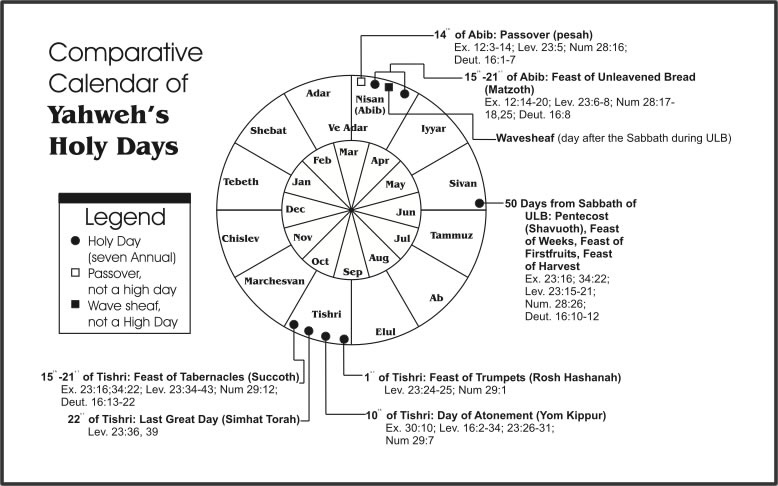
When Jesus said he would be in the heart of the earth three days and three nights, did he mean to say Friday night, Saturday day and Saturday night, or are we just interpreting this with a Roman mindset and calendar? Did the early church celebrate Good Friday or Easter? In order to better understand, we need to define a day and night, Passover, the Feast of Unleavened Bread, and the type of calendar Jesus was using. We will start by establishing day and night.

Gen 1:5 And God called the light, Day. And He called the darkness, Night. And the evening and the morning were the first day.

We use the Gregorian calendar, where a day begins and ends at midnight. With the Hebraic calendar, a day begins and ends at sundown. So, Friday would start on Thursday at sundown, and stop Friday at sundown, which would start Saturday. One night, sundown Thursday to sunup on Friday, one day, sunup Friday until sundown on Friday. Next, we have to understand יהוה God’s feast days.

Lev 23:4 These are the feasts of the LORD, even holy convocations, which ye shall proclaim in their seasons.
Lev 23:5 In the fourteenth day of the first month at even is the LORD’S passover.
Lev 23:6 And on the fifteenth day of the same month is the feast of unleavened bread unto the LORD: seven days ye must eat unleavened bread.
Lev 23:7 In the first day ye shall have an holy convocation: ye shall do no servile work therein.
Lev 23:8 But ye shall offer an offering made by fire unto the LORD seven days: in the seventh day is an holy convocation: ye shall do no servile work therein.

When you see all capitals, LORD, in Bible translations, it is a substitution for his name, יהוה. Pronunciation is not clear, but Josephus, a first century historian, claims it is four vowel sounds in his War of the Jews book five, chapter five. The preface of modern Bibles usually explains LORD is a substitution for יהוה, that happens over 6000 times. It could be pronounced Ee-ah-ew-ah, ee-oh-wa-ah, like Iowa for example. So when the scripture says, “These are the feasts of the LORD”, it really says “These are the feasts of יהוה”. Please see my blog What’s in a name for more on this.

Lev 23:14 And ye shall eat neither bread, nor parched corn, nor green ears, until the selfsame day that ye have brought an offering unto your God: it shall be a statute for ever throughout your generations in all your dwellings.

Lev 23:13 is speaking of the feast of First Fruits. “Forever” here, is the Hebrew word, עלם, Strong’s H5769, olam, which means eternity, always was, is, and will be. This is all important to understand three days and three nights. When we get to the days before Jesus death, we will see we are at the feasts of Passover, Unleavened bread and First Fruits.

Mat 20:17 And Jesus going up to Jerusalem took the twelve disciples apart in the way, and said unto them,
Mat 20:18 Behold, we go up to Jerusalem; and the Son of man shall be betrayed unto the chief priests and unto the scribes, and they shall condemn him to death,
Mat 20:19 And shall deliver him to the Gentiles to mock, and to scourge, and to crucify him: and the third day he shall rise again.

Mat 26:17 Now the first day of the feast of unleavened bread the disciples came to Jesus, saying unto him, Where wilt thou that we prepare for thee to eat the passover?
Mat 26:18 And he said, Go into the city to such a man, and say unto him, The Master saith, My time is at hand; I will keep the passover at thy house with my disciples.

Mar 15:6 Now at that feast he released unto them one prisoner, whomsoever they desired.
Mar 15:7 And there was one named Barabbas, which lay bound with them that had made insurrection with him, who had committed murder in the insurrection.

Joh 19:31 The Jews therefore, because it was the preparation, that the bodies should not remain upon the cross on the sabbath day, (for that sabbath day was an high day,) besought Pilate that their legs might be broken, and that they might be taken away.
Joh 19:32 Then came the soldiers, and brake the legs of the first, and of the other which was crucified with him.

Lev 23:5 In the fourteenth day of the first month at even is the LORD’S passover.
Lev 23:6 And on the fifteenth day of the same month is the feast of unleavened bread unto the LORD: seven days ye must eat unleavened bread.
Lev 23:7 In the first day ye shall have an holy convocation: ye shall do no servile work therein.

The first day spoke of in Lev 23:7 is the Sabbath spoke of in John 19:31. It was not a regular seventh day Sabbath, but the first day of Unleavened Bread, a high Sabbath. Thankfully, John clarified which Sabbath was being spoke of that Jesus was buried before, the high Sabbath of Unleavened bread. This clears up when they rested, when they bought spices and when they went to the tomb and found that Jesus was not there.

Luk 23:53 And he took it down, and wrapped it in linen, and laid it in a sepulchre that was hewn in stone, wherein never man before was laid.
Luk 23:54 And that day was the preparation, and the sabbath drew on.
Luk 23:55 And the women also, which came with him from Galilee, followed after, and beheld the sepulchre, and how his body was laid.

Mar 16:1 When the Sabbath was past, Mary Magdalene, Mary the mother of James, and Salome bought spices, so that they might go and anoint him.

Luk 23:56 And they returned, and prepared spices and ointments; and rested the sabbath day according to the commandment.

So to summarize what we know so far, Jesus ate with the disciples the evening of the 14th day (Sunset of the 13th day), prayed in the garden after supper, was arrested, brought before Pilot, and put on the cross on the day of Passover, dying with the sacrificial lambs, then being taken off the cross before sundown, which would start the first day of Unleavened Bread, a high sabbath day, the 15th day of the month. They rested on the 15th day, high sabbath of Unleavened Bread, and taking Mark 16:1 into consideration, the spices were obtained and prepared, likely returning day two to anoint the body. It was not until after day three, the weekly Sabbath, did they go to the tomb to find it empty. Therefore, Jesus rose on the weekly Sabbath before sundown, which completed the three days and three nights.

Mat 28:1 In the end of the sabbath, as it began to dawn toward the first day of the week, came Mary Magdalene and the other Mary to see the sepulchre.
Mat 28:2 And, behold, there was a great earthquake: for the angel of the Lord descended from heaven, and came and rolled back the stone from the door, and sat upon it.
Mat 28:3 His countenance was like lightning, and his raiment white as snow:
Mat 28:4 And for fear of him the keepers did shake, and became as dead men.
Mat 28:5 And the angel answered and said unto the women, Fear not ye: for I know that ye seek Jesus, which was crucified.
Mat 28:6 He is not here: for he is risen, as he said. Come, see the place where the Lord lay.

Here, the two Mary’s came to the tomb after the weekly Sabbath, early Sunday morning. If Jesus rose at the end of the Sabbath day, then he would have been put in the tomb on Wednesday at the end of Passover, before Unleavened Bread, stayed Wednesday night, Thursday day, Thursday night, Friday day, Friday night, Saturday day, giving us the three days and three nights that are required. It is difficult to reconcile the traditional Roman Friday evening burial and a Sunday morning resurrection, given the passages of scripture we looked at, taking in account two sabbaths during Unleavened Bread, and maintaining three days and three nights, the only sign Jesus gave. Jesus also defined a “day” for us.

Joh 11:9 Jesus answered, “Are there not twelve hours in the day? If anyone walks in the day, he does not stumble, because he sees the light of this world.
Joh 11:10 But if anyone walks in the night, he stumbles, because the light is not in him.”

Luk 24:45 Then he opened their minds to understand the Scriptures,
Luk 24:46 and said to them, “Thus it is written, that the Christ should suffer and on the third day rise from the dead,
Luk 24:47 and that repentance for the forgiveness of sins should be proclaimed in his name to all nations, beginning from Jerusalem.

So how did we loose track of the feasts of God that are forever, and not take Jesus at his word that he would be in the grave three days and three nights? Below is a letter from Constantine, the Roman emperor, to all the Bishops who couldn’t make it to the Concil at Nice in 325AD.

On the Keeping of Easter.
From the Letter of the Emperor to all those not present at the Council.
(Found in Eusebius, Vita Const., Lib. iii., 18–20.)
When the question relative to the sacred festival of Easter arose, it was universally thought that it would be convenient that all should keep the feast on one day; for what could be more beautiful and more desirable, than to see this festival, through which we receive the hope of immortality, celebrated by all with one accord, and in the same manner? It was declared to be particularly unworthy for this, the holiest of all festivals, to follow the custom [the calculation] of the Jews, who had soiled their hands with the most fearful of crimes, and whose minds were blinded. In rejecting their custom,113 we may transmit to our descendants the legitimate mode of celebrating Easter, which we have observed from the time of the Saviour’s Passion to the present day [according to the day of the week]. We ought not, therefore, to have anything in common with the Jews, for the Saviour has shown us another way; our worship follows a more legitimate and more convenient course (the order of the days of the week); and consequently, in unanimously adopting this mode, we desire, dearest brethren, to separate ourselves from the detestable company of the Jews, for it is truly shameful for us to hear them boast that without their direction we could not keep this feast. How can they be in the right, they who, after the death of the Saviour, have no longer been led by reason but by wild violence, as their delusion may urge them? They do not possess the truth in this Easter question; for, in their blindness and repugnance to all improvements, they frequently celebrate two passovers in the same year. We could not imitate those who are openly in error. How, then, could we follow these Jews, who are most certainly blinded by error? for to celebrate the passover twice in one year is totally inadmissible. But even if this were not so, it would still be your duty not to tarnish your soul by communications with such wicked people [the Jews]. Besides, consider well, that in such an important matter, and on a subject of such great solemnity, there ought not to be any division. Our Saviour has left us only one festal day of our redemption, that is to say, of his holy passion, and he desired [to establish] only one Catholic Church
.

In the first Canon of the Fathers assembled at Antioch in 341 AD, they proclaimed everyone must celebrate Easter as the Emperor declared, not as the Jews did, or be excommunicated. It is worth noting that Easter is a made up English word from early translators around the fourteenth century. The word Paschae is the Latin word, which is translated Passover in English. Paschae would have been the word used in these Roman canons that has been translated to Easter. The emperor was not battling “Jews” here so much as he was trying to stamp out earlier followers of Jesus who still kept the feasts and sabbaths as the apostles and Jesus modelled.

The Canons of the Blessed and Holy Fathers Assembled at Antioch in Syria.167 Canon I.
Whosoever shall presume to set aside the decree of the holy and great Synod which was
assembled at Nice in the presence of the pious Emperor Constantine, beloved of God, concerning the holy and salutary feast of Easter; if they shall obstinately persist in opposing what was [then] rightly ordained, let them be excommunicated and cast out of the Church; this is said concerning the laity. But if anyone of those who preside in the Church, whether he be bishop, presbyter, or deacon, shall presume, after this decree, to exercise his own private judgment to the subversion of the people and to the disturbance of the churches, by observing Easter [at the same time] with the Jews, the holy Synod decrees that he shall thenceforth be an alien from the Church, as one who not only heaps sins upon himself, but who is also the cause of destruction and subversion to many; and it deposes not only such persons themselves from their ministry, but those also who after their deposition shall pre- sume to communicate with them. And the deposed shall be deprived even of that external honour, of which the holy Canon and God’s priesthood partake.

After years of debate for the placing of Easter, it finally got placed on the Sunday after the first full moon that occurs after the spring equinox. It will usually fall on the Feast of First Fruits, which occurs the Sunday after the regular sabbath during the week of Unleavened Bread. Therefore, celebrating Jesus as the first fruits of the resurrection, even though those who set the dates, and most of those celebrating Easter today, neither know nor care. Please read my blog, What are the Feasts of the Lord, יהוה?

1Co 5:6 Your boasting is not good. Do you not know that a little leaven leavens the whole lump?
1Co 5:7 Therefore purge out the old leaven so that you may be a new lump, as you are unleavened. For also Christ our Passover is sacrificed for us.
1Co 5:8 Therefore let us keep the feast; not with old leaven, nor with the leaven of malice and wickedness, but with the unleavened bread of sincerity and truth.

1Co 15:19 If in Christ we have hope in this life only, we are of all people most to be pitied.
1Co 15:20 But in fact Christ has been raised from the dead, the firstfruits of those who have fallen asleep.
1Co 15:21 For as by a man came death, by a man has come also the resurrection of the dead.
1Co 15:22 For as in Adam all die, so also in Christ shall all be made alive.
1Co 15:23 But each in his own order: Christ the firstfruits, then at his coming those who belong to Christ.
1Co 15:24 Then comes the end, when he delivers the kingdom to God the Father after destroying every rule and every authority and power.

In these above passages, Paul is shown keeping feasts by the letter and by the spirit of the law. So we can physically not eat leavened bread during the feast of Unleavened Bread, and spiritually not partake in “old leaven” continually, operating in the Spirit. Next, Paul tells us Jesus is the first fruits of the resurrection. For those that would say he keeps the feasts because he is Jewish, Paul says himself there is neither Jew or Greek, we are all Abraham’s seed.

Gal 3:28 There is neither Jew nor Greek, there is neither slave nor free, there is no male and female, for you are all one in Christ Jesus.
Gal 3:29 And if you are Christ’s, then you are Abraham’s offspring, heirs according to promise.

Some try to use this following verse in Galatians to say that Paul was upbraiding the Galatians for observing God’s feast days.

Gal 4:8 Formerly, when you did not know God, you were enslaved to those that by nature are not gods.
Gal 4:9 But now that you have come to know God, or rather to be known by God, how can you turn back again to the weak and worthless elementary principles of the world, whose slaves you want to be once more?
Gal 4:10 You observe days and months and seasons and years!
Gal 4:11 I am afraid I may have labored over you in vain.

The church father, Socrates in the fifth century wrote the following: (The Nicene and Post Nicene Fathers Series II Volume II)

Book V, Chapter XXII.—The Author’s Views respecting the Celebration of Easter, Baptism, Fasting, Marriage, the Eucharist, and Other Ecclesiastical Rites.
“As we have touched the subject I deem it not unreasonable to say a few words concerning Easter. It appears to me that neither the ancients nor moderns who have affected to follow the Jews, have had any rational foundation for contending so obstinately about it. For they have not taken into consideration the fact that when Judaism was changed into Christianity, the obligation to observe the Mosaic law and the ceremonial types ceased. And the proof of the matter is plain; for no law of Christ permits Christians to imitate the Jews. On the contrary the apostle expressly forbids it; not only rejecting circumcision, but also deprecating conten- tion about festival days. In his epistle to the Galatians768 he writes, ‘Tell me ye that desire to be under the law, do ye not hear the law?’ And continuing his train of argument, he demonstrates that the Jews were in bondage as servants, but that those who have come to Christ are ‘called into the liberty of sons.’769 Moreover he exhorts them in no way to regard ‘days, and months, and years.”

The problem with this theory is first, both Jesus and Paul kept the feasts, and second, the Galatians were not Jews. As he said, “Formerly, when you did not know God”. The Galatians were of the nations who were serving other gods, “the weak elementary principles of the world”. Does anyone suspect Paul would call God’s law, ordinances and precepts weak and worthless? First, let’s show Paul keeping feasts again:

Act 18:20 When they desired him to tarry longer time with them, he consented not;
Act 18:21 But bade them farewell, saying, I must by all means keep this feast that cometh in Jerusalem: but I will return again unto you, if God will. And he sailed from Ephesus.

Next, let’s discuss the days, months and years the Galatians were going back to. It could not be God’s feast days because they couldn’t return to something they never celebrated in the first place. The word for elementary is Strong’s G4747.

G4747
στοιχεῖον
stoicheion
Thayer Definition:
1) any first thing, from which the others belonging to some series or composite whole take their rise, an element, first principal
1a) the letters of the alphabet as the elements of speech, not however the written characters, but the spoken sounds
1b) the elements from which all things have come, the material causes of the universe
1c) the heavenly bodies, either as parts of the heavens or (as others think) because in them the elements of man, life and destiny were supposed to reside

1d) the elements, rudiments, primary and fundamental principles of any art, science, or discipline

The stoicheion were the heavenly bodies in this case. Also, the elements of water, air, fire etc. A study of the stoicheion and Galatians would include talking about fairies and even leprechauns. The Galatians were Celtic peoples. The antinomians, those who are against God’s commands, precepts and laws, want to use these verses to show Paul is advocating lawlessness, just as Peter warned:

2Pe 3:14 Therefore, beloved, since you are waiting for these, be diligent to be found by him without spot or blemish, and at peace.
2Pe 3:15 And count the patience of our Lord as salvation, just as our beloved brother Paul also wrote to you according to the wisdom given him,
2Pe 3:16 as he does in all his letters when he speaks in them of these matters. There are some things in them that are hard to understand, which the ignorant and unstable twist to their own destruction, as they do the other Scriptures.
2Pe 3:17 You therefore, beloved, knowing this beforehand, take care that you are not carried away with the error of lawless people and lose your own stability.

There were also Jews who were convincing the Galatians that salvation had to be obtained through circumcision. This is equally wrong as salvation is obtained through faith, not by circumcision or any other one of God’s laws. We follow God’s laws because of our faith, salvation, obedience and the Spirit living inside of us. Again, Paul would never refer to God’s laws as weak and worthless. In Romans he calls them righteous and good.

Rom 7:12 So the law is holy, and the commandment is holy and righteous and good.
Rom 7:13 Did that which is good, then, bring death to me? By no means! It was sin, producing death in me through what is good, in order that sin might be shown to be sin, and through the commandment might become sinful beyond measure.

When John the Baptist saw Jesus he said, “Behold the Lamb of God, which taketh away the sin of the world”. Jesus was the Passover lamb, sacrificed on Passover, and resurrecting three days and three nights later to be the first fruits of the resurrection. Jesus was the only lamb without blemish. The inspection of the Passover lambs was described in Exodus.

Exo 12:3 Tell all the congregation of Israel that on the tenth day of this month every man shall take a lamb according to their fathers’ houses, a lamb for a household.
Exo 12:4 And if the household is too small for a lamb, then he and his nearest neighbor shall take according to the number of persons; according to what each can eat you shall make your count for the lamb.
Exo 12:5 Your lamb shall be without blemish, a male a year old. You may take it from the sheep or from the goats,
Exo 12:6 and you shall keep it until the fourteenth day of this month, when the whole assembly of the congregation of Israel shall kill their lambs at twilight.

If the lambs were picked on the tenth day, that was four days before the death of Jesus on the 14th day which was Passover. What was Jesus doing four days before he would die at the close of the 14th? He was being inspected during the triumphal entry.

Joh 12:1 Six days before the Passover, Jesus therefore came to Bethany, where Lazarus was, whom Jesus had raised from the dead.

Joh 12:12 The next day the large crowd that had come to the feast heard that Jesus was coming to Jerusalem.
Joh 12:13 So they took branches of palm trees and went out to meet him, crying out, “Hosanna! Blessed is he who comes in the name of the Lord, even the King of Israel!”
Joh 12:14 And Jesus found a young donkey and sat on it, just as it is written,
Joh 12:15 “Fear not, daughter of Zion; behold, your king is coming, sitting on a donkey’s colt!”

What is this word Hosanna they were shouting? Strong’s G5614; related words of Hebrew origin H3467 and H4994. If you put the two together it is Yahshana in Hebrew, or ישענא.

G5614
ὡσαννά
hōsanna
Thayer Definition:
1) hosanna
2) be propitious
Part of Speech: interjection
A Related Word by Thayer’s/Strong’s Number: of Hebrew origin H3467 and H4994

H3467
ישׁע
yâsha‛
BDB Definition:
1) to save, be saved, be delivered
1a) (Niphal)
1a1) to be liberated, be saved, be delivered
1a2) to be saved (in battle), be victorious
1b) (Hiphil)
1b1) to save, deliver
1b2) to save from moral troubles
1b3) to give victory to

H4994
נא
nâ’
BDB Definition:
1) I (we) pray, now, please
1a) used in entreaty or exhortation

I discuss the name of Jesus and how it is the transliterated name of Joshua in the Greek in my blog, What’s in a name. Jesus’ Hebrew name was Yahshua, יהושוע, which means the salvation of Yahweh, יהוה. The Apostle John describes a scene in Revelation that shows the Lamb was the only one worthy of opening the book because he was slain and was able to redeem.

Rev 5:1 And I saw in the right hand of him that sat on the throne a book written within and on the backside, sealed with seven seals.
Rev 5:2 And I saw a strong angel proclaiming with a loud voice, Who is worthy to open the book, and to loose the seals thereof?
Rev 5:3 And no man in heaven, nor in earth, neither under the earth, was able to open the book, neither to look thereon.
Rev 5:4 And I wept much, because no man was found worthy to open and to read the book, neither to look thereon.
Rev 5:5 And one of the elders saith unto me, Weep not: behold, the Lion of the tribe of Juda, the Root of David, hath prevailed to open the book, and to loose the seven seals thereof.
Rev 5:6 And I beheld, and, lo, in the midst of the throne and of the four beasts, and in the midst of the elders, stood a Lamb as it had been slain, having seven horns and seven eyes, which are the seven Spirits of God sent forth into all the earth.
Rev 5:7 And he came and took the book out of the right hand of him that sat upon the throne.
Rev 5:8 And when he had taken the book, the four beasts and four and twenty elders fell down before the Lamb, having every one of them harps, and golden vials full of odours, which are the prayers of saints.
Rev 5:9 And they sung a new song, saying, Thou art worthy to take the book, and to open the seals thereof: for thou wast slain, and hast redeemed us to God by thy blood out of every kindred, and tongue, and people, and nation;
Rev 5:10 And hast made us unto our God kings and priests: and we shall reign on the earth.

I realize that by discussing this, I am not only going against the Roman emperor, I am also questioning Roman law and facing 1695 years of the church’s tradition of the Friday crucifixion and Sunday resurrection. I am suggesting that as those who are followers of Jesus, we are no longer under the bondage of Roman law, and are not required to keep Roman canons. This is what Jesus says about replacing the commandments of Yahweh with the traditions of men and teaching them as doctrine.

Mat 15:1 Then came to Jesus scribes and Pharisees, which were of Jerusalem, saying,
Mat 15:2 Why do thy disciples transgress the tradition of the elders? for they wash not their hands when they eat bread.
Mat 15:3 But he answered and said unto them, Why do ye also transgress the commandment of God by your tradition?

Mat 15:8 This people draweth nigh unto me with their mouth, and honoureth me with their lips; but their heart is far from me.
Mat 15:9 But in vain they do worship me, teaching for doctrines the commandments of men.

The Bible pictured belonged to Laughlin P. Farris, (December 23, 1843 – December 9, 1925) from White’s Cove, New Brunswick, Canada.

Please check out some of my other blog posts.

Lost Identity and the New Covenant

What is the new covenant and who is it with? If you are a Christian or were raised attending Sunday school, you have likely heard of the new covenant. Many times, terms are mentioned that were taught about years ago, and now, it is just assumed everyone knows what they mean, when in fact, many times they have just became terms no one really understands or cares about. If you go to church now, you may hear the phrase new covenant during communion or thrown about in a sermon. So the intent here is to define the new covenant based on scripture. Once we do that, it will raise some questions many of us in the church have never been asked. If a person does a search in the bible for the phrase new covenant, the first place we find the term is in Jeremiah.

Jer 31:31 Behold, the days come, saith the LORD, that I will make a new covenant with the house of Israel, and with the house of Judah:
Jer 31:32 Not according to the covenant that I made with their fathers in the day that I took them by the hand to bring them out of the land of Egypt; which my covenant they brake, although I was an husband unto them, saith the LORD:
Jer 31:33 But this shall be the covenant that I will make with the house of Israel; After those days, saith the LORD, I will put my law in their inward parts, and write it in their hearts; and will be their God, and they shall be my people.
Jer 31:34 And they shall teach no more every man his neighbour, and every man his brother, saying, Know the LORD: for they shall all know me, from the least of them unto the greatest of them, saith the LORD: for I will forgive their iniquity, and I will remember their sin no more.

Here the LORD Yahweh, tells us the new covenant is with the house of Israel and the house of Judah, and the problem with the old covenant, given at Mount Horeb, was that they broke it. The reference to marriage between Yahweh and his set apart or holy people is consistent through scripture. Yahweh goes on to say he will put his law in the inward parts and write it in the hearts of his people. So based on this scripture, the new covenant is with two people groups: the house of Israel and the house of Judah. Jesus mentions the new covenant at the last supper, which was presumably the Passover meal with his disciples.

Luk 22:14 And when the hour came, he reclined at table, and the apostles with him.
Luk 22:15 And he said to them, “I have earnestly desired to eat this Passover with you before I suffer.
Luk 22:16 For I tell you I will not eat it until it is fulfilled in the kingdom of God.”
Luk 22:17 And he took a cup, and when he had given thanks he said, “Take this, and divide it among yourselves.
Luk 22:18 For I tell you that from now on I will not drink of the fruit of the vine until the kingdom of God comes.”
Luk 22:19 And he took bread, and when he had given thanks, he broke it and gave it to them, saying, “This is my body, which is given for you. Do this in remembrance of me.”
Luk 22:20 And likewise the cup after they had eaten, saying, “This cup that is poured out for you is the new covenant in my blood.

The writer of Hebrews, who is thought to be Paul or possibly Barnabas, also speaks of the new covenant. He quotes Jeremiah essentially word for word, also adding commentary.

Heb 8:6 But as it is, Christ has obtained a ministry that is as much more excellent than the old as the covenant he mediates is better, since it is enacted on better promises.
Heb 8:7 For if that first covenant had been faultless, there would have been no occasion to look for a second.
Heb 8:8 For he finds fault with them when he says: “Behold, the days are coming, declares the Lord, when I will establish a new covenant with the house of Israel and with the house of Judah,
Heb 8:9 not like the covenant that I made with their fathers on the day when I took them by the hand to bring them out of the land of Egypt. For they did not continue in my covenant, and so I showed no concern for them, declares the Lord.
Heb 8:10 For this is the covenant that I will make with the house of Israel after those days, declares the Lord: I will put my laws into their minds, and write them on their hearts, and I will be their God, and they shall be my people.
Heb 8:11 And they shall not teach, each one his neighbor and each one his brother, saying, ‘Know the Lord,’ for they shall all know me, from the least of them to the greatest.
Heb 8:12 For I will be merciful toward their iniquities, and I will remember their sins no more.”
Heb 8:13 In speaking of a new covenant, he makes the first one obsolete. And what is becoming obsolete and growing old is ready to vanish away
.

After reading these verses in Hebrews, we can conclude the following:

  • The new covenant is better than the old.
  • The new covenant is still with the house of Israel and the house of Judah.
  • The problem with the old covenant came from the fault of the people it was with.
  • The old covenant is obsolete.

In order to understand these points, we have to answer the following questions:

  • What is a covenant?
  • Who are the two people groups; house of Israel and house of Judah?
  • What was the old covenant?
  • What was done to cause the old covenant to become obsolete?

The word covenant used in the letter to the Hebrews is Strong’s G1242. The Hebrew word for covenant in Jeremiah is Strong’s H1285. Based on these two words and their definitions, we can conclude a covenant is a constitution, pledge or arrangement between two entities, in this case between Yahweh and a group of people.

G1242
διαθήκη
diathēkē
Thayer Definition:
1) a disposition, arrangement, of any sort, which one wishes to be valid, the last disposition which one makes of his earthly possessions after his death, a testament or will
2) a compact, a covenant, a testament
2a) God’s covenant with Noah, etc.
Part of Speech: noun feminine

H1285
בּרית
berı̂yth
BDB Definition:
1) covenant, alliance, pledge
1a) between men
1a1) treaty, alliance, league (man to man)
1a2) constitution, ordinance (monarch to subjects)
1a3) agreement, pledge (man to man)
1a4) alliance (of friendship)
1a5) alliance (of marriage)
1b) between God and man
1b1) alliance (of friendship)
1b2) covenant (divine ordinance with signs or pledges)

The people groups these covenants are made with are not hard to define. The new covenant is with the house of Judah and the house of Israel as described in Jeremiah and the letter to the Hebrews. In Jeremiah, Yahweh says the following concerning who he made the old covenant with, “Jer 31:32 Not according to the covenant that I made with their fathers in the day that I took them by the hand to bring them out of the land of Egypt; which my covenant they brake, although I was an husband unto them, saith the LORD:”. So the old covenant was with the fathers of the house of Israel and the house of Judah who he brought out of Egypt. It should be clear that this is speaking of the twelve tribes of Israel, the children of Jacob. So what was the covenant or agreement that Yahweh God made with the twelve tribes?

Exo 19:2 For they were departed from Rephidim, and were come to the desert of Sinai, and had pitched in the wilderness; and there Israel camped before the mount.
Exo 19:3 And Moses went up unto God, and the LORD called unto him out of the mountain, saying, Thus shalt thou say to the house of Jacob, and tell the children of Israel;
Exo 19:4 Ye have seen what I did unto the Egyptians, and how I bare you on eagles’ wings, and brought you unto myself.
Exo 19:5 Now therefore, if ye will obey my voice indeed, and keep my covenant, then ye shall be a peculiar treasure unto me above all people: for all the earth is mine:
Exo 19:6 And ye shall be unto me a kingdom of priests, and an holy nation. These are the words which thou shalt speak unto the children of Israel.

Exo 19:7 And Moses came and called for the elders of the people, and laid before their faces all these words which the LORD commanded him.
Exo 19:8 And all the people answered together, and said, All that the LORD hath spoken we will do. And Moses returned the words of the people unto the LORD.

Here we see Yahweh presenting a covenant for the people. If they obey his voice, in return he will make them a treasured people, a kingdom of priests. They all agreed they would do what Yahweh God commanded. That is the old covenant; the children of Israel would become a holy or set apart nation from the rest of the nations of the world in exchange for obeying Yahweh’s voice and following the commands of his covenant. It is interesting to note that Peter uses the same language actually quoting Exodus 19:6:

1Pe 2:9 But ye are a chosen generation, a royal priesthood, an holy nation, a peculiar people; that ye should shew forth the praises of him who hath called you out of darkness into his marvellous light:
1Pe 2:10 Which in time past were not a people, but are now the people of God: which had not obtained mercy, but now have obtained mercy.

Where Peter is using the same language for those in the new covenant, does that mean it could be better called a renewed covenant? The Strong’s word for new is H2319, but look at the word it comes from, H2318. It has the same spelling in Hebrew with a slight difference in pronunciation.

H2319
חדשׁ
châdâsh
BDB Definition:
1) new, new thing, fresh
Part of Speech: adjective
A Related Word by BDB/Strong’s Number: from H2318

H2318
חדשׁ
châdash
BDB Definition:
1) to be new, renew, repair
1a) (Piel)
1a1) to renew, make anew
1a2) to repair
1b) (Hithpael) to renew oneself

It could be argued that the new covenant is a repaired old covenant, completely fresh yet renewed from something old. That is a thought that is not my own, but something I find worth considering.

The old covenant was made with the twelve tribes of Israel at Mount Horeb or Sinai. So who is the house of Israel and the house of Judah that the new covenant is made with, and where do we who have faith in Jesus fit in to this new covenant?

1Ki 11:31 And he said to Jeroboam, Take thee ten pieces: for thus saith the LORD, the God of Israel, Behold, I will rend the kingdom out of the hand of Solomon, and will give ten tribes to thee:
1Ki 11:32 (But he shall have one tribe for my servant David’s sake, and for Jerusalem’s sake, the city which I have chosen out of all the tribes of Israel:)

1Ki 11:33 Because that they have forsaken me, and have worshipped Ashtoreth the goddess of the Zidonians, Chemosh the god of the Moabites, and Milcom the god of the children of Ammon, and have not walked in my ways, to do that which is right in mine eyes, and to keep my statutes and my judgments, as did David his father.
1Ki 11:34 Howbeit I will not take the whole kingdom out of his hand: but I will make him prince all the days of his life for David my servant’s sake, whom I chose, because he kept my commandments and my statutes:
1Ki 11:35 But I will take the kingdom out of his son’s hand, and will give it unto thee, even ten tribes.
1Ki 11:36 And unto his son will I give one tribe, that David my servant may have a light alway before me in Jerusalem, the city which I have chosen me to put my name there.
1Ki 11:37 And I will take thee, and thou shalt reign according to all that thy soul desireth, and shalt be king over Israel.
1Ki 11:38 And it shall be, if thou wilt hearken unto all that I command thee, and wilt walk in my ways, and do that is right in my sight, to keep my statutes and my commandments, as David my servant did; that I will be with thee, and build thee a sure house, as I built for David, and will give Israel unto thee.
1Ki 11:39 And I will for this afflict the seed of David, but not for ever.

The above passage in the book of 1st Kings, best summarizes where the house of Judah and the house of Israel originate. King Solomon, son of David in the tribe of Judah, sinned beyond what Yahweh could bare. Yahweh took ten of the twelve tribes and gave them to Jeroboam, which became the house of Israel, Ephraim or Joseph, and gave one tribe, Benjamin to Solomon’s son, which became the southern kingdom consisting of the tribe of Judah and Benjamin. So here he was giving Jeroboam a chance to carry on the covenant that was made at Mount Horeb. That didn’t last too long though. Jeroboam went and made up his own feast or holiday, which Yahweh never commanded along with using images and customs of the nations to worship Yahweh.

1Ki 12:25 Then Jeroboam built Shechem in mount Ephraim, and dwelt therein; and went out from thence, and built Penuel.
1Ki 12:26 And Jeroboam said in his heart, Now shall the kingdom return to the house of David:
1Ki 12:27 If this people go up to do sacrifice in the house of the LORD at Jerusalem, then shall the heart of this people turn again unto their lord, even unto Rehoboam king of Judah, and they shall kill me, and go again to Rehoboam king of Judah.
1Ki 12:28 Whereupon the king took counsel, and made two calves of gold, and said unto them, It is too much for you to go up to Jerusalem: behold thy gods, O Israel, which brought thee up out of the land of Egypt.
1Ki 12:29 And he set the one in Bethel, and the other put he in Dan.

1Ki 12:30 And this thing became a sin: for the people went to worship before the one, even unto Dan.
1Ki 12:31 And he made an house of high places, and made priests of the lowest of the people, which were not of the sons of Levi.
1Ki 12:32 And Jeroboam ordained a feast in the eighth month, on the fifteenth day of the month, like unto the feast that is in Judah, and he offered upon the altar. So did he in Bethel, sacrificing unto the calves that he had made: and he placed in Bethel the priests of the high places which he had made.
1Ki 12:33 So he offered upon the altar which he had made in Bethel the fifteenth day of the eighth month, even in the month which he had devised of his own heart; and ordained a feast unto the children of Israel: and he offered upon the altar, and burnt incense.

1Ki 14:15 For the LORD shall smite Israel, as a reed is shaken in the water, and he shall root up Israel out of this good land, which he gave to their fathers, and shall scatter them beyond the river, because they have made their groves, provoking the LORD to anger.
1Ki 14:16 And he shall give Israel up because of the sins of Jeroboam, who did sin, and who made Israel to sin.

Yahweh scattered the house of Israel into the nations of the earth for their disobedience, making up their own holy days instead of following his holy days, using the symbols of the nations to worship Yahweh, which he forbid. With this he seeded the nations, as alluded to in Hosea.

Hos 1:2 The beginning of the word of the LORD by Hosea. And the LORD said to Hosea, Go, take unto thee a wife of whoredoms and children of whoredoms: for the land hath committed great whoredom, departing from the LORD.
Hos 1:3 So he went and took Gomer the daughter of Diblaim; which conceived, and bare him a son.
Hos 1:4 And the LORD said unto him, Call his name Jezreel; for yet a little while, and I will avenge the blood of Jezreel upon the house of Jehu, and will cause to cease the kingdom of the house of Israel.
Hos 1:5 And it shall come to pass at that day, that I will break the bow of Israel in the valley of Jezreel.
Hos 1:6 And she conceived again, and bare a daughter. And God said unto him, Call her name Loruhamah: for I will no more have mercy upon the house of Israel; but I will utterly take them away.
Hos 1:7 But I will have mercy upon the house of Judah, and will save them by the LORD their God, and will not save them by bow, nor by sword, nor by battle, by horses, nor by horsemen.
Hos 1:8 Now when she had weaned Loruhamah, she conceived, and bare a son.
Hos 1:9 Then said God, Call his name Loammi: for ye are not my people, and I will not be your God.
Hos 1:10 Yet the number of the children of Israel shall be as the sand of the sea, which cannot be measured nor numbered; and it shall come to pass, that in the place where it was said unto them, Ye are not my people, there it shall be said unto them, Ye are the sons of the living God.
Hos 1:11 Then shall the children of Judah and the children of Israel be gathered together, and appoint themselves one head, and they shall come up out of the land: for great shall be the day of Jezreel.

Jazreel, the name Yahweh tells Hosea to name his son representing the northern tribes of Israel, or the house of Israel, meaning God sow’s. Strong’s H3157.

H3157
יזרעאל
yizre‛ê’l
BDB Definition:
Jezreel = “God sows”
1) a descendant of the father or founder of Etam of Judah (noun proper masculine)
2) first son of Hosea the prophet (noun proper masculine)
3) a city in the Nekeb of Judah (noun proper locative)
4) a city in Issachar on the northwest spur of Mount Gilboa (noun proper locative

Paul refers to these scriptures in his letter to the Roman’s.

Rom 9:22 What if God, desiring to show his wrath and to make known his power, has endured with much patience vessels of wrath prepared for destruction,
Rom 9:23 in order to make known the riches of his glory for vessels of mercy, which he has prepared beforehand for glory—
Rom 9:24 even us whom he has called, not from the Jews only but also from the Gentiles?
Rom 9:25 As indeed he says in Hosea, “Those who were not my people I will call ‘my people,’ and her who was not beloved I will call ‘beloved.’”
Rom 9:26 “And in the very place where it was said to them, ‘You are not my people,’ there they will be called ‘sons of the living God.’”

Rom 9:27 And Isaiah cries out concerning Israel: “Though the number of the sons of Israel be as the sand of the sea, only a remnant of them will be saved,
Rom 9:28 for the Lord will carry out his sentence upon the earth fully and without delay.”
Rom 9:29 And as Isaiah predicted, “If the Lord of hosts had not left us offspring, we would have been like Sodom and become like Gomorrah.”

Gentile, Strong’s G1484, is a made up word from the Latin which makes it sound like it is a special people group. It is just people who are not from the tribe of Judah, (Jews), and includes the house of Israel that was scattered into the nations as God’s seeds, to extend his covenant to all the nations of the world.

G1484
ἔθνος
ethnos
eth’-nos
Probably from G1486; a race (as of the same habit), that is, a tribe; specifically a foreign (non-Jewish) one (usually by implication pagan): – Gentile, heathen, nation, people.

To summarize what we know so far; the old covenant was with all twelve tribes of the the Israelite’s, and it consisted of a pact between the twelve tribes and Yahweh that they would do what he said and follow his instructions. The twelve tribes broke into two groups because of Solomon’s idolatry and sorcery. Ten tribes went under the leadership of Jeroboam and one tribe stayed with Solomon’s son, Rehoboam, and the tribe of Judea. These two groups were called the house of Israel and the house of Judah. Jeroboam lead the house of Israel astray, and they were scattered into the nations, seeding the nations as in Jazreel. The house of Judah remained for the sake of David because he followed Yahweh’s commandments. However, they had many trials due to their idolatry and lawlessness.

Now we need to answer why the new covenant is better, and how do we fit into the new covenant as followers of Jesus. Notice there is no mention of the church in the new covenant, only the house of Israel and the house of Judah. This is not because the prophets did not see the church and Yahweh had to change his plans, as some doctrines suggest. Church is simply a word for congregation or a set apart people that I have defined in my other blogs. It is Ekklesia, Strong’s G1577.

G1577
ἐκκλησία
ekklēsia
Thayer Definition:
1) a gathering of citizens called out from their homes into some public place, an assembly
1a) an assembly of the people convened at the public place of the council for the purpose of deliberating
1b) the assembly of the Israelites
1c) any gathering or throng of men assembled by chance, tumultuously
1d) in a Christian sense
1d1) an assembly of Christians gathered for worship in a religious meeting
1d2) a company of Christian, or of those who, hoping for eternal salvation through Jesus Christ, observe their own religious rites, hold their own religious meetings, and manage their own affairs, according to regulations prescribed for the body for order’s sake
1d3) those who anywhere, in a city, village, constitute such a company and are united into one body
1d4) the whole body of Christians scattered throughout the earth
1d5) the assembly of faithful Christians already dead and received into heaven

Paul does a good job of explaining how we, as twenty first century Christians, are part of the new covenant through grafting into the green olive tree. We will look into that shortly. The old covenant grew old and vanished not because Yahweh changed his laws or commandments, or did away with anything, it is because the people who entered the agreement with Yahweh broke their end of the contract. The language that God uses is pretty clear. They broke the wedlock that they had on Mount Horeb where he was a husband to them. The new covenant is better because it opened up to all the nations through the scattering of the house of Israel and through the work on the cross that Jesus did. By the shed blood, he has made a way for us to keep his commandments by writing them on our hearts and sending his Holy Spirit to be a helper living inside of us. “Heb 8:6 But as it is, Christ has obtained a ministry that is as much more excellent than the old as the covenant he mediates is better, since it is enacted on better promises.

Mat 5:17 Think not that I am come to destroy the law, or the prophets: I am not come to destroy, but to fulfil.
Mat 5:18 For verily I say unto you, Till heaven and earth pass, one jot or one tittle shall in no wise pass from the law, till all be fulfilled
.

Mat 5:27 Ye have heard that it was said by them of old time, Thou shalt not commit adultery:
Mat 5:28 But I say unto you, That whosoever looketh on a woman to lust after her hath committed adultery with her already in his heart.

Mat 5:21 Ye have heard that it was said by them of old time, Thou shalt not kill; and whosoever shall kill shall be in danger of the judgment:
Mat 5:22 But I say unto you, That whosoever is angry with his brother without a cause shall be in danger of the judgment: and whosoever shall say to his brother, Raca, shall be in danger of the council: but whosoever shall say, Thou fool, shall be in danger of hell fire.

Based on the above scriptures, Jesus didn’t come to change any of the father Yahweh’s commandments. He intensified them, and gave us a way to be able to keep them through the power of the Holy Spirit. “Php 4:13 I can do all things through Christ which strengtheneth me”.

Next we will explore how the modern follower of Jesus is grafted into the new covenant with the house of Israel and the house of Judah. In Jeremiah, we see more information regarding the old covenant. The old covenant was an agreement where the twelve tribes would follow Yahweh’s commandments, which in turn Yahweh would bring them into the promised land with blessings. If they failed to follow his word, the result would be curses and a broken covenant.

Jer 11:1 The word that came to Jeremiah from the LORD, saying,
Jer 11:2 Hear ye the words of this covenant, and speak unto the men of Judah, and to the inhabitants of Jerusalem;
Jer 11:3 And say thou unto them, Thus saith the LORD God of Israel; Cursed be the man that obeyeth not the words of this covenant,
Jer 11:4 Which I commanded your fathers in the day that I brought them forth out of the land of Egypt, from the iron furnace, saying, Obey my voice, and do them, according to all which I command you: so shall ye be my people, and I will be your God:

Jer 11:5 That I may perform the oath which I have sworn unto your fathers, to give them a land flowing with milk and honey, as it is this day. Then answered I, and said, So be it, O LORD.
Jer 11:6 Then the LORD said unto me, Proclaim all these words in the cities of Judah, and in the streets of Jerusalem, saying, Hear ye the words of this covenant, and do them.
Jer 11:7 For I earnestly protested unto your fathers in the day that I brought them up out of the land of Egypt, even unto this day, rising early and protesting, saying, Obey my voice.
Jer 11:8 Yet they obeyed not, nor inclined their ear, but walked every one in the imagination of their evil heart: therefore I will bring upon them all the words of this covenant, which I commanded them to do; but they did them not.
Jer 11:9 And the LORD said unto me, A conspiracy is found among the men of Judah, and among the inhabitants of Jerusalem.
Jer 11:10 They are turned back to the iniquities of their forefathers, which refused to hear my words; and they went after other gods to serve them: the house of Israel and the house of Judah have broken my covenant which I made with th
eir fathers.
Jer 11:11 Therefore thus saith the LORD, Behold, I will bring evil upon them, which they shall not be able to escape; and though they shall cry unto me, I will not hearken unto them.
Jer 11:12 Then shall the cities of Judah and inhabitants of Jerusalem go, and cry unto the gods unto whom they offer incense: but they shall not save them at all in the time of their trouble.
Jer 11:13 For according to the number of thy cities were thy gods, O Judah; and according to the number of the streets of Jerusalem have ye set up altars to that shameful thing, even altars to burn incense unto Baal.
Jer 11:14 Therefore pray not thou for this people, neither lift up a cry or prayer for them: for I will not hear them in the time that they cry unto me for their trouble.
Jer 11:15 What hath my beloved to do in mine house, seeing she hath wrought lewdness with many, and the holy flesh is passed from thee? when thou doest evil, then thou rejoicest.
Jer 11:16 The LORD called thy name, A green olive tree, fair, and of goodly fruit: with the noise of a great tumult he hath kindled fire upon it, and the branches of it are broken.
Jer 11:17 For the LORD of hosts, that planted thee, hath pronounced evil against thee, for the evil of the house of Israel and of the house of Judah, which they have done against themselves to provoke me to anger in offering incense unto Baal.

Israel was called a green olive tree that Yahweh planted. Now due to Israel breaking the covenant, branches have broken off of the tree. God also tells Jeremiah that he will bring them back together again.

Jer 16:14 Therefore, behold, the days come, saith the LORD, that it shall no more be said, The LORD liveth, that brought up the children of Israel out of the land of Egypt;
Jer 16:15 But, The LORD liveth, that brought up the children of Israel from the land of the north, and from all the lands whither he had driven them: and I will bring them again into their land that I gave unto their fathers.

We pick up the olive tree comparison with Paul in his letter to the Roman’s. I am using the Modern King James Version for their rendering of the Greek word ethnos as nations instead of the Latin word gentile with a capital g, which has grown into something more than it is. It is worth mentioning here that once we are grafted in, or back in to the root, we are no longer of the nations or “gentiles” any longer. Also, I am quoting more than needed just to provide the context.

Rom 11:1 I say then, Did not God put away His people? Let it not be said! For I also am an Israelite, of the seed of Abraham, of the tribe of Benjamin.
Rom 11:2 God did not thrust out His people whom He foreknew. Or do you not know what the Scripture said in Elijah, how he pleaded with God against Israel, saying,
Rom 11:3 “Lord, they killed Your prophets and dug down Your altars, and I am left alone, and they seek my life.”
Rom 11:4 But what does the Divine answer say to him? “I have reserved to Myself seven thousand men who have not bowed the knee to Baal.”
Rom 11:5 Even so then, also in this present time a remnant according to the election of grace has come into being.
Rom 11:6 But if by grace, then it is no more of works; otherwise grace is no more grace. But if it is of works, then it is no more of grace; otherwise work is no more work.
Rom 11:7 What then? Israel has not obtained that which it seeks, but the election obtained it, and the rest were hardened
Rom 11:8 even as it is written, “God gave to them a spirit of slumber, eyes not seeing, and ears not hearing” until this day.

Rom 11:9 And David said, “Let their table become for a snare and a trap and a stumbling block and a recompense to them.
Rom 11:10 Let their eyes be darkened so that they may not see, and their back always bowing.”
Rom 11:11 I say then, Did they not stumble that they fall? Let it not be! But by their slipping away came salvation to the nations, to provoke them to jealousy.
Rom 11:12 But if their slipping away is the riches of the world, and their default is the riches of the nations, how much more their fullness?
Rom 11:13 For I speak to you, the nations; since I am the apostle of the nations, I glorify my ministry;
Rom 11:14 if by any means I may provoke those who are my flesh to jealousy, and might save some of them.
Rom 11:15 For if their casting away is the reconciling of the world, what is the reception except life from the dead?
Rom 11:16 For if the firstfruit is holy, the lump is also holy; and if the root is holy, also the branches.

Rom 11:17 And if some of the branches were broken off, and you, being a wild olive tree, were grafted in among them, and became a sharer of the root and the fatness of the olive tree with them,
Rom 11:18 do not boast against the branches. But if you boast, it is not you that bears the root, but the root bears you.
Rom 11:19 You will say then, The branches were broken off so that I might be grafted in.

Rom 11:20 Well, because of unbelief they were broken off, and you stand by faith. Do not be high-minded, but fear.
Rom 11:21 For if God did not spare the natural branches, fear lest He also may not spare you either!
Rom 11:22 Behold then the kindness, and the severity of God; on those having fallen, severity; but on you, kindness, if you continue in the kindness. Otherwise you also will be cut off.
Rom 11:23 And those also, if they do not continue in unbelief, will be grafted in. For God is able to graft them in again.

In order to make this clearer, let’s look at the root of this olive tree. Now would be a good time to read the parable of the prodigal son. It was never talking about what is typically assigned to it in modern sermons. Jesus was referring to the younger brother Ephraim coming home to the Father, and the older brother Judah having a problem with that.

Isa 11:10 In that day the root of Jesse, who shall stand as a signal for the peoples—of him shall the nations inquire, and his resting place shall be glorious.
Isa 11:11 In that day the Lord will extend his hand yet a second time to recover the remnant that remains of his people, from Assyria, from Egypt, from Pathros, from Cush, from Elam, from Shinar, from Hamath, and from the coastlands of the sea.
Isa 11:12 He will raise a signal for the nations and will assemble the banished of Israel, and gather the dispersed of Judah from the four corners of the earth.
Isa 11:13 The jealousy of Ephraim shall depart, and those who harass Judah shall be cut off; Ephraim shall not be jealous of Judah, and Judah shall not harass Ephraim.

Rom 15:8 And I say, Jesus Christ has become a minister of the circumcision for the truth of God, to confirm the promises made to the fathers,
Rom 15:9 and that the nations might glorify God for His mercy, as it is written, “For this cause I will confess to You in the nations, and I will praise Your name.”
Rom 15:10 And again He says, “Rejoice, O nations, with His people.”
Rom 15:11 And again, “Praise the Lord, all the nations, and praise Him, all the peoples.”
Rom 15:12 And again Isaiah says, “There shall be a root of Jesse, and He who shall rise to reign over the nations, in Him shall the nations trust.”
Rom 15:13 And may the God of hope fill you with all joy and peace in believing, that you may abound in hope through the power of the Holy Spirit.

As you can see, from the above passage in Roman’s, this is not my interpretation of Isaiah, but Paul’s. Jesse was King David’s father whose line brought forth the Messiah, Jesus. What does Jesus say about all of this?

Joh 15:1 I am the true vine, and my Father is the husbandman.
Joh 15:2 Every branch in me that beareth not fruit he taketh away: and every branch that beareth fruit, he purgeth it, that it may bring forth more fruit.
Joh 15:3 Now ye are clean through the word which I have spoken unto you.
Joh 15:4 Abide in me, and I in you. As the branch cannot bear fruit of itself, except it abide in the vine; no more can ye, except ye abide in me.
Joh 15:5 I am the vine, ye are the branches: He that abideth in me, and I in him, the same bringeth forth much fruit: for without me ye can do nothing.
Joh 15:6 If a man abide not in me, he is cast forth as a branch, and is withered; and men gather them, and cast them into the fire, and they are burned.
Joh 15:7 If ye abide in me, and my words abide in you, ye shall ask what ye will, and it shall be done unto you.
Joh 15:8 Herein is my Father glorified, that ye bear much fruit; so shall ye be my disciples.
Joh 15:9 As the Father hath loved me, so have I loved you: continue ye in my love.
Joh 15:10 If ye keep my commandments, ye shall abide in my love; even as I have kept my Father’s commandments, and abide in his love.

Mat 15:24 But he answered and said, I am not sent but unto the lost sheep of the house of Israel.

Joh 10:16 And other sheep I have, which are not of this fold: them also I must bring, and they shall hear my voice; and there shall be one fold, and one shepherd.

Once we are grafted into the vine, we leave the nations and become part of the green olive tree. This is the new covenant. “This cup that is poured out for you is the new covenant in my blood.”

Eph 2:11 Therefore remember that you, the nations, in time past were in the flesh, who are called Uncircumcision by that which is called the Circumcision in the flesh made by hands;
Eph 2:12 and that at that time you were without Christ, being aliens from the commonwealth of Israel, and strangers from the covenants of promise, having no hope, and without God in the world.
Eph 2:13 But now in Christ Jesus you who were once afar off are made near by the blood of Christ.
Eph 2:14 For He is our peace, He making us both one, and He has broken down the middle wall of partition between us,
Eph 2:15 having abolished in His flesh the enmity (the Law of commandments contained in ordinances) so that in Himself He might make the two into one new man, making peace between them;
Eph 2:16 and so that He might reconcile both to God in one body by the cross, having slain the enmity in Himself.
Eph 2:17 And He came and preached peace to you who were afar off, and to those who were near.
Eph 2:18 For through Him we both have access by one Spirit to the Father.
Eph 2:19 Now therefore you are no longer strangers and foreigners, but fellow citizens with the saints, and of the household of God,
Eph 2:20 and are built upon the foundation of the apostles and prophets, Jesus Christ Himself being the chief cornerstone,
Eph 2:21 in whom every building having been fitly framed together, grows into a holy sanctuary in the Lord;
Eph 2:22 in whom you also are built together for a dwelling place of God through the Spirit.

Through hundreds of years of replacement theology, dispensationalism theology, apostasy, lawlessness and anomianism, we as believers have lost our identity. We think we are “the church” on a separate journey with Yahweh, distinguished from the tribe of Judah, or we have replaced Judah. We still call ourselves “gentiles”, when if we are grafted back into the vine, we are part of the Commonwealth of Israel, because there are only two groups of people in the new covenant: the house of Israel and the house of Judah. However, we are all one now through Christ Jesus, being Abraham’s seed. There is only the olive tree, no walnuts, hickories or pines.

Gal 3:26 For ye are all the children of God by faith in Christ Jesus.
Gal 3:27 For as many of you as have been baptized into Christ have put on Christ.
Gal 3:28 There is neither Jew nor Greek, there is neither bond nor free, there is neither male nor female: for ye are all one in Christ Jesus.
Gal 3:29 And if ye be Christ’s, then are ye Abraham’s seed, and heirs according to the promise.

What does this mean then? For one, it changes the end time prophecy narrative responsible for millions of dollars of book and movie sales. If the “church” is grafted into the Commonwealth of Israel, then there is no separate path for “Jews” and the “church”. This also makes the bible much easier to understand because we do not need charts and graphs to figure out what dispensation we are in or what group of people are doing what when. As followers of Jesus, we are grafted in to the good olive tree, the vine of which Jesus is, connected to the root, and we are all into the end times together.

Rev 14:6 And I saw another angel fly in the midst of heaven, having the everlasting gospel to preach unto them that dwell on the earth, and to every nation, and kindred, and tongue, and people,
Rev 14:7 Saying with a loud voice, Fear God, and give glory to him; for the hour of his judgment is come: and worship him that made heaven, and earth, and the sea, and the fountains of waters.
Rev 14:8 And there followed another angel, saying, Babylon is fallen, is fallen, that great city, because she made all nations drink of the wine of the wrath of her fornication.
Rev 14:9 And the third angel followed them, saying with a loud voice, If any man worship the beast and his image, and receive his mark in his forehead, or in his hand,
Rev 14:10 The same shall drink of the wine of the wrath of God, which is poured out without mixture into the cup of his indignation; and he shall be tormented with fire and brimstone in the presence of the holy angels, and in the presence of the Lamb:
Rev 14:11 And the smoke of their torment ascendeth up for ever and ever: and they have no rest day nor night, who worship the beast and his image, and whosoever receiveth the mark of his name.
Rev 14:12 Here is the patience of the saints: here are they that keep the commandments of God, and the faith of Jesus.
Rev 14:13 And I heard a voice from heaven saying unto me, Write, Blessed are the dead which die in the Lord from henceforth: Yea, saith the Spirit, that they may rest from their labours; and their works do follow them.

Rev 14:14 And I looked, and behold a white cloud, and upon the cloud one sat like unto the Son of man, having on his head a golden crown, and in his hand a sharp sickle.
Rev 14:15 And another angel came out of the temple, crying with a loud voice to him that sat on the cloud, Thrust in thy sickle, and reap: for the time is come for thee to reap; for the harvest of the earth is ripe.
Rev 14:16 And he that sat on the cloud thrust in his sickle on the earth; and the earth was reaped.
Rev 14:17 And another angel came out of the temple which is in heaven, he also having a sharp sickle.
Rev 14:18 And another angel came out from the altar, which had power over fire; and cried with a loud cry to him that had the sharp sickle, saying, Thrust in thy sharp sickle, and gather the clusters of the vine of the earth; for her grapes are fully ripe.
Rev 14:19 And the angel thrust in his sickle into the earth, and gathered the vine of the earth, and cast it into the great winepress of the wrath of God.
Rev 14:20 And the winepress was trodden without the city, and blood came out of the winepress, even unto the horse bridles, by the space of a thousand and six hundred furlongs.

Mat 13:27 So the servants of the householder came and said unto him, Sir, didst not thou sow good seed in thy field? from whence then hath it tares?
Mat 13:28 He said unto them, An enemy hath done this. The servants said unto him, Wilt thou then that we go and gather them up?
Mat 13:29 But he said, Nay; lest while ye gather up the tares, ye root up also the wheat with them.
Mat 13:30 Let both grow together until the harvest: and in the time of harvest I will say to the reapers, Gather ye together first the tares, and bind them in bundles to burn them: but gather the wheat into my barn.

Photo by Emma Vail

Clean or unclean? What is Truth?

With all the diets that have come out over the last fifty years are any of them really worth pursuing? I changed my eating habits seven years ago when I realized I needed to start eating real food instead of choosing from the chemical laden, manufactured, mineral deficient food that is so readily available. Once I started feeling better and noticing I was no longer getting sick five or six times a year, I realized I was on to something life changing. A little over a year ago I started looking at some of the diets that are bible based. There is the Daniel diet , which is the diet Daniel chose while being captive in Babylon. Then there are the so called food laws of Leviticus.

Lev 11:1 And the LORD spoke to Moses and Aaron, saying to them,
Lev 11:2 “Speak to the people of Israel, saying, These are the living things that you may eat among all the animals that are on the earth.

This is the supposed “Old Law” we in the New Testament age are no longer supposed to be “under the bondage” of, but what if the lists of animals that were good to eat were just that? What if there are animals that if eaten, will nourish our bodies, and other animals if eaten will cause us harm? What if those that had faith enough in Yahweh, to follow his commandments, ended up having a better life then those who didn’t?

Deu 28:2 And all these blessings shall come upon you and overtake you, if you obey the voice of the LORD your God.
Deu 28:3 Blessed shall you be in the city, and blessed shall you be in the field.
Deu 28:4 Blessed shall be the fruit of your womb and the fruit of your ground and the fruit of your cattle, the increase of your herds and the young of your flock.
Deu 28:5 Blessed shall be your basket and your kneading bowl.
Deu 28:6 Blessed shall you be when you come in, and blessed shall you be when you go out.
Deu 28:7 “The LORD will cause your enemies who rise against you to be defeated before you. They shall come out against you one way and flee before you seven ways.
Deu 28:8 The LORD will command the blessing on you in your barns and in all that you undertake. And he will bless you in the land that the LORD your God is giving you.
Deu 28:9 The LORD will establish you as a people holy to himself, as he has sworn to you, if you keep the commandments of the LORD your God and walk in his ways.

There are not too many people that enjoy eating bat, rat, owl, mouse or eagles, at least in the West. It’s when we start talking about pigs, shrimp and lobster that it starts to hit home. They all have one thing in common though; they are scavengers. They are scavengers that clean up the Earth and store the toxins in their bodies.

The ancient Israelites could go anywhere in the world (which they did), and by following the food guidelines given to Moses by the Word of Yahweh, they could figure out which animals were good to eat and which ones were not. It was Yahweh’s menu. So did these animals that were not created for human consumption all of a sudden become good to eat? They are still bottom feeders and full of toxins, so what changed? Did anything change? A favourite verse to use to argue that Yahweh, the creator of all things, changed his mind about what creatures are good to eat, is found in The Gospel of Mark.

Mar 7:18 And he said to them, “Then are you also without understanding? Do you not see that whatever goes into a person from outside cannot defile him,
Mar 7:19 since it enters not his heart but his stomach, and is expelled?” (Thus he declared all foods clean.)
Mar 7:20 And he said, “What comes out of a person is what defiles him.
Mar 7:21 For from within, out of the heart of man, come evil thoughts, sexual immorality, theft, murder, adultery,
Mar 7:22 coveting, wickedness, deceit, sensuality, envy, slander, pride, foolishness.
Mar 7:23 All these evil things come from within, and they defile a person.”

The above passages are from the English Standard Version. Where did the “thus he declare all foods clean” come from? If we look at the King James Version, we will see it is not there.

Mar 7:19 Because it entereth not into his heart, but into the belly, and goeth out into the draught, purging all meats?

The 1560 Geneva translation is the same, as well as the Tyndale and Wycliffe translations.

19 because it entrith not in to his hert but into ye belly: and goeth out into the draught that porgeth oute all meates. (1525 Tyndale)

Most of the newer translations use a different Greek source text than that which the King James Version and earlier English versions used. That is a huge debate and something that is beyond the scope of this blog, but “who added the commentary “ thus he declared all foods clean” ?” is a valid question. Here is another verse to examine in Paul’s first letter to Timothy:

1Ti 4:1 Now the Spirit speaketh expressly, that in the latter times some shall depart from the faith, giving heed to seducing spirits, and doctrines of devils;
1Ti 4:2 Speaking lies in hypocrisy; having their conscience seared with a hot iron;
1Ti 4:3 Forbidding to marry, and commanding to abstain from meats, which God hath created to be received with thanksgiving of them which believe and know the truth.
1Ti 4:4 For every creature of God is good, and nothing to be refused, if it be received with thanksgiving:
1Ti 4:5 For it is sanctified by the word of God and prayer.

At first glance, a person could read this as all meat has been declared clean, and nothing is to be refused. If you are of the mindset that the so called dietary laws have been done away with, then that is how this will appear. If you believe Yahweh does not change his word, then it will be read as follows: “Commanded to abstain from meats which God has created to be received with thanksgiving of them which believe and know the truth”, meaning those that know the truth, (Psa 119:142 Your righteousness is an everlasting righteousness, and Your Law is the truth.), will know that we can eat what God has declared food. These verses are speaking of someone forbidding us to eat biblically clean meat, (“For it is sanctified by the word of God and prayer”; sanctified means set apart or made holy by God. There are animals set apart by the word of God that are good to eat. One of my favourite verses comes from Isaiah chapter sixty six, set in the future.

Isa 66:15 For, behold, the LORD will come with fire, and with his chariots like a whirlwind, to render his anger with fury, and his rebuke with flames of fire.
Isa 66:16 For by fire and by his sword will the LORD plead with all flesh: and the slain of the LORD shall be many.
Isa 66:17 They that sanctify themselves, and purify themselves in the gardens behind one tree in the midst, eating swine’s flesh, and the abomination, and the mouse, shall be consumed together, saith the LORD.
Isa 66:18 For I know their works and their thoughts:
it shall come, that I will gather all nations and tongues; and they shall come, and see my glory.
Isa 66:19 And I will set a sign among them, and I will send those that escape of them unto the nations, to Tarshish, Pul, and Lud, that draw the bow, to Tubal, and Javan, to the isles afar off, that have not heard my fame, neither have seen my glory; and they shall declare my glory among the Gentiles.
Isa 66:20 And they shall bring all your brethren for an offering unto the LORD out of all nations upon horses, and in chariots, and in litters, and upon mules, and upon swift beasts, to my holy mountain Jerusalem, saith the LORD, as the children of Israel bring an offering in a clean vessel into the house of the LORD.
Isa 66:21 And I will also take of them for priests and for Levites, saith the LORD.
Isa 66:22 For as the new heavens and the new earth, which I will make, shall remain before me, saith the LORD, so shall your seed and your name remain.
Isa 66:23 And it shall come to pass, that from one new moon to another, and from one sabbath to another, shall all flesh come to worship before me, saith the LORD.
Isa 66:24 And they shall go forth, and look upon the carcases of the men that have transgressed against me: for their worm shall not die, neither shall their fire be quenched; and they shall be an abhorring unto all flesh.

I wonder if swine’s flesh and mouse make up a modern hot dog? Just a thought. So what do we make of this? Peter had a vision that is often used to say that all meat is clean and good to eat.

Act 10:9 The next day, as they were on their journey and approaching the city, Peter went up on the housetop about the sixth hour to pray.
Act 10:10 And he became hungry and wanted something to eat, but while they were preparing it, he fell into a trance
Act 10:11 and saw the heavens opened and something like a great sheet descending, being let down by its four corners upon the earth.
Act 10:12 In it were all kinds of animals and reptiles and birds of the air.
Act 10:13 And there came a voice to him: “Rise, Peter; kill and eat.”
Act 10:14 But Peter said, “By no means, Lord; for I have never eaten anything that is common or unclean.”
Act 10:15 And the voice came to him again a second time, “What God has made clean, do not call common.”
Act 10:16 This happened three times, and the thing was taken up at once to heaven.

The first question that comes to mind is if Jesus already declared all food clean in Mark 7:19 discussed earlier, why does Peter say several years later when told to kill and eat, “by no means, Lord; for I have never eaten anything that is common or unclean”? The next question is; what does Peter take away from this vision?

Act 10:17 Now while Peter was inwardly perplexed as to what the vision that he had seen might mean, behold, the men who were sent by Cornelius, having made inquiry for Simon’s house, stood at the gate
Act 10:18 and called out to ask whether Simon who was called Peter was lodging there.
Act 10:19 And while Peter was pondering the vision, the Spirit said to him, “Behold, three men are looking for you.
Act 10:20 Rise and go down and accompany them without hesitation, for I have sent them.”
Act 10:21 And Peter went down to the men and said, “I am the one you are looking for. What is the reason for your coming?”
Act 10:22 And they said, “Cornelius, a centurion, an upright and God-fearing man, who is well spoken of by the whole Jewish nation, was directed by a holy angel to send for you to come to his house and to hear what you have to say.”
Act 10:23 So he invited them in to be his guests. The next day he rose and went away with them, and some of the brothers from Joppa accompanied him.
Act 10:24 And on the following day they entered Caesarea. Cornelius was expecting them and had called together his relatives and close friends.
Act 10:25 When Peter entered, Cornelius met him and fell down at his feet and worshiped him.
Act 10:26 But Peter lifted him up, saying, “Stand up; I too am a man.”
Act 10:27 And as he talked with him, he went in and found many persons gathered.
Act 10:28 And he said to them, “You yourselves know how unlawful it is for a Jew to associate with or to visit anyone of another nation, but God has shown me that I should not call any person common or unclean.

Notice Peter was perplexed at what the vision could mean. He did not immediately think יהוה God was telling him to literally eat meat that was declared unclean. As the events unfolded, he realized that it was about calling people unclean. The Jewish Law forbade Jews from associating with those who were not Jews. This was not God’s Law from the Torah, it was Jewish Law from the Babylonian Talmud. The Talmudic laws are what Jesus referred to as the traditions of men. Christianity has developed traditions of men, just like the Talmud. Here is what the Torah commands:

Exo 12:49 One law shall be to him that is homeborn, and unto the stranger that sojourneth among you.

Lev 19:33 And if a stranger sojourn with thee in your land, ye shall not vex him.
Lev 19:34 But the stranger that dwelleth with you shall be unto you as one born among you, and thou shalt love him as thyself; for ye were strangers in the land of Egypt: I am the LORD your God.

What does God show Ezekiel? It’s a an early conspiracy theory.

Eze 22:25 The conspiracy of her prophets in her midst is like a roaring lion tearing the prey; they have devoured human lives; they have taken treasure and precious things; they have made many widows in her midst.
Eze 22:26 Her priests have done violence to my law and have profaned my holy things. They have made no distinction between the holy and the common, neither have they taught the difference between the unclean and the clean, and they have disregarded my Sabbaths, so that I am profaned among them.
Eze 22:27 Her princes in her midst are like wolves tearing the prey, shedding blood, destroying lives to get dishonest gain.
Eze 22:28 And her prophets have smeared whitewash for them, seeing false visions and divining lies for them, saying, ‘Thus says the Lord GOD,’ when the LORD has not spoken.

Not teaching the difference between clean and unclean is just one of the items God is angry about here. What has changed? Did God change his mind?

Jer 16:19 O LORD, my strength and my stronghold, my refuge in the day of trouble, to you shall the nations come from the ends of the earth and say: “Our fathers have inherited nothing but lies, worthless things in which there is no profit.
Jer 16:20 Can man make for himself gods? Such are not gods!”
Jer 16:21 “Therefore, behold, I will make them know, this once I will make them know my power and my might, and they shall know that my name is the LORD.”

Something that I have pointed out before, and is worth mentioning here, is that Jeremiah did not say “Oh LORD” in verse 16:19. The bible translators used a substitution for God’s name which is יהוה. Here is the explanation from the New International Version Bible preface for this substitution of over 6000 times in the Old Testament.

“In regard to the divine name YHWH, commonly referred to as the Tetragrammaton, the translators adopted the device used in most English versions of rendering that name as “Lord” in capital letters to distinguish it from Adonai, another Hebrew word rendered “Lord,” for which small letters are used. Wherever the two names stand together in the Old Testament as a compound name of God, they are rendered “Sovereign Lord.””

With that in mind, in verse 16:21 it should say the following: “Therefore, behold, I will make them know, this once I will make them know my power and my might, and they shall know that my name is Yahweh”, (ee yah oo ah).

I think it is important we know what God’s name is. Here it is telling us to praise the name of the LORD; but how can we do that if no one knows his name?

Psa 113:1 Praise the LORD! Praise, O servants of the LORD, praise the name of the LORD!

If a person does a search on how often we are to declare and praise the name of Yahweh, the list would be very long. Regarding clean and unclean meat, there is another issue I would like to explore. If all scripture is actually not for instruction, then what was Paul referring to when writing to Timothy?

2Ti 3:15 And that from a child thou hast known the holy scriptures, which are able to make thee wise unto salvation through faith which is in Christ Jesus.
2Ti 3:16 All scripture is given by inspiration of God, and is profitable for doctrine, for reproof, for correction, for instruction in righteousness:
2Ti 3:17 That the man of God may be perfect, throughly furnished unto all good works.

All scripture here is referring to what we call the Old Testament since the New Testament wasn’t compiled yet, but even if we apply it to the New Testament, it still means the same thing. So is he speaking the truth here? Let’s say the Old Testament doesn’t apply to Christians today as dispensationalism claims. What does that do for comforting scripture like Psalm 91:1 or Psalm 103?

Psa 103:1 A Psalm of David. Bless the LORD, O my soul: and all that is within me, bless his holy name.
Psa 103:2 Bless the LORD, O my soul, and forget not all his benefits:
Psa 103:3 Who forgiveth all thine iniquities; who healeth all thy diseases;
Psa 103:4 Who redeemeth thy life from destruction; who crowneth thee with lovingkindness and tender mercies;
Psa 103:5 Who satisfieth thy mouth with good things; so that thy youth is renewed like the eagle’s.
Psa 103:6 The LORD executeth righteousness and judgment for all that are oppressed.
Psa 103:7 He made known his ways unto Moses, his acts unto the children of Israel.
Psa 103:8 The LORD is merciful and gracious, slow to anger, and plenteous in mercy.
Psa 103:9 He will not always chide: neither will he keep his anger for ever.
Psa 103:10 He hath not dealt with us after our sins; nor rewarded us according to our iniquities.
Psa 103:11 For as the heaven is high above the earth, so great is his mercy toward them that fear him.
Psa 103:12 As far as the east is from the west, so far hath he removed our transgressions from us.
Psa 103:13 Like as a father pitieth his children, so the LORD pitieth them that fear him.
Psa 103:14 For he knoweth our frame; he remembereth that we are dust.
Psa 103:15 As for man, his days are as grass: as a flower of the field, so he flourisheth.
Psa 103:16 For the wind passeth over it, and it is gone; and the place thereof shall know it no more.
Psa 103:17 But the mercy of the LORD is from everlasting to everlasting upon them that fear him, and his righteousness unto children’s children;

This portion of Psalm 103 is easily taken out of context. If we read past the semicolon there is more to learn. Here is the rest of Psalm 103:

Psa 103:18 To such as keep his covenant, and to those that remember his commandments to do them.
Psa 103:19 The LORD hath prepared his throne in the heavens; and his kingdom ruleth over all.
Psa 103:20 Bless the LORD, ye his angels, that excel in strength, that do his commandments, hearkening unto the voice of his word.
Psa 103:21 Bless ye the LORD, all ye his hosts; ye ministers of his, that do his pleasure.
Psa 103:22 Bless the LORD, all his works in all places of his dominion: bless the LORD, O my soul.

We really can’t claim the first 17 verses and neglect the rest. Also, notice it makes mention of the angels keeping his commandments, as well as the hosts of heaven. Most of the problems we face today come from these three groups not keeping Yahweh’s instructions: men, angels and heavenly hosts. At the end of Paul’s second letter to Timothy, this was his warning:

2Ti 4:1 I charge thee therefore before God, and the Lord Jesus Christ, who shall judge the quick and the dead at his appearing and his kingdom;
2Ti 4:2 Preach the word; be instant in season, out of season; reprove, rebuke, exhort with all longsuffering and doctrine.
2Ti 4:3 For the time will come when they will not endure sound doctrine; but after their own lusts shall they heap to themselves teachers, having itching ears;
2Ti 4:4 And they shall turn away their ears from the truth, and shall be turned unto fables.

Truth in scripture is defined as יהוה God’s law and Jesus himself. This should not be a surprise because Jesus is the Word of יהוה Yahweh who gave the instruction in the first place. Jesus became fully man while remaining fully God יהוה, and kept the commandments perfectly showing us how it is done, sending us the Holy Spirit to circumcise our hearts.

Psa 119:142 Your righteousness is an everlasting righteousness, and Your Law is the truth.

Joh 14:6 Jesus said to him, “I am the way, and the truth, and the life. No one comes to the Father except through me.

Joh 4:23 But the hour is coming, and is now here, when the true worshipers will worship the Father in spirit and truth, for the Father is seeking such people to worship him.
Joh 4:24 God is spirit, and those who worship him must worship in spirit and truth.”

Finally, here is the prayer Jesus prayed before going to the garden where he would be betrayed. I have put in bold print where Jesus speaks of keeping the Father’s word and the importance of declaring the name of Yahweh. After all, how can His name be declared when using a generic substitution? How can we be followers of the Truth, yet deny the substance of the Truth?

Joh 17:1 When Jesus had spoken these words, he lifted up his eyes to heaven, and said, “Father, the hour has come; glorify your Son that the Son may glorify you,
Joh 17:2 since you have given him authority over all flesh, to give eternal life to all whom you have given him.
Joh 17:3 And this is eternal life, that they know you, the only true God, and Jesus Christ whom you have sent.
Joh 17:4 I glorified you on earth, having accomplished the work that you gave me to do.
Joh 17:5 And now, Father, glorify me in your own presence with the glory that I had with you before the world existed.
Joh 17:6 “I have manifested your name to the people whom you gave me out of the world. Yours they were, and you gave them to me, and they have kept your word.
Joh 17:7 Now they know that everything that you have given me is from you.
Joh 17:8 For I have given them the words that you gave me, and they have received them and have come to know in truth that I came from you; and they have believed that you sent me.
Joh 17:9 I am praying for them. I am not praying for the world but for those whom you have given me, for they are yours.
Joh 17:10 All mine are yours, and yours are mine, and I am glorified in them.
Joh 17:11 And I am no longer in the world, but they are in the world, and I am coming to you. Holy Father, keep them in your name, which you have given me, that they may be one, even as we are one.
Joh 17:12 While I was with them, I kept them in your name, which you have given me. I have guarded them, and not one of them has been lost except the son of destruction, that the Scripture might be fulfilled.
Joh 17:13 But now I am coming to you, and these things I speak in the world, that they may have my joy fulfilled in themselves.
Joh 17:14 I have given them your word, and the world has hated them because they are not of the world, just as I am not of the world.
Joh 17:15 I do not ask that you take them out of the world, but that you keep them from the evil one.

Joh 17:16 They are not of the world, just as I am not of the world.
Joh 17:17 Sanctify them in the truth; your word is truth.
Joh 17:18 As you sent me into the world, so I have sent them into the world.
Joh 17:19 And for their sake I consecrate myself, that they also may be sanctified in truth.
Joh 17:20 “I do not ask for these only, but also for those who will believe in me through their word,
Joh 17:21 that they may all be one, just as you, Father, are in me, and I in you, that they also may be in us, so that the world may believe that you have sent me.
Joh 17:22 The glory that you have given me I have given to them, that they may be one even as we are one,
Joh 17:23 I in them and you in me, that they may become perfectly one, so that the world may know that you sent me and loved them even as you loved me.
Joh 17:24 Father, I desire that they also, whom you have given me, may be with me where I am, to see my glory that you have given me because you loved me before the foundation of the world.
Joh 17:25 O righteous Father, even though the world does not know you, I know you, and these know that you have sent me.
Joh 17:26 I made known to them your name, and I will continue to make it known, that the love with which you have loved me may be in them, and I in them.”

Thief in the night? Sacrifice or obedience?

We have always been told in evangelical churches to be ready because Jesus will come like a thief in the night, and no one knows the day or hour. So how does one stay ready? If a person is ready then does the thief in the night analogy even apply? Are we talking about a dispensational pre-tribulation rapture here, the second coming, or the day of the Lord? The more time spent reading what the scriptures actually say, reveals things that are hard to reconcile with twentieth century eschatology. I wonder how much money was spent on books that were completely irrelevant ten years after they were written in the last half of the twentieth century? Arguments over pre-tribulation, mid-tribulation, and post tribulation rapture theories could cause bloodshed if someone didn’t end the argument with “remember, no one knows the day or the hour”. That is more of an American thing though, in Canada it seems we just accept the dispensational theological narrative and keep quiet about it, or we don’t think about it at all. If you read my blog Immortal Soul or Resurrected Body, I show that the resurrection should be our focus and our hope, not a secret rapture. I would like to deal with some of this here. First, below is one of a few places where Jesus uses the thief analogy.

Mat 24:42 Therefore, stay awake, for you do not know on what day your Lord is coming.
Mat 24:43 But know this, that if the master of the house had known in what part of the night the thief was coming, he would have stayed awake and would not have let his house be broken into.
Mat 24:44 Therefore you also must be ready, for the Son of Man is coming at an hour you do not expect.
Mat 24:45 “Who then is the faithful and wise servant, whom his master has set over his household, to give them their food at the proper time?
Mat 24:46 Blessed is that servant whom his master will find so doing when he comes.
Mat 24:47 Truly, I say to you, he will set him over all his possessions.
Mat 24:48 But if that wicked servant says to himself, ‘My master is delayed,’
Mat 24:49 and begins to beat his fellow servants and eats and drinks with drunkards,
Mat 24:50 the master of that servant will come on a day when he does not expect him and at an hour he does not know
Mat 24:51 and will cut him in pieces and put him with the hypocrites. In that place there will be weeping and gnashing of teeth.

Now let’s look at how Jesus describes the way he will come back in Matthew 24:

Mat 24:21 For then there will be great tribulation, such as has not been from the beginning of the world until now, no, and never will be.
Mat 24:22 And if those days had not been cut short, no human being would be saved. But for the sake of the elect those days will be cut short.
Mat 24:23 Then if anyone says to you, ‘Look, here is the Christ!’ or ‘There he is!’ do not believe it.
Mat 24:24 For false christs and false prophets will arise and perform great signs and wonders, so as to lead astray, if possible, even the elect.
Mat 24:25 See, I have told you beforehand.
Mat 24:26 So, if they say to you, ‘Look, he is in the wilderness,’ do not go out. If they say, ‘Look, he is in the inner rooms,’ do not believe it.
Mat 24:27 For as the lightning comes from the east and shines as far as the west, so will be the coming of the Son of Man.
Mat 24:28 Wherever the corpse is, there the vultures will gather.
Mat 24:29 “Immediately after the tribulation of those days the sun will be darkened, and the moon will not give its light, and the stars will fall from heaven, and the powers of the heavens will be shaken.
Mat 24:30 Then will appear in heaven the sign of the Son of Man, and then all the tribes of the earth will mourn, and they will see the Son of Man coming on the clouds of heaven with power and great glory.
Mat 24:31 And he will send out his angels with a loud trumpet call, and they will gather his elect from the four winds, from one end of heaven to the other.

Jesus appears as lightning across the sky. In Revelation 1:7, “Behold, he is coming with the clouds, and every eye will see him, even those who pierced him, and all tribes of the earth will wail on account of him. Even so. Amen.” With these two passages there does not appear to be the sense of a thief in the night. So what is meant by this idea of a thief in the night? I know what you are thinking, in dispensational theology these verses are not referring to the “secret rapture”, thief in the night scenario, but a time later. The “church” has already been removed. I agree that believers will not experience the wrath of God, however, we can not make things appear in scripture that are not there. Please read my blog, The church and Israel, the church or Israel, or both? Faith works. Let’s look at who the coming of Christ will appear as a thief in the night to according to Paul.

1Th 5:1 Now concerning the times and the seasons, brothers, you have no need to have anything written to you.
1Th 5:2 For you yourselves are fully aware that the day of the Lord will come like a thief in the night.
1Th 5:3 While people are saying, “There is peace and security,” then sudden destruction will come upon them as labor pains come upon a pregnant woman, and they will not escape.
1Th 5:4 But you are not in darkness, brothers, for that day to surprise you like a thief.
1Th 5:5 For you are all children of light, children of the day. We are not of the night or of the darkness.
1Th 5:6 So then let us not sleep, as others do, but let us keep awake and be sober.
1Th 5:7 For those who sleep, sleep at night, and those who get drunk, are drunk at night.
1Th 5:8 But since we belong to the day, let us be sober, having put on the breastplate of faith and love, and for a helmet the hope of salvation.
1Th 5:9 For God has not destined us for wrath, but to obtain salvation through our Lord Jesus Christ,
1Th 5:10 who died for us so that whether we are awake or asleep we might live with him.

1Th 5:11 Therefore encourage one another and build one another up, just as you are doing.

In these verses we have an important distinction. People will be in a false sense of security, but those who are not in darkness will not be surprised by the day. The thief in the night comparison is being used to describe what the day of the Lord will be like for those in a false sense of security and darkness. The day of the Lord requires its own blog, but let’s look at a verse describing it out of the book of Zechariah.

Zec 14:1 Behold, a day is coming for the LORD, when the spoil taken from you will be divided in your midst.
Zec 14:2 For I will gather all the nations against Jerusalem to battle, and the city shall be taken and the houses plundered and the women raped. Half of the city shall go out into exile, but the rest of the people shall not be cut off from the city.
Zec 14:3 Then the LORD will go out and fight against those nations as when he fights on a day of battle.
Zec 14:4 On that day his feet shall stand on the Mount of Olives that lies before Jerusalem on the east, and the Mount of Olives shall be split in two from east to west by a very wide valley, so that one half of the Mount shall move northward, and the other half southward.
Zec 14:5 And you shall flee to the valley of my mountains, for the valley of the mountains shall reach to Azal. And you shall flee as you fled from the earthquake in the days of Uzziah king of Judah. Then the LORD my God will come, and all the holy ones with him.
Zec 14:6 On that day there shall be no light, cold, or frost.
Zec 14:7 And there shall be a unique day, which is known to the LORD, neither day nor night, but at evening time there shall be light.
Zec 14:8 On that day living waters shall flow out from Jerusalem, half of them to the eastern sea and half of them to the western sea. It shall continue in summer as in winter.
Zec 14:9 And the LORD will be king over all the earth. On that day the LORD will be one and his name one.
Zec 14:10 The whole land shall be turned into a plain from Geba to Rimmon south of Jerusalem. But Jerusalem shall remain aloft on its site from the Gate of Benjamin to the place of the former gate, to the Corner Gate, and from the Tower of Hananel to the king’s winepresses.
Zec 14:11 And it shall be inhabited, for there shall never again be a decree of utter destruction. Jerusalem shall dwell in security.
Zec 14:12 And this shall be the plague with which the LORD will strike all the peoples that wage war against Jerusalem: their flesh will rot while they are still standing on their feet, their eyes will rot in their sockets, and their tongues will rot in their mouths.
Zec 14:13 And on that day a great panic from the LORD shall fall on them, so that each will seize the hand of another, and the hand of the one will be raised against the hand of the other.
Zec 14:14 Even Judah will fight at Jerusalem. And the wealth of all the surrounding nations shall be collected, gold, silver, and garments in great abundance.
Zec 14:15 And a plague like this plague shall fall on the horses, the mules, the camels, the donkeys, and whatever beasts may be in those camps.
Zec 14:16 Then everyone who survives of all the nations that have come against Jerusalem shall go up year after year to worship the King, the LORD of hosts, and to keep the Feast of Booths.

A couple points here show that it’s a unique day known to the Lord, “Mat 24:36 “But concerning that day and hour no one knows, not even the angels of heaven, nor the Son, but the Father only.”, and there will be those of the nations that survive and will be required to keep the fall feast of Booths. As believers we will not be taken by surprise because we have been told what to look for.

Mat 24:6 And you will hear of wars and rumors of wars. See that you are not alarmed, for this must take place, but the end is not yet.
Mat 24:7 For nation will rise against nation, and kingdom against kingdom, and there will be famines and earthquakes in various places.
Mat 24:8 All these are but the beginning of the birth pains.
Mat 24:9 “Then they will deliver you up to tribulation and put you to death, and you will be hated by all nations for my name’s sake.
Mat 24:10 And then many will fall away and betray one another and hate one another.
Mat 24:11 And many false prophets will arise and lead many astray.
Mat 24:12 And because lawlessness will be increased, the love of many will grow cold.
Mat 24:13 But the one who endures to the end will be saved.
Mat 24:14 And this gospel of the kingdom will be proclaimed throughout the whole world as a testimony to all nations, and then the end will come.

Mat 24:21 For then there will be great tribulation, such as has not been from the beginning of the world until now, no, and never will be.Mat 24:22 And if those days had not been cut short, no human being would be saved. But for the sake of the elect those days will be cut short.

Some of the signs for us to look for, not to have the day come on us like a thief, are the following: false teachers leading people astray, lawlessness, (anomia, abandonment of the commandments and statutes of יהוה), people being hated for their faith, leaving the faith and great tribulation. Paul gives us some more signs.

2Th 2:1 Now concerning the coming of our Lord Jesus Christ and our being gathered together to him, we ask you, brothers,
2Th 2:2 not to be quickly shaken in mind or alarmed, either by a spirit or a spoken word, or a letter seeming to be from us, to the effect that the day of the Lord has come.
2Th 2:3 Let no one deceive you in any way. For that day will not come, unless the rebellion comes first, and the man of lawlessness is revealed, the son of destruction,
2Th 2:4 who opposes and exalts himself against every so-called god or object of worship, so that he takes his seat in the temple of God, proclaiming himself to be God.
2Th 2:5 Do you not remember that when I was still with you I told you these things?
2Th 2:6 And you know what is restraining him now so that he may be revealed in his time.
2Th 2:7 For the mystery of lawlessness is already at work. Only he who now restrains it will do so until he is out of the way.
2Th 2:8 And then the lawless one will be revealed, whom the Lord Jesus will kill with the breath of his mouth and bring to nothing by the appearance of his coming.
2Th 2:9 The coming of the lawless one is by the activity of Satan with all power and false signs and wonders,
2Th 2:10 and with all wicked deception for those who are perishing, because they refused to love the truth and so be saved.
2Th 2:11 Therefore God sends them a strong delusion, so that they may believe what is false,
2Th 2:12 in order that all may be condemned who did not believe the truth but had pleasure in unrighteousness.

This opening statement tells us about the subject that follows, “Now concerning the coming of our Lord Jesus Christ and our being gathered together to him”. This gathering is spoken about from the beginning to the end of scripture. Notice the similarities between verse eight and what John speaks of in Revelation.

Rev 19:11 Then I saw heaven opened, and behold, a white horse! The one sitting on it is called Faithful and True, and in righteousness he judges and makes war.
Rev 19:12 His eyes are like a flame of fire, and on his head are many diadems, and he has a name written that no one knows but himself.
Rev 19:13 He is clothed in a robe dipped in blood, and the name by which he is called is The Word of God.
Rev 19:14 And the armies of heaven, arrayed in fine linen, white and pure, were following him on white horses.
Rev 19:15 From his mouth comes a sharp sword with which to strike down the nations, and he will rule them with a rod of iron. He will tread the winepress of the fury of the wrath of God the Almighty.
Rev 19:16 On his robe and on his thigh he has a name written, King of kings and Lord of lords.
Rev 19:17 Then I saw an angel standing in the sun, and with a loud voice he called to all the birds that fly directly overhead, “Come, gather for the great supper of God,
Rev 19:18 to eat the flesh of kings, the flesh of captains, the flesh of mighty men, the flesh of horses and their riders, and the flesh of all men, both free and slave, both small and great.”
Rev 19:19 And I saw the beast and the kings of the earth with their armies gathered to make war against him who was sitting on the horse and against his army.
Rev 19:20 And the beast was captured, and with it the false prophet who in its presence had done the signs by which he deceived those who had received the mark of the beast and those who worshiped its image. These two were thrown alive into the lake of fire that burns with sulfur.
Rev 19:21 And the rest were slain by the sword that came from the mouth of him who was sitting on the horse, and all the birds were gorged with their flesh.

A similar prophecy in Ezekiel also has the birds cleaning up the mess.

Eze 39:17 “As for you, son of man, thus says the Lord GOD: Speak to the birds of every sort and to all beasts of the field: ‘Assemble and come, gather from all around to the sacrificial feast that I am preparing for you, a great sacrificial feast on the mountains of Israel, and you shall eat flesh and drink blood.
Eze 39:18 You shall eat the flesh of the mighty, and drink the blood of the princes of the earth—of rams, of lambs, and of he-goats, of bulls, all of them fat beasts of Bashan.
Eze 39:19 And you shall eat fat till you are filled, and drink blood till you are drunk, at the sacrificial feast that I am preparing for you.
Eze 39:20 And you shall be filled at my table with horses and charioteers, with mighty men and all kinds of warriors,’ declares the Lord GOD.
Eze 39:21 “And I will set my glory among the nations, and al
l the nations shall see my judgment that I have executed, and my hand that I have laid on them.

Jesus even makes reference to the birds. “Mat 24:27 For as the lightning comes from the east and shines as far as the west, so will be the coming of the Son of Man.
Mat 24:28 Wherever the corpse is, there the vultures will gather.
” These all appear to be speaking of the same event.

In the second letter to the Thessalonians, quoted earlier, Paul was clarifying what he wrote in his first letter to the Thessalonians. There is one coming of the Lord, and one gathering of the saints to him.

1Th 4:13 But I would not have you to be ignorant, brethren, concerning them which are asleep, that ye sorrow not, even as others which have no hope.
1Th 4:14 For if we believe that Jesus died and rose again, even so them also which sleep in Jesus will God bring with him.
1Th 4:15 For this we say unto you by the word of the Lord, that we which are alive and remain unto the coming of the Lord shall not prevent them which are asleep.
1Th 4:16 For the Lord himself shall descend from heaven with a shout, with the voice of the archangel, and with the trump of God: and the dead in Christ shall rise first:
1Th 4:17 Then we which are alive and remain shall be caught up together with them in the clouds, to meet the Lord in the air: and so shall we ever be with the Lord.
1Th 4:18 Wherefore comfort one another with these words.

Daniel speaks of the same event many years before Paul’s letters.

Dan 12:1 And at that time shall Michael stand up, the great prince which standeth for the children of thy people: and there shall be a time of trouble, such as never was since there was a nation even to that same time: and at that time thy people shall be delivered, every one that shall be found written in the book.
Dan 12:2 And many of them that sleep in the dust of the earth shall awake, some to everlasting life, and some to shame and everlasting contempt.
Dan 12:3 And they that be wise shall shine as the brightness of the firmament; and they that turn many to righteousness as the stars for ever and ever.
Dan 12:4 But thou, O Daniel, shut up the words, and seal the book, even to the time of the end: many shall run to and fro, and knowledge shall be increased.

Where Paul speaks of one restraining, “2Th 2:6 And you know what is restraining him now so that he may be revealed in his time.”, it could be Michael in Daniel 12:1 who stands up and allows the time of trouble. Some would say that it is the church remaining on Earth that restrains, but there is no scripture to support that. The word for “stand up” H5975, can also mean cease or stop moving. Compare this to the Greek word for restraining. It makes sense that Michael standing up implies he is is stopping whatever it is he is doing that prevents the great time of trouble.

H5975
עמד
‛âmad
BDB Definition:
1) to stand, remain, endure, take one’s stand
1a) (Qal)
1a1) to stand, take one’s stand, be in a standing attitude, stand forth, take a stand, present oneself, attend upon, be or become servant of
1a2) to stand still, stop (moving or doing), cease
1a3) to tarry, delay, remain, continue, abide, endure, persist, be steadfast
1a4) to make a stand, hold one’s ground
1a5) to stand upright, remain standing, stand up, rise, be erect, be upright
1a6) to arise, appear, come on the scene, stand forth, appear, rise up or against
1a7) to stand with, take one’s stand, be appointed, grow flat, grow insipid

G2722
κατέχω
katechō
Thayer Definition:
1) to hold back, detain, retain
1a) from going away
1b) to restrain, hinder (the course or progress of)
1b1) that which hinders, Antichrist from making his appearance
1b2) to check a ship’s headway, i.e. to hold or head the ship
1c) to hold fast, keep secure, keep firm possession of
2) to get possession of, take
2b) to possess

Peter also warns us not to be impatient, and the the day will come as a thief, but he is not referring to a dispensational type rapture here. Verse four, in my opinion, is speaking of a time in the future when Christians who have been deceived will loose faith in his coming because it didn’t follow the pattern of the common dispensational view.

2Pe 3:1 This is now the second letter that I am writing to you, beloved. In both of them I am stirring up your sincere mind by way of reminder,
2Pe 3:2 that you should remember the predictions of the holy prophets and the commandment of the Lord and Savior through your apostles,
2Pe 3:3 knowing this first of all, that scoffers will come in the last days with scoffing, following their own sinful desires.
2Pe 3:4 They will say, “Where is the promise of his coming? For ever since the fathers fell asleep, all things are continuing as they were from the beginning of creation.”
2Pe 3:5 For they deliberately overlook this fact, that the heavens existed long ago, and the earth was formed out of water and through water by the word of God,
2Pe 3:6 and that by means of these the world that then existed was deluged with water and perished.
2Pe 3:7 But by the same word the heavens and earth that now exist are stored up for fire, being kept until the day of judgment and destruction of the ungodly.
2Pe 3:8 But do not overlook this one fact, beloved, that with the Lord one day is as a thousand years, and a thousand years as one day.
2Pe 3:9 The Lord is not slow to fulfill his promise as some count slowness, but is patient toward you, not wishing that any should perish, but that all should reach repentance.
2Pe 3:10 But the day of the Lord will come like a thief, and then the heavens will pass away with a roar, and the heavenly bodies will be burned up and dissolved, and the earth and the works that are done on it will be exposed.
2Pe 3:11 Since all these things are thus to be dissolved, what sort of people ought you to be in lives of holiness and godliness,
2Pe 3:12 waiting for and hastening the coming of the day of God, because of which the heavens will be set on fire and dissolved, and the heavenly bodies will melt as they burn!
2Pe 3:13 But according to his promise we are waiting for new heavens and a new earth in which righteousness dwells.

How do we stay awake? Depart from wickedness, iniquity, and lawlessness, which is anomia in the Greek, and pursue righteousness. Both lawlessness and righteousness are defined throughout scripture, and it would be my guess that is the way יהוה God still defines them. The definition of anomia again is the following:

G458
ἀνομία
anomia
Thayer Definition:
1) the condition of without law
1a) because ignorant of it
1b) because of violating it
2) contempt and violation of law, iniquity, wickedness

2Ti 2:14 Remind them of these things, and charge them before God not to quarrel about words, which does no good, but only ruins the hearers.
2Ti 2:15 Do your best to present yourself to God as one approved, a worker who has no need to be ashamed, rightly handling the word of truth.
2Ti 2:16 But avoid irreverent babble, for it will lead people into more and more ungodliness,
2Ti 2:17 and their talk will spread like gangrene. Among them are Hymenaeus and Philetus,
2Ti 2:18 who have swerved from the truth, saying that the resurrection has already happened. They are upsetting the faith of some.
2Ti 2:19 But God’s firm foundation stands, bearing this seal: “The Lord knows those who are his,” and, “Let everyone who names the name of the Lord depart from iniquity.”
2Ti 2:20 Now in a great house there are not only vessels of gold and silver but also of wood and clay, some for honorable use, some for dishonorable.
2Ti 2:21 Therefore, if anyone cleanses himself from what is dishonorable, he will be a vessel for honorable use, set apart as holy, useful to the master of the house, ready for every good work.
2Ti 2:22 So flee youthful passions and pursue righteousness, faith, love, and peace, along with those who call on the Lord from a pure heart.
2Ti 2:23 Have nothing to do with foolish, ignorant controversies; you know that they breed quarrels.
2Ti 2:24 And the Lord’s servant must not be quarrelsome but kind to everyone, able to teach, patiently enduring evil,
2Ti 2:25 correcting his opponents with gentleness. God may perhaps grant them repentance leading to a knowledge of the truth,
2Ti 2:26 and they may come to their senses and escape from the snare of the devil, after being captured by him to do his will.

Psa 37:27 Turn away from evil and do good; so shall you dwell forever.
Psa 37:28 For the LORD loves justice; he will not forsake his saints. They are preserved forever, but the children of the wicked shall be cut off.
Psa 37:29 The righteous shall inherit the land and dwell upon it forever.
Psa 37:30 The mouth of the righteous utters wisdom, and his tongue speaks justice.
Psa 37:31 The law of his God is in his heart; his steps do not slip.
Psa 37:32 The wicked watches for the righteous and seeks to put him to death.
Psa 37:33 The LORD will not abandon him to his power or let him be condemned when he is brought to trial.
Psa 37:34 Wait for the LORD and keep his way, and he will exalt you to inherit the land; you will look on when the wicked are cut off.
Psa 37:35 I have seen a wicked, ruthless man, spreading himself like a green laurel tree.
Psa 37:36 But he passed away, and behold, he was no more; though I sought him, he could not be found.
Psa 37:37 Mark the blameless and behold the upright, for there is a future for the man of peace.
Psa 37:38 But transgressors shall be altogether destroyed; the future of the wicked shall be cut off.
Psa 37:39 The salvation of the righteous is from the LORD; he is their stronghold in the time of trouble.
Psa 37:40 The LORD helps them and delivers them; he delivers them from the wicked and saves them, because they take refuge in him.

What is יהוה God looking for us to do? Here are some examples:

Gen 26:4 And I will make thy seed to multiply as the stars of heaven, and will give unto thy seed all these countries; and in thy seed shall all the nations of the earth be blessed;
Gen 26:5 Because that Abraham obeyed my voice, and kept my charge, my commandments, my statutes, and my laws.

Luk 1:5 There was in the days of Herod, the king of Judaea, a certain priest named Zacharias, of the course of Abia: and his wife was of the daughters of Aaron, and her name was Elisabeth.
Luk 1:6 And they were both righteous before God, walking in all the commandments and ordinances of the Lord blameless.

Jas 1:21 Therefore put away all filthiness and rampant wickedness and receive with meekness the implanted word, which is able to save your souls.
Jas 1:22 But be doers of the word, and not hearers only, deceiving yourselves.
Jas 1:23 For if anyone is a hearer of the word and not a doer, he is like a man who looks intently at his natural face in a mirror.
Jas 1:24 For he looks at himself and goes away and at once forgets what he was like.
Jas 1:25 But the one who looks into the perfect law, the law of liberty, and perseveres, being no hearer who forgets but a doer who acts, he will be blessed in his doing.

Jer 7:20 Therefore thus saith the Lord GOD; Behold, mine anger and my fury shall be poured out upon this place, upon man, and upon beast, and upon the trees of the field, and upon the fruit of the ground; and it shall burn, and shall not be quenched.
Jer 7:21 Thus saith the LORD of hosts, the God of Israel; Put your burnt offerings unto your sacrifices, and eat flesh.
Jer 7:22 For I spake not unto your fathers, nor commanded them in the day that I brought them out of the land of Egypt, concerning burnt offerings or sacrifices:

Jer 7:23 But this thing commanded I them, saying, Obey my voice, and I will be your God, and ye shall be my people: and walk ye in all the ways that I have commanded you, that it may be well unto you.

Speaking of sacrifice, here is an interesting situation in Leviticus 17:11 that was pointed out to me. If we look at Leviticus 17:11, with the Strong’s numbers, both in the Hebrew text and English text we will see something that is curious. Here is the verse, “Lev 17:11 For the life of the flesh is in the blood: and I have given it to you upon the altar to make an atonement for your souls: for it is the blood that maketh an atonement for the soul.” Nearly all English translations translate it this way. Let’s look at it with the Strong’s numbers.

Lev 17:11 ForH3588the lifeH5315of the fleshH1320is in the blood:H1818and IH589have givenH5414it to you uponH5921the altarH4196to make an atonementH3722forH5921your souls:H5315forH3588itH1931is the bloodH1818that maketh an atonementH3722for the soul.H5315

Lev 17:11 כיH3588נפשׁH5315הבשׂרH1320בדםH1818הואH1931ואניH589נתתיוH5414לכם עלH5921המזבחH4196לכפרH3722עלH5921נפשׁתיכםH5315כיH3588הדםH1818הואH1931בנפשׁH5315יכפר׃H3722

Remember, Hebrew reads right to left and English left to right. It reads in English, “ and I” , but in Hebrew, “הוא ואני”, which clearly says he and I, even in the first two Duo Lingo lessons of Hebrew! H1931 is missing in the King James with Strong’s numbers, but it is there in the Hebrew text complete with the Strong’s number for He.

The Eth CEPHER version translates this verse as follows: “For the soul of the flesh is in the blood: he and I have given it to you upon the altar to make an atonement for your souls: for it is the blood of him that makes an atonement in the soul. VAYIQRA (LEVITICUS) 17:11 את CEPHER”

God Yahweh has always wanted his set apart people to follow his commandments, and he always intended for Jesus to be the sacrifice for our sins. That is why the priestly sacrificial system is no longer in play. The temple was destroyed in 70 AD and his people are scattered throughout the nations waiting to be regathered at the last day.

Heb 5:5 So also Christ did not exalt himself to be made a high priest, but was appointed by him who said to him, “You are my Son, today I have begotten you”;
Heb 5:6 as he says also in another place, “You are a priest forever, after the order of Melchizedek.”
Heb 5:7 In the days of his flesh, Jesus offered up prayers and supplications, with loud cries and tears, to him who was able to save him from death, and he was heard because of his reverence.
Heb 5:8 Although he was a son, he learned obedience through what he suffered.
Heb 5:9 And being made perfect, he became the source of eternal salvation to all who obey him,
Heb 5:10 being designated by God a high priest after the order of Melchizedek.
Heb 5:11 About this we have much to say, and it is hard to explain, since you have become dull of hearing.
Heb 5:12 For though by this time you ought to be teachers, you need someone to teach you again the basic principles of the oracles of God. You need milk, not solid food,
Heb 5:13 for everyone who lives on milk is unskilled in the word of righteousness, since he is a child.
Heb 5:14 But solid food is for the mature, for those who have their powers of discernment trained by constant practice to distinguish good from evil.

So, we must discern good from evil by constant practice. What happens when we stop practicing good, and can no longer discern good from evil? A warning from the writer of Hebrews:

Heb 6:4 For it is impossible, in the case of those who have once been enlightened, who have tasted the heavenly gift, and have shared in the Holy Spirit,
Heb 6:5 and have tasted the goodness of the word of God and the powers of the age to come,
Heb 6:6 and then have fallen away, to restore them again to repentance, since they are crucifying once again the Son of God to their own harm and holding him up to contempt.

Rev 21:6 And he said to me, “It is done! I am the Alpha and the Omega, the beginning and the end. To the thirsty I will give from the spring of the water of life without payment.
Rev 21:7 The one who conquers will have this heritage, and I will be his God and he will be my son.
Rev 21:8 But as for the cowardly, the faithless, the detestable, as for murderers, the sexually immoral, sorcerers, idolaters, and all liars, their portion will be in the lake that burns with fire and sulfur, which is the second death.”

What’s in a name?

It is interesting unraveling some of the linguistic situations that present themselves in modern translations of the Bible. In the Christian Bible there is the Old Testament, which was originally written in Hebrew, and the New Testament, which was originally written in Greek; or was it? Then there is the Septuagint, which seventy Hebrew translators worked at translating the Hebrew Scriptures into Greek around the third century BC. This version helps us understand Greek words in the New Testament, and how the translators of the Septuagint would have translated them. Another translation to consider is the Latin Vulgate that Jerome translated sometime in the fourth century.

It’s all somewhat boring history until a person starts pulling things apart and realizes that many things really do evolve in translations and transliterations. When we translate we take a word in language A and use a word in language B that means the same thing. An example is chat in French means cat in English. Transliteration is a little different where a word would get spelled out the way it sounds in the original language and become a new word in the new language. The name Jesus is a good example of transliteration.

Mat 1:21 And she shall bring forth a son, and thou shalt call his name JESUS: for he shall save his people from their sins.

We see that in Matthew 1:21 they called his name Jesus because he will save his people from their sins. At first glance it would make a thinking person ask why? What does the name Jesus, on it’s own, have to do with saving people? To answer this we have to look at an event early in the history of Israel.

Num 13:1 And the LORD spake unto Moses, saying,
Num 13:2 Send thou men, that they may search the land of Canaan, which I give unto the children of Israel: of every tribe of their fathers shall ye send a man, every one a ruler among them.
Num 13:3 And Moses by the commandment of the LORD sent them from the wilderness of Paran: all those men were heads of the children of Israel.
Num 13:4 And these were their names: of the tribe of Reuben, Shammua the son of Zaccur.
Num 13:5 Of the tribe of Simeon, Shaphat the son of Hori.
Num 13:6 Of the tribe of Judah, Caleb the son of Jephunneh.
Num 13:7 Of the tribe of Issachar, Igal the son of Joseph.
Num 13:8 Of the tribe of Ephraim, Oshea the son of Nun.
Num 13:9 Of the tribe of Benjamin, Palti the son of Raphu.
Num 13:10 Of the tribe of Zebulun, Gaddiel the son of Sodi.
Num 13:11 Of the tribe of Joseph, namely, of the tribe of Manasseh, Gaddi the son of Susi.
Num 13:12 Of the tribe of Dan, Ammiel the son of Gemalli.
Num 13:13 Of the tribe of Asher, Sethur the son of Michael.
Num 13:14 Of the tribe of Naphtali, Nahbi the son of Vophsi.
Num 13:15 Of the tribe of Gad, Geuel the son of Machi.
Num 13:16 These are the names of the men which Moses sent to spy out the land. And Moses called Oshea the son of Nun Jehoshua.

Here we see Moses changed the name of the son of Nun from Oshea to Jehoshua. These are both transliterated names. Oshea is הושע, and Jehoshua is יהושוע, which literally mean Yah, a shortened form of Yahweh or יהוה, saves. So what does this have to do with Jesus and his name saving people from their sins? This is where the the Septuagint is helpful.

Num 13:16 ταυτα G3778 D-NPN  τα G3588 T-NPN  ονοματα G3686 N-NPN  των G3588 T-GPM  ανδρων G435 N-GPM  ους G3739 R-APM  απεστειλεν G649 V-AAI-3S  μωυσης N-NSM  κατασκεψασθαι V-AMN  την G3588 T-ASF  γην G1065 N-ASF  και G2532 CONJ  επωνομασεν V-AAI-3S  μωυσης N-NSM  τον G3588 T-ASM  αυση N-PRI  υιον G5207 N-ASM  ναυη N-PRI  ιησουν G2424 N-PRI

Strong’s G2424, the Greek word for Joshua, is translated as Iesous. “ee-ay-soos”

Ἰησοῦς
Iēsous
Thayer Definition:
Jesus = “Jehovah is salvation”
1) Jesus, the Son of God, the Saviour of mankind, God incarnate
2) Jesus Barabbas was the captive robber whom the Jews begged Pilate to release instead of Christ
3) Joshua was the famous captain of the Israelites, Moses’ successor (Act 7:45, Heb 4:8)
4) Jesus, son of Eliezer, one of the ancestors of Christ (Luk 3:29)
5) Jesus, surnamed Justus, a Jewish Christian, an associate with Paul in the preaching of the gospel (Col 4:11)

If we look at the Tyndale English translation, from the early 1500’s, we see the name of Jesus in its transliterated Greek form. The English language didn’t have a J in the alphabet until a little later.

21 She shall brynge forthe a sonne and thou shalt call his name Iesus. For he shall save his peple from their synnes.

So Jesus could have been translated directly to Joshua, except the transcripts were in Greek, so it was Iesous, because that is what יהושוע is translated to when going from Hebrew to Greek.

Another name that took a strange turn is James. In the Old English version it was Iames because there was no J. Let’s look at it with the help of the Strong numbers.

Jas 1:1 James, G2385  a servant G1401  of God G2316  and G2532  of the Lord G2962  Jesus G2424  Christ, G5547  to the G3588  twelve G1427  tribes G5443  which G3588  are scattered abroad, G1722 G1290  greeting. G5463

Here James is writing to the twelve tribes scattered abroad. His name is Strong’s G2385.

Ἰάκωβος
Iakōbos
ee-ak’-o-bos
The same as G2384 Graecized; Jacobus, the name of three Israelites: – James.

So James is the same as G2384, Jacobus. What does G2384 show us.

Ἰακώβ
Iakōb
ee-ak-obe’
Of Hebrew origin [H3290]; Jacob (that is, Ja’akob), the pogenitor of the Israelites; also an Israelite: – Jacob.

Now we are getting to the bottom of it. James is really Jacob.

יַעֲקֹב
ya‛ăqôb
yah-ak-obe’
From H6117; heel catcher (that is, supplanter); Jaakob, the Israelitish patriarch: – Jacob.

It’s not Jacob though, because there is no J sound in Hebrew. It is pronounced Ya’acove. How did Jacob become James? I really do not know. It predated King James so we can’t blame him.

With all of this Hebrew to Greek and Greek to English, it is also interesting to see how God, Lord and יהוה are treated in the Septuagint, because we can then understand how Jesus and the Apostles used the same words.

Mat 4:10 Then G5119  saith G3004  Jesus G2424  unto him, G846  Get thee hence, G5217  Satan: G4567  for G1063  it is written, G1125  Thou shalt worship G4352  the Lord G2962  thy G4675  God, G2316  and G2532  him G846  only G3441  shalt thou serve. G3000

Here we have Lord, G2962 and God, G2316. A verse in Exodus that uses the same phrase, Lord thy God is as follows:

Exo 20:5 Thou shalt not bow down thyself to them, nor serve them: for I the LORD thy God am a jealous God, visiting the iniquity of the fathers upon the children unto the third and fourth generation of them that hate me;

In the Greek Septuagint, G2962 is used for Lord and G2316 is used for God.

Exo 20:5 ου G3364 ADV  προσκυνησεις G4352 V-FAI-2S  αυτοις G846 D-DPM  ουδε G3761 CONJ  μη G3165 ADV  λατρευσης G3000 V-AAS-2S  αυτοις G846 D-DPN  εγω G1473 P-NS  γαρ G1063 PRT  ειμι G1510 V-PAI-1S  κυριος G2962 N-NSM  ο G3588 T-NSM  θεος G2316 N-NSM  σου G4771 P-GS  θεος G2316 N-NSM  ζηλωτης G2207 N-NSM  αποδιδους G591 V-PAPNS  αμαρτιας G266 N-GSF  πατερων G3962 N-GPM  επι G1909 PREP  τεκνα G5043 N-APN  εως G2193 PREP  τριτης G5154 A-GSF  και G2532 CONJ  τεταρτης G5067 A-GSF  γενεας G1074 N-GSF  τοις G3588 T-DPM  μισουσιν G3404 V-PAPDP  με G1473 P-AS

G2962
κύριος
kurios
Thayer Definition:
1) he to whom a person or thing belongs, about which he has power of deciding; master, lord
1a) the possessor and disposer of a thing
1a1) the owner; one who has control of the person, the master
1a2) in the state: the sovereign, prince, chief, the Roman emperor
1b) is a title of honour expressive of respect and reverence, with which servants greet their master
1c) this title is given to: God, the Messiah

G2316
θεός
theos
Thayer Definition:
1) a god or goddess, a general name of deities or divinities
2) the Godhead, trinity
2a) God the Father, the first person in the trinity
2b) Christ, the second person of the trinity
2c) Holy Spirit, the third person in the trinity
3) spoken of the only and true God
3a) refers to the things of God
3b) his counsels, interests, things due to him
4) whatever can in any respect be likened unto God, or resemble him in any way
4a) God’s representative or viceregent
4a1) of magistrates and judges

So Kurios is the word the Greeks used for the supreme being, יהוה (Yahweh), and Theos is what they used for God or gods, אלהים, (Eloheem).

With this in mind we could read Matthew 4:10 as follows:“Mat 4:10 Then saith Jesus unto him, Get thee hence, Satan: for it is written, Thou shalt worship Yahweh Elohayka, and him only shalt thou serve.”

Elohayka being the possessive form of Eloheem, meaning Yahweh your God. Once a person identifies Kurios with Yahweh and Theos as god or God, it makes things interesting when you look at what is being said in some verses. We know John 1:1-3:

Joh 1:1 In the beginning was the Word, and the Word was with God, and the Word was God.
Joh 1:2 The same was in the beginning with God.
Joh 1:3 All things were made by him; and without him was not any thing made that was made.

Php 2:4 Look not every man on his own things, but every man also on the things of others.
Php 2:5 Let this mind be in you, which was also in Christ Jesus:
Php 2:6 Who, being in the form of God, thought it not robbery to be equal with God:
Php 2:7 But made himself of no reputation, and took upon him the form of a servant, and was made in the likeness of men:
Php 2:8 And being found in fashion as a man, he humbled himself, and became obedient unto death, even the death of the cross.
Php 2:9 Wherefore God also hath highly exalted him, and given him a name which is above every name:
Php 2:10 That at the name of Jesus every knee should bow, of things in heaven, and things in earth, and things under the earth;
Php 2:11 And that every tongue should confess that Jesus Christ is Lord, to the glory of God the Father.

So The Word was with God and was God, and all things were made by him. Also, “Every tongue shall confess that Jesus Christ is Lord”, in light of what is found in Isaiah:

Isa 45:21 Tell ye, and bring them near; yea, let them take counsel together: who hath declared this from ancient time? who hath told it from that time? have not I the LORD? and there is no God else beside me; a just God and a Saviour; there is none beside me.
Isa 45:22 Look unto me, and be ye saved, all the ends of the earth: for I am God, and there is none else.
Isa 45:23 I have sworn by myself, the word is gone out of my mouth in righteousness, and shall not return, That unto me every knee shall bow, every tongue shall swear
.
Isa 45:24 Surely, shall one say, in the LORD have I righteousness and strength: even to him shall men come; and all that are incensed against him shall be ashamed.
Isa 45:25 In the LORD shall all the seed of Israel be justified, and shall glory.

We have to conclude that Jesus Christ is Kurios, to the glory of Theos, the Father, or Jesus Christ is יהוה, to the glory of Eloheem, the Father, or some such thing. I am not promoting a “oneness” doctrine here, but I can see where it comes from, where Jesus is declared Kurios in the letter to the Philippians and in Isaiah there is none beside the LORD, which is יהוה (Yahweh) in Hebrew or κύριος (Kurios) in Greek. The question I want considered here is this; what are we really saying when we say Jesus is Lord? Today in the Christian church do we understand who Jesus is? It’s a question to think about. There are exceptions, but I would say by looking around at the 40,000 plus groups that descended from the original church, the answer is, we do not think about who Jesus is, and He is in some cases made out to whatever our imaginations want him to be. Jesus gave the following warning:

Mat 7:21 Not every one that saith unto me, Lord, Lord, shall enter into the kingdom of heaven; but he that doeth the will of my Father which is in heaven.
Mat 7:22 Many will say to me in that day, Lord, Lord, have we not prophesied in thy name? and in thy name have cast out devils? and in thy name done many wonderful works?
Mat 7:23 And then will I profess unto them, I never knew you: depart from me, ye that work iniquity.

After reading this statement by Jesus, the two questions I have are, one, what is the will of his Father in heaven, and two what is meant by working iniquity. The first word “will” is G2307 in the Strong’s Greek numbering system and defined by the Thayer Greek lexicon as follows:

θέλημα
thelēma
Thayer Definition:
1) what one wishes or has determined shall be done
1a) of the purpose of God to bless mankind through Christ
1b) of what God wishes to be done by us
1b1) commands, precepts
2) will, choice, inclination, desire, pleasure

So God’s will could be summarized as one, what he intends to do for us, and two, what he expects us to do. We cannot do what God’s will is for himself, which is to bless mankind through Christ, but we can do what God wishes to be done by us. The next word to define is “iniquity”, which is G458 and a related word G459:

ἀνομία
anomia
Thayer Definition:
1) the condition of without law
1a) because ignorant of it
1b) because of violating it
2) contempt and violation of law, iniquity, wickedness
Part of Speech: noun feminine
A Related Word by Thayer’s/Strong’s Number: from G459

ἄνομος
anomos
Thayer Definition:
1) destitute of (the Mosaic) law
1a) of the Gentiles
2) departing from the law, a violator of the law, lawless, wicked

Joshua, the son of nun, says it best when he says the following:

Jos 24:14 “So now, revere Yahweh and serve him in sincerity and faithfulness; remove the gods that your ancestors served beyond the river and in Egypt, and serve Yahweh.
Jos 24:15 But if it is bad in your eyes to serve Yahweh, choose for yourselves today whom you want to serve, whether it is the gods that your ancestors served beyond the river, or the gods of the Amorites in whose land you are living; but as for me and my household, we will serve Yahweh.” (Lexam English Bible Translation)

Lost in Translation; What’s a Hem?

Did you ever wonder what was special about the hem of Jesus’ garment? What would the hem actually be referring to? A common definition of hem is, “a border of a cloth article doubled back and stitched down” Was it the “hem” that the woman who was healed touched, as Jesus walked by? Maybe looking at the scripture with a Hebraic mindset instead of a Roman, Greek or 21st century Christian mindset may clear things up.

Mat 9:20 And, behold, a woman, which was diseased with an issue of blood twelve years, came behind him, and touched the hem of his garment:
Mat 9:21 For she said within herself, If I may but touch his garment, I shall be whole.
Mat 9:22 But Jesus turned him about, and when he saw her, he said, Daughter, be of good comfort; thy faith hath made thee whole. And the woman was made whole from that hour.

Mat 9:20 And, G2532  behold, G2400  a woman, G1135  which was diseased with an issue of blood G131  twelve G1427  years, G2094  came G4334  behind G3693  him, and touched G680  the G3588 hem G2899of his G846  garment: G2440

What is meant by hem? Is that actually what is being said here? Let’s look at Strong’s G2899.

G2899
κράσπεδον
kraspedon
kras’-ped-on
Of uncertain derivation; a margin, that is, (specifically) a fringe or tassel: – border, hem.

In the book of Numbers יהוה God tells Moses to have the people wear tassels.

Num 15:37 And the LORD spake unto Moses, saying,
Num 15:38 Speak unto the children of Israel, and bid them that they make them fringes in the borders of their garments throughout their generations, and that they put upon the fringe of the borders a ribband of blue:
Num 15:39 And it shall be unto you for a fringe, that ye may look upon it, and remember all the commandments of the LORD, and do them; and that ye seek not after your own heart and your own eyes, after which ye use to go a whoring:
Num 15:40 That ye may remember, and do all my commandments, and be holy unto your God.
Num 15:41 I am the LORD your God, which brought you out of the land of Egypt, to be your God: I am the LORD your God.

Num 15:38 Speak H1696  unto H413  the children H1121  of Israel, H3478  and bid H559 H413  them that they make H6213  them fringes H6734 in H5921  the borders H3671  of their garments H899  throughout their generations, H1755  and that they put H5414  upon H5921  the fringe H6734  of the borders H3671  a ribband H6616  of blue: H8504

The fringe is Strong’s H6734 in Hebrew. A quick comparison to the Greek Septuagint will show that Strong’s 2899 is used in this verse in Numbers for fringe.

H6734
ציצת
tsı̂ytsith
BDB Definition:
1) fringe, tassel, lock
Part of Speech: noun feminine

Num 15:38 λαλησον G2980 V-AAD-2S  τοις G3588 T-DPM  υιοις G5207 N-DPM  ισραηλ G2474 N-PRI  και G2532 CONJ  ερεις V-FAI-2S  προς G4314 PREP  αυτους G846 D-APM  και G2532 CONJ  ποιησατωσαν G4160 V-AAD-3P  εαυτοις G1438 D-DPMκρασπεδα G2899 N-APN  επι G1909 PREP  τα G3588 T-APN  πτερυγια G4419 N-APN  των G3588 T-GPN  ιματιων G2440 N-GPN  αυτων G846 D-GPM  εις G1519 PREP  τας G3588 T-APF  γενεας G1074 N-APF  αυτων G846 D-GPM  και G2532 CONJ  επιθησετε G2007 V-FAI-2P  επι G1909 PREP  τα G3588 T-APN κρασπεδαn G2899 N-APN  των G3588 T-GPN  πτερυγιων G4419 N-GPN  κλωσμα N-ASN  υακινθινον G5191 A-ASN

The Septuagint was a Greek translation of the Hebrew Scriptures that was started in the third century BC. It was a common translation quoted by the Apostles and it is a great way to see how the Greek words in the New Testament times compare to their Hebrew meanings.

Jesus was wearing tassels, or tzit tzit, just as the Torah commanded. When a person looked at their tassels it was supposed to remind them to keep the commandments. Right after Moses told the people about יהוה God’s commandments to wear tassels, Korah rebelled.

Num 16:1 Now Korah the son of Izhar, son of Kohath, son of Levi, and Dathan and Abiram the sons of Eliab, and On the son of Peleth, sons of Reuben, took men.
Num 16:2 And they rose up before Moses, with a number of the people of Israel, 250 chiefs of the congregation, chosen from the assembly, well-known men.
Num 16:3 They assembled themselves together against Moses and against Aaron and said to them, “You have gone too far! For all in the congregation are holy, every one of them, and the LORD is among them. Why then do you exalt yourselves above the assembly of the LORD?”
Num 16:4 When Moses heard it, he fell on his face,
Num 16:5 and he said to Korah and all his company, “In the morning the LORD will show who is his, and who is holy, and will bring him near to him. The one whom he chooses he will bring near to him.

Num 16:19 Then Korah assembled all the congregation against them at the entrance of the tent of meeting. And the glory of the LORD appeared to all the congregation.
Num 16:20 And the LORD spoke to Moses and to Aaron, saying,
Num 16:21 “Separate yourselves from among this congregation, that I may consume them in a moment.”
Num 16:22 And they fell on their faces and said, “O God, the God of the spirits of all flesh, shall one man sin, and will you be angry with all the congregation?”
Num 16:23 And the LORD spoke to Moses, saying,
Num 16:24 “Say to the congregation, Get away from the dwelling of Korah, Dathan, and Abiram.”
Num 16:25 Then Moses rose and went to Dathan and Abiram, and the elders of Israel followed him.
Num 16:26 And he spoke to the congregation, saying, “Depart, please, from the tents of these wicked men, and touch nothing of theirs, lest you be swept away with all their sins.”

These fringes and tassels can be seen in many cultures from the dispersion of the Northern Kingdom of Israel into the nations after they were conquered by the Assyrians. “Deu 28:64 And the LORD will scatter you among all peoples, from one end of the earth to the other, and there you shall serve other gods of wood and stone, which neither you nor your fathers have known.”

2Ki 17:16 And they abandoned all the commandments of the LORD their God, and made for themselves metal images of two calves; and they made an Asherah and worshiped all the host of heaven and served Baal.
2Ki 17:17 And they burned their sons and their daughters as offerings and used divination and omens and sold themselves to do evil in the sight of the LORD, provoking him to anger.
2Ki 17:18 Therefore the LORD was very angry with Israel and removed them out of his sight. None was left but the tribe of Judah only.
2Ki 17:19 Judah also did not keep the commandments of the LORD their God, but walked in the customs that Israel had introduced.
2Ki 17:20 And the LORD rejected all the descendants of Israel and afflicted them and gave them into the hand of plunderers, until he had cast them out of his sight.

This dispersion was prophesied by Moses that the people would not follow יהוה God’s commandments, therefore being scattered.

Deu 28:62 Whereas you were as numerous as the stars of heaven, you shall be left few in number, because you did not obey the voice of the LORD your God.
Deu 28:63 And as the LORD took delight in doing you good and multiplying you, so the LORD will take delight in bringing ruin upon you and destroying you. And you shall be plucked off the land that you are entering to take possession of it.
Deu 28:64 “And the LORD will scatter you among all peoples, from one end of the earth to the other, and there you shall serve other gods of wood and stone, which neither you nor your fathers have known.
Deu 28:65 And among these nations you shall find no respite, and there shall be no resting place for the sole of your foot, but the LORD will give you there a trembling heart and failing eyes and a languishing soul.
Deu 28:66 Your life shall hang in doubt before you. Night and day you shall be in dread and have no assurance of your life.

Ezra, or sometimes called Esdras, speaks of a land far away that many of these dispersed Israelites traveled to called Arsareth.


2Es 13:29 Behold, the days come, when the most High will begin to deliver them that are upon the earth.
2Es 13:30 And he shall come to the astonishment of them that dwell on the earth.
2Es 13:31 And one shall undertake to fight against another, one city against another, one place against another, one people against another, and one realm against another.
2Es 13:32 And the time shall be when these things shall come to pass, and the signs shall happen which I shewed thee before, and then shall my Son be declared, whom thou sawest as a man ascending.
2Es 13:33 And when all the people hear his voice, every man shall in their own land leave the battle they have one against another.
2Es 13:34 And an innumerable multitude shall be gathered together, as thou sawest them, willing to come, and to overcome him by fighting.
2Es 13:35 But he shall stand upon the top of the mount Sion.
2Es 13:36 And Sion shall come, and shall be shewed to all men, being prepared and builded, like as thou sawest the hill graven without hands.
2Es 13:37 And this my Son shall rebuke the wicked inventions of those nations, which for their wicked life are fallen into the tempest;

2Es 13:38 And shall lay before them their evil thoughts, and the torments wherewith they shall begin to be tormented, which are like unto a flame: and he shall destroy them without labour by the law which is like unto me.
2Es 13:39 And whereas thou sawest that he gathered another peaceable multitude unto him;
2Es 13:40 Those are the ten tribes, which were carried away prisoners out of their own land in the time of Osea the king, whom Salmanasar the king of Assyria led away captive, and he carried them over the waters, and so came they into another land.
2Es 13:41 But they took this counsel among themselves, that they would leave the multitude of the heathen, and go forth into a further country, where never mankind dwelt,
2Es 13:42 That they might there keep their statutes, which they never kept in their own land.
2Es 13:43 And they entered into Euphrates by the narrow places of the river.
2Es 13:44 For the most High then shewed signs for them, and held still the flood, till they were passed over.
2Es 13:45 For through that country there was a great way to go, namely, of a year and a half: and the same region is called Arsareth.

2Es 13:46 Then dwelt they there until the latter time; and now when they shall begin to come,
2Es 13:47 The Highest shall stay the springs of the stream again, that they may go through: therefore sawest thou the multitude with peace.
2Es 13:48 But those that be left behind of thy people are they that are found within my borders.
2Es 13:49 Now when he destroyeth the multitude of the nations that are gathered together, he shall defend his people that remain.
2Es 13:50 And then shall he shew them great wonders.

Jesus speaks of this gathering, similar to the book of second Esdras, which was removed from most modern bibles. The language Jesus uses is a summary of the prophecy in second Esdras.

Mat 24:30 And then shall appear the sign of the Son of man in heaven: and then shall all the tribes of the earth mourn, and they shall see the Son of man coming in the clouds of heaven with power and great glory.
Mat 24:31 And he shall send his angels with a great sound of a trumpet, and they shall gather together his elect from the four winds, from one end of heaven to the other.

John the Baptist also spoke of a similar concept: “Mat 3:12 His winnowing fork is in his hand, and he will clear his threshing floor and gather his wheat into the barn, but the chaff he will burn with unquenchable fire.” The sad part is many that think they are doing the work of יהוה God are not, and are just practicing lawlessness. You must determine correctly what exactly “the will of my Father who is in heaven” means. A good place to start is to learn how the Father in heaven, יהוה God, defines lawlessness and iniquity.

Mat 7:17 So, every healthy tree bears good fruit, but the diseased tree bears bad fruit.
Mat 7:18 A healthy tree cannot bear bad fruit, nor can a diseased tree bear good fruit.
Mat 7:19 Every tree that does not bear good fruit is cut down and thrown into the fire.
Mat 7:20 Thus you will recognize them by their fruits.
Mat 7:21 “Not everyone who says to me, ‘Lord, Lord,’ will enter the kingdom of heaven, but the one who does the will of my Father who is in heaven.
Mat 7:22 On that day many will say to me, ‘Lord, Lord, did we not prophesy in your name, and cast out demons in your name, and do many mighty works in your name?’
Mat 7:23 And then will I declare to them, ‘I never knew you; depart from me, you workers of lawlessness.’

Sunday Sabbath or Saturday?

The Sabbath is listed as the first feast day of God יהוה. Lev 23:3 “Six days shall work be done, but on the seventh day is a Sabbath of solemn rest, a holy convocation. You shall do no work. It is a Sabbath to the LORD in all your dwelling places”. What is the Sabbath day? It is one of the Ten Commandments, yet is it taken seriously? The Sabbath is the seventh day of the week, which is our Saturday; or is it Sunday? What is the Lord’s day? My intention is to never try to fully answer these questions. Obviously I have my opinions, but is up to you, the reader, to know for yourself the truth. Hopefully with some of the information provided, it will give you something to study and not blindly follow traditions of men. In Jesus’ prayer to the Father, He defines truth for us as “thy word is truth”.

Joh 17:15 I pray not that thou shouldest take them out of the world, but that thou shouldest keep them from the evil.
Joh 17:16 They are not of the world, even as I am not of the world.
Joh 17:17 Sanctify them through thy truth: thy word is truth.

Below is a question and answer section of the Catholic Catechism:

356Q. Are the Sabbath and the Sunday the same? A. The Sabbath day and the Sunday are not the same. The Sabbath is the seventh day of the week, and is the day which was kept holy in the Old Law; the Sunday is the first day of the week, and is the day which is kept in the New Law. “Old Law means the law God gave to the Jews, the New Law, the law that our Lord gave to the Christians.

357Q. Why does the Church command us to keep the Sunday holy instead of the Sabbath? A. The Church commands us to keep the Sunday holy instead of the Sabbath because on Sunday Christ rose from the dead, and on Sunday He sent the Holy Ghost upon the Apostles. We keep Sunday instead of Saturday also to teach that the Old Law is not now binding on us, but that we must keep the New Law, which takes its place.”

What is this “New Law” spoken of here that has replaced the “Old Law”? Wait a minute; What??? The old law is not binding, but now there is a new law that takes its place? Where did this new law come from? Did it come from the Word of God, or did it come from tradition and Rome in the way of Roman canons? Below is Canon XXIX from the Synod of Laodicea 343 AD:

Canon XXIX.Christians must not judaize by resting on the Sabbath, but must work on that day, rather honouring the Lord’s Day; and, if they can, resting then as Christians. But if any shall be found to be judaizers, let them be anathema from Christ. Notes. Ancient Epitome of Canon XXIX.A Christian shall not stop work on the Sabbath, but on the Lord’s Day. Balsamon.Here the Fathers order that no one of the faithful shall stop work on the Sabbath as do the Jews, but that they should honour the Lord’s Day, on account of the Lord’s resurrection, and that on that day they should abstain from manual labour and go to church. But thus abstaining from work on Sunday they do not lay down as a necessity, but they add, “if they can.” For if through need or any other necessity any one worked on the Lord’s day this was not reckoned against him.

Did Rome have the authority to change the laws of God, יהוה? Here is what Jesus said about the law.

Mat 5:17 Think not that I am come to destroy the law, or the prophets: I am not come to destroy, but to fulfil.
Mat 5:18 For verily I say unto you, Till heaven and earth pass, one jot or one tittle shall in no wise pass from the law, till all be fulfilled.
Mat 5:19 Whosoever therefore shall break one of these least commandments, and shall teach men so, he shall be called the least in the kingdom of heaven: but whosoever shall do and teach them, the same shall be called great in the kingdom of heaven.

Another later canon regarding the Sabbath:

Canon VIII of the Seventh Ecumenical Council, 787 AD:

Canon VIII.That Hebrews ought not to be received unless they have been converted in sincerity of heart. Since certain, erring in the superstitions of the Hebrews, have thought to mock at Christ our God, and feigning to be converted to the religion of Christ do deny him, and in private and secretly keep the Sabbath and observe other Jewish customs, we decree that such persons be not received to communion, nor to prayers, nor into the Church; but let them be openly Hebrews according to their religion, and let them not bring their children to baptism, nor purchase or possess a slave. But if any of them,out of a sincere heart and in faith,is converted and makes profession with his whole heart, setting at naught their customs and observances, and so that others may be convinced and converted, such an one is to be received and bap- tized, and his children likewise; and let them be taught to take care to hold aloof from the ordinances of the Hebrews. But if they will not do this, let them in no wise be received.

Is Sabbath keeping really just a “Jewish Custom”? Below we see Moses’ account of the event where יהוה God spoke face to face with all twelve tribes of Israel, and those who sojourned with them, not just the tribe of Judah, who are commonly referred to as Jews.

Deu 5:4 The LORD spoke with you face to face at the mountain, out of the midst of the fire,
Deu 5:5 while I stood between the LORD and you at that time, to declare to you the word of the LORD. For you were afraid because of the fire, and you did not go up into the mountain. He said:
Deu 5:6 “‘I am the LORD your God, who brought you out of the land of Egypt, out of the house of slavery.
Deu 5:7 “‘You shall have no other gods before me.
Deu 5:8 “‘You shall not make for yourself a carved image, or any likeness of anything that is in heaven above, or that is on the earth beneath, or that is in the water under the earth.
Deu 5:9 You shall not bow down to them or serve them; for I the LORD your God am a jealous God, visiting the iniquity of the fathers on the children to the third and fourth generation of those who hate me,
Deu 5:10 but showing steadfast love to thousands of those who love me and keep my commandments.
Deu 5:11 “‘You shall not take the name of the LORD your God in vain, for the LORD will not hold him guiltless who takes his name in vain.
Deu 5:12 “‘Observe the Sabbath day, to keep it holy, as the LORD your God commanded you.
Deu 5:13 Six days you shall labor and do all your work,
Deu 5:14 but the seventh day is a Sabbath to the LORD your God. On it you shall not do any work, you or your son or your daughter or your male servant or your female servant, or your ox or your donkey or any of your livestock, or the sojourner who is within your gates, that your male servant and your female servant may rest as well as you.
Deu 5:15 You shall remember that you were a slave in the land of Egypt, and the LORD your God brought you out from there with a mighty hand and an outstretched arm. Therefore the LORD your God commanded you to keep the Sabbath day.

Deu 5:16 “‘Honor your father and your mother, as the LORD your God commanded you, that your days may be long, and that it may go well with you in the land that the LORD your God is giving you.
Deu 5:17 “‘You shall not murder.
Deu 5:18 “‘And you shall not commit adultery.
Deu 5:19 “‘And you shall not steal.
Deu 5:20 “‘And you shall not bear false witness against your neighbor.
Deu 5:21 “‘And you shall not covet your neighbor’s wife. And you shall not desire your neighbor’s house, his field, or his male servant, or his female servant, his ox, or his donkey, or anything that is your neighbor’s.’
Deu 5:22 “These words the LORD spoke to all your assembly at the mountain out of the midst of the fire, the cloud, and the thick darkness, with a loud voice; and he added no more. And he wrote them on two tablets of stone and gave them to me.
Deu 5:23 And as soon as you heard the voice out of the midst of the darkness, while the mountain was burning with fire, you came near to me, all the heads of your tribes, and your elders.
Deu 5:24 And you said, ‘Behold, the LORD our God has shown us his glory and greatness, and we have heard his voice out of the midst of the fire. This day we have seen God speak with man, and man still live.
Deu 5:25 Now therefore why should we die? For this great fire will consume us. If we hear the voice of the LORD our God any more, we shall die.
Deu 5:26 For who is there of all flesh, that has heard the voice of the living God speaking out of the midst of fire as we have, and has still lived?
Deu 5:27 Go near and hear all that the LORD our God will say, and speak to us all that the LORD our God will speak to you, and we will hear and do it.’
Deu 5:28 “And the LORD heard your words, when you spoke to me. And the LORD said to me, ‘I have heard the words of this people, which they have spoken to you. They are right in all that they have spoken.
Deu 5:29 Oh that they had such a heart as this always, to fear me and to keep all my commandments, that it might go well with them and with their descendants forever!

We are talking about a very large group of people if we consider twelve tribes of Israel, those who sojourned with them, and all of their descendants. If all of these people would have a heart always, to fear and keep God’s commands, it will go well with their descendants forever.

The protesting Catholics, otherwise known as Protestants, seem to be in agreement with the Roman canons in the Westminster Confessions regarding the Sabbath:

“VII. As it is the law of nature, that, in general, a due proportion of time be set apart for the worship of God; so, in His Word, by a positive, moral, and perpetual commandment binding all men in all ages, He has particularly appointed one day in seven, for a Sabbath, to be kept holy unto him:437 which, from the beginning of the world to the resurrection of Christ, was the last day of the week: and, from the resurrection of Christ, was changed into the first day of the week,438 which, in Scripture, is called the Lord’s Day, 439 and is to be continued to the end of the world, as the Christian Sabbath.440
VIII. This Sabbath is then kept holy unto the Lord, when men, after a due preparing of their hearts, and ordering of their common affairs beforehand, do not only observe an holy rest, all the day, from their own works, words, and thoughts about their worldly employments and recreations,441 but also are taken up, the whole time, in the public and private exercises of His worship, and in the duties of necessity and mercy. 442”

Where do they get this from? Can we find where the Sabbath was changed to the Lord’s day in scripture? Would we not read somewhere in the Prophets that in the future God’s law would change? Again, why would God change something that was already perfect?

Mal 2:17 You have wearied the LORD with your words. But you say, “How have we wearied him?” By saying, “Everyone who does evil is good in the sight of the LORD, and he delights in them.” Or by asking, “Where is the God of justice?”

Mal 3:6 “For I the LORD do not change; therefore you, O children of Jacob, are not consumed.
Mal 3:7 From the days of your fathers you have turned aside from my statutes and have not kept them. Return to me, and I will return to you, says the LORD of hosts. But you say, ‘How shall we return?’

A common scripture to justify the changing of the Sabbath to the first day of the week is found in Acts 20:7.

Act 20:7 And upon the first day of the week, when the disciples came together to break bread, Paul preached unto them, ready to depart on the morrow; and continued his speech until midnight.

Let’s look at this with the Strong’s numbers.

Act 20:7 And G1161  upon G1722  the G3588  first G3391  day of the G3588  week, G4521  when the G3588  disciples G3101  came together G4863  to break G2806  bread, G740  Paul G3972  preached G1256  unto them, G846  ready G3195  to depart G1826  on the G3588  morrow; G1887  and G5037  continued G3905  his speech G3056  until G3360  midnight. G3317

Notice the word “day” does not have a Strong’s number associated to it. It will be italizied in most Bibles to indicate the word has been added by the translators. That bit of information usually can be found in the Bible preface. G4863 is referencing the word “to” and G4521 is for the word “week”. Below is Thayer’s Greek lexicon’s definition of Strong’s G4521:

σάββατον
sabbaton
Thayer Definition:
1) the seventh day of each week which was a sacred festival on which the Israelites were required to abstain from all work
1a) the institution of the sabbath, the law for keeping holy every seventh day of the week
1b) a single sabbath, sabbath day
2) seven days, a week
Part of Speech: noun neuter
A Related Word by Thayer’s/Strong’s Number: of Hebrew origin H7676

The first definition is the Sabbath day and the second definition is “a week”. Let’s look at the related Hebrew word, Strong’s H7676:

H7676
שׁבּת
shabbâth
BDB Definition:
1) Sabbath
1a) sabbath
1b) day of atonement
1c) sabbath year
1d) week
1e) produce (in sabbath year)
Part of Speech: noun feminine or masculine

Week is the fifth choice in this list. Since the translators had to add the word “day” to make “week” work as the translation of Sabbath, it is possible one of the other definitions would work better. If we look at it in context we see this passage occurs during the Feast of Unleavened Bread.

Act 20:6 And we sailed away from Philippi after the days of unleavened bread, and came unto them to Troas in five days; where we abode seven days.
Act 20:7 And upon the first day of the week, when the disciples came together to break bread, Paul preached unto them, ready to depart on the morrow; and continued his speech until midnight.

It could be translated “on the first Sabbath” where seven weeks are counted until the feast of Shavuot. In verse 20:6 they sailed away after the days of Unleavened Bread and arrived in five days. The first Sabbath in the counting of the weeks would be the day they are speaking of. See the following regarding the counting of the weeks.

Lev 23:15 “You shall count seven full weeks from the day after the Sabbath, from the day that you brought the sheaf of the wave offering.
Lev 23:16 You shall count fifty days to the day after the seventh Sabbath. Then you shall present a grain offering of new grain to the LORD.

In Leviticus 23:15, it is talking about counting seven weeks starting after the day that you brought the sheaf of the wave offering. That day would have been First Fruits. So the first Sabbath in the counting of the weeks would occur after they arrived in Troas in verse six. By the time the New Testament was translated to English, the Roman Canon establishing the “New Law” had been in place over 1000 years. It makes sense the translators would force a Roman mindset on the text instead of a Hebrew mindset. It is no fault of theirs and completely understandable. Yet it is highly likely Acts 20:7 was talking about the first Sabbath, not the first day of the week.

Of course this can be argued against, but it comes down to whether or not a person believes there is a “New Law” we are required to follow, and if the church or government of Rome had the power to change the day of the Sabbath. Also, even if the Apostles did meet on the first day, where is the command for us to change the Sabbath? Acts also shows the Apostles meeting every day house to house.

Act 5:41 Then they left the presence of the council, rejoicing that they were counted worthy to suffer dishonor for the name.
Act 5:42 And every day, in the temple and from house to house, they did not cease teaching and preaching that the Christ is Jesus.

Another verse in Revelation speaks of the Lord’s day. Yet there is no commandment given here either that the Sabbath has been changed to the Lord’s day.

Rev 1:10 I was in the Spirit on the Lord’s day, and I heard behind me a loud voice like a trumpet.

“Lord’s” is Strong’s G2960, possessive form of the word the Greeks used to translate יהוה in the Greek version of the Old Testament around the third century BC. Is that what we use to establish changing the Law of the Sabbath? Could John be referring to the Day of the Lord here? If John’s vision happens on the Lord’s day, and that is referring to Sunday, does that mean we are not to honour the fourth commandment any more?

G2960 (Strong)
κυριακός
kuriakos
koo-ree-ak-os’
From G2962; belonging to the Lord (Jehovah or Jesus): – Lord’s.

Let’s look at some of the other canons from where Canon XXIX was given around 343 AD in Laodicea. “The Canons of the Synod Held in the City of Laodicea, in Phrygia Pacatiana, in which Many Blessed Fathers from Divers Provinces of Asia Were Gathered Together”.

Canon II.
They who have sinned in divers particulars, if they have persevered in the prayer of confession and penance, and are wholly converted from their faults, shall be received again to communion, through the mercy and goodness of God, after a time of penance appointed to them, in proportion to the nature of their offence.

Canon III.
He who has been recently baptized ought not to be promoted to the sacerdotal order

Canon IX.
The members of the Church are not allowed to meet in the cemeteries, nor attend the so-called martyries of any of the heretics, for prayer or service; but such as so do, if they be communicants, shall be excommunicated for a time; but if they repent and confess that they have sinned they shall be received.

Canon XV.
No others shall sing in the Church, save only the canonical singers, who go up into the ambo and sing from a book.

Canon XX.
It is not right for a deacon to sit in the presence of a presbyter, unless he be bidden by the presbyter to sit down. Likewise the deacons shall have worship of the subdeacons and all the [inferior] clergy.

Canon XXIV.
No one of the priesthood, from presbyters to deacons, and so on in the ecclesiastical order to subdeacons, readers, singers, exorcists, door-keepers, or any of the class of the As- cetics, ought to enter a tavern.

Canon XXV.
A subdeacon must not give the Bread, nor bless the Cup.

Canon XXIX.
Christians must not judaize by resting on the Sabbath, but must work on that day, rather honouring the Lord’s Day; and, if they can, resting then as Christians. But if any shall be found to be judaizers, let them be anathema from Christ.

The Canons go on and on. Many of these are adhered to today, one way or another, in the 40,000 plus denominations of the church. The following chart shows how the major denominations all descend from Rome, and why many still hold on to the Roman Canons. It is important to remember that catholic simply means universal, and there has been only one true “catholic” church. Many of the splits were caused by political divisions as well as doctrinal disagreements.

Approximate family tree of church denominations.

If we really are under a “New Law” as the Catholic Catechism states, it cannot be found in the bible. So what was wrong with the “Old Law” anyway?

Psa 19:7 The law of the LORD is perfect, reviving the soul; the testimony of the LORD is sure, making wise the simple;
Psa 19:8 the precepts of the LORD are right, rejoicing the heart; the commandment of the LORD is pure, enlightening the eyes;
Psa 19:9 the fear of the LORD is clean, enduring forever; the rules of the LORD are true, and righteous altogether.

Why would something that was perfect, right and pure have to be made better? Was the Sabbath of the Ten Commandments not good enough that it had to be changed in the 343 AD Council in Laodicea? By the time of Jesus, the Pharisees had made up their own laws by the means of the Jewish Talmud. This is what Jesus said to them regarding changing the laws of God, יהוה:

Mat 15:1 Then Pharisees and scribes came to Jesus from Jerusalem and said,
Mat 15:2 “Why do your disciples break the tradition of the elders? For they do not wash their hands when they eat.”
Mat 15:3 He answered them, “And why do you break the commandment of God for the sake of your tradition?
Mat 15:4 For God commanded, ‘Honor your father and your mother,’ and, ‘Whoever reviles father or mother must surely die.’
Mat 15:5 But you say, ‘If anyone tells his father or his mother, “What you would have gained from me is given to God,”
Mat 15:6 he need not honor his father.’ So for the sake of your tradition you have made void the word of God.
Mat 15:7 You hypocrites! Well did Isaiah prophesy of you, when he said:
Mat 15:8 “‘This people honors me with their lips, but their heart is far from me;
Mat 15:9 in vain do they worship me, teaching as doctrines the commandments of men.’”

Here we see the Pharisees holding Jesus to a Talmudic Law. Washing hands before eating is not a law given to Moses in the Torah. Adding laws is in itself a violation of God’s commandments. This is what Jesus was talking about. A major misconception today is the Pharisees were keeping the law of God, and Jesus was scolding them for that. Jesus kept the entire Law of God perfectly, and knew it perfectly because he is the Word in flesh that originally gave it.

Joh 1:1 In the beginning was the Word, and the Word was with God, and the Word was God.
Joh 1:2 The same was in the beginning with God.
Joh 1:3 All things were made by him; and without him was not any thing made that was made.

Word is Strong’s G3056, Logos. Here is the Thayer’s Greek lexicon definition of Logos. “The sayings of God”, “moral precepts given by God”, and “Old Testament prophecy given by the prophets” , are all appropriate definitions.

G3056
λόγος
logos
Thayer Definition:
1) of speech
1a) a word, uttered by a living voice, embodies a conception or idea
1b) what someone has said
1b1) a word
1b2) the sayings of God
1b3) decree, mandate or order
1b4) of the moral precepts given by God
1b5) Old Testament prophecy given by the prophets
1b6) what is declared, a thought, declaration, aphorism, a weighty saying, a dictum, a maxim
1c) discourse
1c1) the act of speaking, speech
1c2) the faculty of speech, skill and practice in speaking
1c3) a kind or style of speaking
1c4) a continuous speaking discourse – instruction
1d) doctrine, teaching
1e) anything reported in speech; a narration, narrative
1f) matter under discussion, thing spoken of, affair, a matter in dispute, case, suit at law
1g) the thing spoken of or talked about; event, deed
2) its use as respect to the MIND alone
2a) reason, the mental faculty of thinking, meditating, reasoning, calculating
2b) account, i.e. regard, consideration
2c) account, i.e. reckoning, score
2d) account, i.e. answer or explanation in reference to judgment
2e) relation, i.e. with whom as judge we stand in relation
2e1) reason would
2f) reason, cause, ground
3) In John, denotes the essential Word of God, Jesus Christ, the personal wisdom and power in union with God, his minister in creation and government of the universe, the cause of all the world’s life both physical and ethical, which for the procurement of man’s salvation put on human nature in the person of Jesus the Messiah, the second person in the Godhead, and shone forth conspicuously from His words and deeds.

Psa 43:3 Send out your light and your truth; let them lead me; let them bring me to your holy hill and to your dwelling!
Psa 43:4 Then I will go to the altar of God, to God my exceeding joy, and I will praise you with the lyre, O God, my God.

Joh 14:6 Jesus said to him, “I am the way, and the truth, and the life. No one comes to the Father except through me.

This whole idea that the Word is God’s laws and precepts, as is Jesus, is a whole study in itself worth pursuing. There is much to gain by learning the biblical definitions of truth, light and the way. Once the truth sets you free, it is impossible to succumb to so called truth that is not truth at all, but sayings of men.

Joh 8:31 So Jesus said to the Jews who had believed him, “If you abide in my word, you are truly my disciples,
Joh 8:32 and you will know the truth, and the truth will set you free.”
Joh 8:33 They answered him, “We are offspring of Abraham and have never been enslaved to anyone. How is it that you say, ‘You will become free’?”
Joh 8:34 Jesus answered them, “Truly, truly, I say to you, everyone who practices sin is a slave to sin.
Joh 8:35 The slave does not remain in the house forever; the son remains forever.
Joh 8:36 So if the Son sets you free, you will be free indeed.
Joh 8:37 I know that you are offspring of Abraham; yet you seek to kill me because my word finds no place in you.
Joh 8:38 I speak of what I have seen with my Father, and you do what you have heard from your father.”
Joh 8:39 They answered him, “Abraham is our father.” Jesus said to them, “If you were Abraham’s children, you would be doing the works Abraham did,
Joh 8:40 but now you seek to kill me, a man who has told you the truth that I heard from God. This is not what Abraham did.
Joh 8:41 You are doing the works your father did.” They said to him, “We were not born of sexual immorality. We have one Father—even God.”
Joh 8:42 Jesus said to them, “If God were your Father, you would love me, for I came from God and I am here. I came not of my own accord, but he sent me.
Joh 8:43 Why do you not understand what I say? It is because you cannot bear to hear my word.
Joh 8:44 You are of your father the devil, and your will is to do your father’s desires. He was a murderer from the beginning, and does not stand in the truth, because there is no truth in him. When he lies, he speaks out of his own character, for he is a liar and the father of lies.
Joh 8:45 But because I tell the truth, you do not believe me.
Joh 8:46 Which one of you convicts me of sin? If I tell the truth, why do you not believe me?
Joh 8:47 Whoever is of God hears the words of God. The reason why you do not hear them is that you are not of God.”

The book of Jubilees, an extra biblical text, was found in the caves of Qumrân along side of the oldest known copies of Genesis. Presumed to be a work of Moses, it speaks of the Sabbath and its significance in the heavens.

And he finished all his work on the sixth day all that is in the heavens and on the earth, and in the seas and in the abysses, and in the light and in the darkness, and in everything. And he gave us a great sign, the Shabbath, that we should work six days, but guard the Shabbath on the seventh day from all work. And all the angels of the presence, and all the angels of sanctification, these two great classes he has bidden us to guard the Shabbath with him in heaven and on earth. And he said unto us: Behold, I will separate unto myself a people from among all the peoples, and these shall guard the Shabbath, and I will sanctify them unto myself as my people, and will bless them; as I have sanctified the Shabbath and do sanctify it unto myself, even so will I bless them, and they shall be my people and I will be their ELOHIYM. And I have chosen the seed of Ya`aqov from amongst all that I have seen, and have written him down as my firstborn son, and have sanctified him unto myself forever and ever; and I will teach them the Shabbath, that they may guard the Shabbath thereon from all work. And thus he created therein a sign in accordance with which they should guard the Shabbath with us on the seventh day, to eat and to drink, and to bless him who has created all things as he has blessed and sanctified unto himself a peculiar people above all peoples, and that they should guard the Shabbath together with us. YOVHELIYM (JUBILEES) 2:17-22 את CEPHER

Do יהוה God, Jesus the Messiah, and the rest of heaven now follow the Roman Canon stating we are to no longer rest on the Sabbath, but observe the Lord’s day, abstaining from work only if convenient? It is a question to consider. If the “New Law” replaces the “Old Law”, as The Catholic Catechism and The Westminster Confessions imply, what do we do with Matthew 5:18, “For verily I say unto you, Till heaven and earth pass, one jot or one tittle shall in no wise pass from the law, till all be fulfilled.” Did the Earth pass away? In Matthew 24, speaking of a time in the future, Jesus says the following, indicating the Sabbath is still being observed by the elect:

Mat 24:20 But pray ye that your flight be not in the winter, neither on the sabbath day:
Mat 24:21 For then shall be great tribulation, such as was not since the beginning of the world to this time, no, nor ever shall be.
Mat 24:22 And except those days should be shortened, there should no flesh be saved: but for the elect’s sake those days shall be shortened.

שלום

What are the Feasts of the LORD, יהוה?

After doing a study on the Biblical feast days with my church small group some time ago, I was surprised to learn the significance of the feast days, and the prophetic implications of them. Why had I never learned any of this before? I had read about them, but obviously while wearing blinders. Unfortunately, church tradition, misunderstandings, antisemitism in the early church, and a calculated move by the church to replace these holy days, has left us believing they are merely irrelevant, Jewish holidays. That couldn’t be further from the truth. I recommend reading my post, The church and Israel, the church or Israel, or both, before continuing.

Gal 3:28 There is neither Jew nor Greek, there is neither slave nor free, there is no male and female, for you are all one in Christ Jesus.
Gal 3:29 And if you are Christ’s, then you are Abraham’s offspring, heirs according to promise.

Once the church is defined, and we realize that God, יהוה, delivered his instructions to twelve tribes, not just one (Judah or the “Jews”), then we can start to understand what words like forever, and phrases like, “in all your generations” actually mean. These feasts are eternal, predating Moses, and in our future as believers.

Lev 23:1 The LORD spoke to Moses, saying,
Lev 23:2 “Speak to the people of Israel and say to them, These are the appointed feasts of the LORD that you shall proclaim as holy convocations; they are my appointed feasts.
The Sabbath
Lev 23:3 “Six days shall work be done, but on the seventh day is a Sabbath of solemn rest, a holy convocation. You shall do no work. It is a Sabbath to the LORD in all your dwelling places.
The Passover
Lev 23:4 “These are the appointed feasts of the LORD, the holy convocations, which you shall proclaim at the time appointed for them.
Lev 23:5 In the first month, on the fourteenth day of the month at twilight, is the LORD’s Passover.
Lev 23:6 And on the fifteenth day of the same month is the Feast of Unleavened Bread to the LORD; for seven days you shall eat unleavened bread.
Lev 23:7 On the first day you shall have a holy convocation; you shall not do any ordinary work.
Lev 23:8 But you shall present a food offering to the LORD for seven days. On the seventh day is a holy convocation; you shall not do any ordinary work.”

Notice they are the feasts of the LORD, יהוה, not feasts of the “Jews”. A side note; whenever you see LORD in the Bible, it is a substitution for יהוה. That is the name of God, pronounced Yahweh or Yahuah , and LORD is a substitution in most Bibles. You can read about that in the preface of your Bible. I prefer using יהוה, because it leaves no doubt as to the identity of the Lord or God I am referring to. So we have the feasts of יהוה, and now we will see that they are forever.

Passover:

Exo 12:14 “This day shall be for you a memorial day, and you shall keep it as a feast to the LORD; throughout your generations, as a statute forever, you shall keep it as a feast.

Unleavened Bread:

Exo 12:17 And you shall observe the Feast of Unleavened Bread, for on this very day I brought your hosts out of the land of Egypt. Therefore you shall observe this day, throughout your generations, as a statute forever.

Feast of First Fruits:

Lev 23:14 And you shall eat neither bread nor grain parched or fresh until this same day, until you have brought the offering of your God: it is a statute forever throughout your generations in all your dwellings.

Feast of Weeks, Shavuot or Pentecost:

Lev 23:21 And you shall make a proclamation on the same day. You shall hold a holy convocation. You shall not do any ordinary work. It is a statute forever in all your dwelling places throughout your generations.

Day of Atonement:

Lev 23:31 You shall not do any work. It is a statute forever throughout your generations in all your dwelling places.

Feast of Tabernacles Or Booths:

Lev 23:41 You shall celebrate it as a feast to the LORD for seven days in the year. It is a statute forever throughout your generations; you shall celebrate it in the seventh month.

A definition of forever, Strong’s H5769, from the Brown Driver Briggs lexicon:

H5769
עלם / עולם
‛ôlâm
BDB Definition:
1) long duration, antiquity, futurity, for ever, ever, everlasting, evermore, perpetual, old, ancient, world
1a) ancient time, long time (of past)
1b) (of future)
1b1) for ever, always
1b2) continuous existence, perpetual
1b3) everlasting, indefinite or unending future, eternity

So עולם is not only eternity forward, it is also eternity backward. Where else do these feasts show up in the Bible? Referring to a time in the future after the Day of the LORD, Zechariah prophesies the following:

Zec 14:16 Then everyone who survives of all the nations that have come against Jerusalem shall go up year after year to worship the King, the LORD of hosts, and to keep the Feast of Booths.
Zec 14:17 And if any of the families of the earth do not go up to Jerusalem to worship the King, the LORD of hosts, there will be no rain on them.
Zec 14:18 And if the family of Egypt does not go up and present themselves, then on them there shall be no rain; there shall be the plague with which the LORD afflicts the nations that do not go up to keep the Feast of Booths.

If we take the book of Jubilees found in the caves of Qumran, along side the oldest fragments of Genesis, at the very least as historically important, it sheds more light on the origins of these feasts.

And he gave to Noach and his sons a sign that there should not again be a flood on the earth. He set his bow in the cloud for a sign of the eternal covenant that there should not again be a flood on the earth to destroy it all the days of the earth. For this reason it is ordained and written on the heavenly tablets, that they should celebrate the Feast of Shavu’oth in this month once a year, to renew the covenant every year. And this whole feast was celebrated in heaven from the day of creation till the days of Noach twenty six jubilees and five weeks of years: and Noach and his sons observed it for seven jubilees and one week of years, till the day of Noach’s death, and from the day of Noach’s death his sons did away with it until the days of Avraham, and they ate blood. But Avraham observed it, and Yitschaq and Ya`aqov and his children observed it up to your days, and in your days the children of Yashar’el forgot it until ye celebrated it anew on this mountain. And do you command the children of Yashar’el to observe this feast in all their generations for a commandment unto them: one day in the year in this month they shall celebrate the feast. YOVHELIYM (JUBILEES) 6:15-20 את CEPHER

We also see Jesus keeping the Sabbath, Passover, and actually being the Passover lamb, rising as the First Fruits of the resurrection, which I will cover in a future post, Three days and Three Nights, or Two Nights and a Day. The following passage is speaking of Jesus:

Luk 4:16 And he came to Nazareth, where he had been brought up: and, as his custom was, he went into the synagogue on the sabbath day, and stood up for to read.

Let’s establish that Jesus did not come with a different doctrine than that of his Father, יהוה. Also, the only sacred writings Timothy would have been aquatinted with would not have included anything from our “New Testament”.

Joh 14:23 Jesus answered him, “If anyone loves me, he will keep my word, and my Father will love him, and we will come to him and make our home with him.
Joh 14:24 Whoever does not love me does not keep my words. And the word that you hear is not mine but the Father’s who sent me.
Joh 14:25 “These things I have spoken to you while I am still with you.

2Ti 3:14 But as for you, continue in what you have learned and have firmly believed, knowing from whom you learned it
2Ti 3:15 and how from childhood you have been acquainted with the sacred writings, which are able to make you wise for salvation through faith in Christ Jesus.
2Ti 3:16 All Scripture is breathed out by God and profitable for teaching, for reproof, for correction, and for training in righteousness,
2Ti 3:17 that the man of God may be complete, equipped for every good work.

It was on the Day of Pentecost, which was the Feast of Shavuot, that the Spirit of יהוה was sent to the apostles gathered for the feast.

Act 2:1 When the day of Pentecost arrived, they were all together in one place.
Act 2:2 And suddenly there came from heaven a sound like a mighty rushing wind, and it filled the entire house where they were sitting.
Act 2:3 And divided tongues as of fire appeared to them and rested on each one of them.
Act 2:4 And they were all filled with the Holy Spirit and began to speak in other tongues as the Spirit gave them utterance.

See below the definition of Pentecost, Strong’s G4005, from Thayer’s Greek lexicon. It is the fiftieth day, counted from after the regular sabbath, during the Feast of Unleavened Bread. This feast does get celebrated by some denominations today, but some of its history and significance gets over looked. This day was celebrated when Noah got off the ark, at the giving of the Ten Commandments and at “Pentecost”.

πεντηκοστή
pentēkostē
Thayer Definition:
Pentecost = “the fiftieth day”
1) the second of the three great Jewish feasts, celebrated at Jerusalem yearly, the seventh week after the Passover, in grateful recognition of the completed harvest

Paul was also keeping feasts after the death and resurrection of Jesus:

Act 18:20 When they desired him to tarry longer time with them, he consented not;
Act 18:21 But bade them farewell, saying, I must by all means keep this feast that cometh in Jerusalem: but I will return again unto you, if God will. And he sailed from Ephesus.

Maybe some of the best evidence for keeping the feasts comes from some of the reasons the church has strayed from the keeping the feasts. Below is part of a writing from a fourth century church father, John Chrysostom, in “Against the Jews, Homily 1, chapter 5”.

(5) What is this disease? The festivals of the pitiful and miserable Jews are soon to march upon us one after the other and in quick succession: the feast of Trumpets, the feast of Tabernacles, the fasts. There are many in our ranks who say they think as we do. Yet some of these are going to watch the festivals and others will join the Jews in keeping their feasts and observing their fasts. I wish to drive this perverse custom from the Church right now. My homilies against the Anomians can be put off to another time, and the postponement would cause no harm. But now that the Jewish festivals are close by and at the very door, if I should fail to cure those who are sick with the Judaizing disease. I am afraid that, because of their ill-suited association and deep ignorance, some Christians may partake in the Jews’ transgressions; once they have done so, I fear my homilies on these transgressions will be in vain. For if they hear no word from me today, they will then join the Jews in their fasts; once they have committed this sin it will be useless for me to apply the remedy.

John Chrysostom obviously had contempt for the Jewish people, but in order for him to be so worked up about it, there must have been church people still keeping the feasts in the fourth century. This is especially evident as he states he wants to drive the perverse custom from the church. How can one call something God, יהוה, calls “my feasts”, perverse customs? I find that very disturbing. Maybe he learned this from the Roman Emperor Constantine who wrote the following concerning Passover to the bishops who could not attend the 325 AD Council of Nice.

From the Letter of the Emperor to all those not present at the Council.
(Found in Eusebius, Vita Const., Lib. iii., 18–20.)
When the question relative to the sacred festival of Easter arose, it was universally
thought that it would be convenient that all should keep the feast on one day; for what could be more beautiful and more desirable, than to see this festival, through which we receive the hope of immortality, celebrated by all with one accord, and in the same manner? It was declared to be particularly unworthy for this, the holiest of all festivals, to follow the custom [the calculation] of the Jews, who had soiled their hands with the most fearful of crimes, and whose minds were blinded. In rejecting their custom, 113 we may transmit to our des-cendants the legitimate mode of celebrating Easter, which we have observed from the time of the Saviour’s Passion to the present day [according to the day of the week]. We ought not, therefore, to have anything in common with the Jews, for the Saviour has shown us another way; our worship follows a more legitimate and more convenient course (the order of the days of the week); and consequently, in unanimously adopting this mode, we desire, dearest brethren, to separate ourselves from the detestable company of the Jews, for it is truly shameful for us to hear them boast that without their direction we could not keep this feast. How can they be in the right, they who, after the death of the Saviour, have no longer been led by reason but by wild violence, as their delusion may urge them? They do not possess the truth in this Easter question; for, in their blindness and repugnance to all im- provements, they frequently celebrate two passovers in the same year. We could not imitate those who are openly in error. How, then, could we follow these Jews, who are most certainly blinded by error? for to celebrate the passover twice in one year is totally inadmissible. But even if this were not so, it would still be your duty not to tarnish your soul by communications with such wicked people[theJews]. Besides, consider well, that in such an important matter, and on a subject of such great solemnity, there ought not to be any division. Our Saviour has left us only one festal day of our redemption, that is to say, of his holy passion, and he desired [to establish] only one Catholic Church. Think, then, how unseemly it is, that on the same day some should be fasting whilst others are seated at a banquet; and that after Easter, some should be rejoicing at feasts, whilst others are still observing a strict fast.

Below is a chart of the feast days of יהוה:

Feasts of יהוה (www.yaiy.org)

So what did the church replace these feast days with? It is a totally different holiday wheel, and I know we can argue about Yule being on December 23 and the purity and good intentions the Roman church had when picking these dates, but I think the Wiccan wheel of holidays speaks for itself.

Wiccan or Druid holiday wheel.

Ostara, Astoreth, Isis, Venus and Ishtar are all the same goddess of fertility, throughout the ages with egg and rabbit symbols. Imbolic is kept alive as ground hog day, Beltane is May Day, where they used to dance around the May pole or Ashera pole. Samhain is embodied as All Saints Day and Halloween. Yule needs no explanation. The best understanding for these holidays are found on Wiccan, Druid and Church of Satan websites. Here is a quote from wiccaliving.com:

”Before Christianity came to dominate the cultures of Europe, most pagans celebrated festivals on or near the Equinox, often honoring deities associated with fertility and abundance. One such deity was Ostara (also known as Eostre), a Northern European goddess of fertility who was worshipped in many areas populated by Germanic tribes. As part of the strategy to absorb and therefore eliminate the pagan religions, the Christians eventually adopted the name Easter for their own Spring holiday, and the Equinox festivals gradually declined over time.

However, as we know, the Old Religion never fully disappeared—just as with Yule, some traditions that are now associated with Easter actually have Pagan roots. For example, painting eggs was a custom among Druids and ancient Eastern European cultures, and the rabbit has always been a symbol of fertility. So if you grew up with these typical Easter customs, you’ve already tapped in to the power of Ostara!“

One more quote from wiccaliving.com, this time regarding Yule.

This is a celebration of the renewal of life, but compared to other Sabbats it is a relatively quiet, indoor holiday, as people gather within the warm shelters of their homes to be merry and give thanks. As a Yule ritual, many Wiccans decorate their altars with evergreen branches, such as cedar, pine, hemlock and spruce, as well as bright sprigs of holly, pinecones, and other festive winter flora.

Candles are paramount to this Sabbat, of course, with Yule traditions emphasizing the colors red, green, white, and gold. Images of the Sun are also appropriate. Those lucky enough to have a fireplace can burn a sacred Yule log, but you don’t need an actual hearth to brighten up your home with candles galore! Interestingly, many traditions which are generally thought of as belonging to Christmas—including the Yule log, a decorated tree, wreaths, and even caroling—are actually rooted in pre-Christian pagan traditions. So it’s quite likely that you’ve already been celebrating Yule for years, with or without your knowledge!”

Here is one from churchofsatan.com regarding Yule:

“The Christians stole this holiday from the pagans—Santa Claus has come to signify indulgence, and he is a combination of Dionysos and Silenus from Roman and Greek myths (the Romans celebrated the orgiastic Saturnalia at this time). The Nazarene has little place in the general public’s celebrations of this season, which were meant by pagans to be celebrations of abundance during a season of cold and emptiness. So for the Yule holiday season we enjoy the richness of life and the company of people whom we cherish, as we will often be the only ones who know where the traditions really came from!“

The Wiccans and Satanists are more honest about their holy days then Christianity. They are willing to say their holy days have been Christianized, and that if you are interested in the Wiccan religion and grew up with typical Christian symbols, you have already been celebrating Wiccan or Satanist traditions. Christians don’t like admitting this, and some won’t hear of the fact that many of their traditions come from Mystery Babylon. A good place to learn of the gods of these holidays, that Wiccans and Satanists celebrate, is in the Old Testament of your Bible.

2Ki 17:9 And the people of Israel did secretly against the LORD their God things that were not right. They built for themselves high places in all their towns, from watchtower to fortified city.
2Ki 17:10 They set up for themselves pillars and Asherim on every high hill and under every green tree,
2Ki 17:11 and there they made offerings on all the high places, as the nations did whom the LORD carried away before them. And they did wicked things, provoking the LORD to anger,
2Ki 17:12 and they served idols, of which the LORD had said to them, “You shall not do this.”
2Ki 17:13 Yet the LORD warned Israel and Judah by every prophet and every seer, saying, “Turn from your evil ways and keep my commandments and my statutes, in accordance with all the Law that I commanded your fathers, and that I sent to you by my servants the prophets.”

Jer 7:15 And I will cast you out of my sight, as I cast out all your kinsmen, all the offspring of Ephraim.
Jer 7:16 “As for you, do not pray for this people, or lift up a cry or prayer for them, and do not intercede with me, for I will not hear you.
Jer 7:17 Do you not see what they are doing in the cities of Judah and in the streets of Jerusalem?
Jer 7:18 The children gather wood, the fathers kindle fire, and the women knead dough, to make cakes for the queen of heaven. And they pour out drink offerings to other gods, to provoke me to anger.
Jer 7:19 Is it I whom they provoke? declares the LORD. Is it not themselves, to their own shame?
Jer 7:20 Therefore thus says the Lord GOD: Behold, my anger and my wrath will be poured out on this place, upon man and beast, upon the trees of the field and the fruit of the ground; it will burn and not be quenched.”
Jer 7:21 Thus says the LORD of hosts, the God of Israel: “Add your burnt offerings to your sacrifices, and eat the flesh.
Jer 7:22 For in the day that I brought them out of the land of Egypt, I did not speak to your fathers or command them concerning burnt offerings and sacrifices.
Jer 7:23 But this command I gave them: ‘Obey my voice, and I will be your God, and you shall be my people. And walk in all the way that I command you, that it may be well with you.’

With a little research, it is not hard to determine who the queen of heaven is that Jeremiah is speaking of. The cited sources of a Wikipedia entry can be valuable resources. Here is one to some Sumerian literature, http://etcsl.orinst.ox.ac.uk/section1/tr141.htm about Inanna, likely the predecessor to Isis, Astarte, Ishtar, Eostre, the queen of heaven. The best source of information, of course, is from the Bible, and after reading about all of the customs of the sun gods and the fertility goddesses that entrap the tribes of Israel, it doesn’t take long to understand the two holiday wheels. Here is Isaiah speaking of the daughter of Babylon.

Isa 47:1 Come down and sit in the dust, O virgin daughter of Babylon; sit on the ground without a throne, O daughter of the Chaldeans! For you shall no more be called tender and delicate.
Isa 47:2 Take the millstones and grind flour, put off your veil, strip off your robe, uncover your legs, pass through the rivers.
Isa 47:3 Your nakedness shall be uncovered, and your disgrace shall be seen. I will take vengeance, and I will spare no one.
Isa 47:4 Our Redeemer—the LORD of hosts is his name— is the Holy One of Israel.
Isa 47:5 Sit in silence, and go into darkness, O daughter of the Chaldeans; for you shall no more be called the mistress of kingdoms.

Below, the Apostle John speaks of the woman representing Babylon. We can see the connection between the mother of harlots and the queen of heaven.

Rev 17:3 So he carried me away in the spirit into the wilderness: and I saw a woman sit upon a scarlet coloured beast, full of names of blasphemy, having seven heads and ten horns.
Rev 17:4 And the woman was arrayed in purple and scarlet colour, and decked with gold and precious stones and pearls, having a golden cup in her hand full of abominations and filthiness of her fornication:
Rev 17:5 And upon her forehead was a name written, MYSTERY, BABYLON THE GREAT, THE MOTHER OF HARLOTS AND ABOMINATIONS OF THE EARTH.
Rev 17:6 And I saw the woman drunken with the blood of the saints, and with the blood of the martyrs of Jesus: and when I saw her, I wondered with great admiration.

We can also speak of sun god worship, Asherah poles and Obelisks, which Ezekiel saw at the temple, calling it the image of jealousy. You can research the obelisk yourself, but it is all related to Ishtar and Baal worship, complete with temple prostitutes and child sacrifice.

Eze 8:3 He put out the form of a hand and took me by a lock of my head, and the Spirit lifted me up between earth and heaven and brought me in visions of God to Jerusalem, to the entrance of the gateway of the inner court that faces north, where was the seat of the image of jealousy, which provokes to jealousy.
Eze 8:4 And behold, the glory of the God of Israel was there, like the vision that I saw in the valley.
Eze 8:5 Then he said to me, “Son of man, lift up your eyes now toward the north.” So I lifted up my eyes toward the north, and behold, north of the altar gate, in the entrance, was this image of jealousy.
Eze 8:6 And he said to me, “Son of man, do you see what they are doing, the great abominations that the house of Israel are committing here, to drive me far from my sanctuary? But you will see still greater abominations.”

St. Peter’s Square with the sun wheel and obelisk. There is a lot of symbolism here, which once you know, will be impossible to not see.
The sun wheel and obelisk up close.

Israel continued to forsake Yahweh, יהוה, turning to the queen of heaven, Asherah, Ishtar, Baal and the many others. We continue to do the same thing today. I am not trying to single out any denomination, just bringing to light the mixture of religious symbolism that has been passed down to every denomination from the early beginnings of the church. Rome cannot be separated from the tradition of all of the Christian churches today, whether still protesting or not!

Did Rome and the Christian church have the authority to cancel the appointed feast days of יהוה, and change the sabbath to the day of the sun? Much research can be done, and it will come down to whether or not you believe the church has more authority than scripture. Many believe that to be the case, but if it is not true; does what we believe to be true or untrue change God, יהוה? There were believers keeping the feasts and sabbaths well into the 8th century that church fathers were trying to stamp out. Is this what the Apostle John speaks about in Revelation?

Rev 12:15 And the serpent cast out of his mouth water as a flood after the woman, that he might cause her to be carried away of the flood.
Rev 12:16 And the earth helped the woman, and the earth opened her mouth, and swallowed up the flood which the dragon cast out of his mouth.
Rev 12:17 And the dragon was wroth with the woman, and went to make war with the remnant of her seed, which keep the commandments of God, and have the testimony of Jesus Christ.

A final word from John.

1Jn 2:1 My little children, I am writing these things to you so that you may not sin. But if anyone does sin, we have an advocate with the Father, Jesus Christ the righteous.
1Jn 2:2 He is the propitiation for our sins, and not for ours only but also for the sins of the whole world.
1Jn 2:3 And by this we know that we have come to know him, if we keep his commandments.
1Jn 2:4 Whoever says “I know him” but does not keep his commandments is a liar, and the truth is not in him,

1Jn 2:5 but whoever keeps his word, in him truly the love of God is perfected. By this we may know that we are in him:
1Jn 2:6 whoever says he abides in him ought to walk in the same way in which he walked.
1Jn 2:7 Beloved, I am writing you no new commandment, but an old commandment that you had from the beginning. The old commandment is the word that you have heard.
1Jn 2:8 At the same time, it is a new commandment that I am writing to you, which is true in him and in you, because the darkness is passing away and the true light is already shining.

שלום