
John 1:11–13 (LEB)
He came to his own things, and his own people did not receive him. But as many as received him—to those who believe in his name—he gave to them authority to become children of God, who were born not of blood, nor of the will of the flesh, nor of the will of a husband, but of God.
Two words that almost define the entire Christian consciousness are the words “believe” and “confess”. Both of these words have lead believers into thinking that speaking words and somehow “believing” in their minds is all that the Creator requires of them. After all, Jesus did all the hard work and now we just need to “believe” in Jesus like a child believes in the tooth fairy.
Yeshua, the Hebrew name of “Jesus”, which translates to Joshua in English, made it possible for us to come back to covenant with the Father and Creator God. Yeshua is the seed of Abraham that will bless the whole world. Without Yeshua there is no way for people to come to the God of Abraham, Isaac and Jacob.
Romans 3:21–31 (LEB): 21 But now, apart from the law, the righteousness of God has been revealed, being testified about by the law and the prophets—22 that is, the righteousness of God through faith in Jesus Christ to all who believe. For there is no distinction, 23 for all have sinned and fall short of the glory of God, 24 being justified as a gift by his grace, through the redemption which is in Christ Jesus, 25 whom God made publicly available as the mercy seat through faith in his blood, for a demonstration of his righteousness, because of the passing over of previously committed sins, 26 in the forbearance of God, for the demonstration of his righteousness in the present time, so that he should be just and the one who justifies the person by faith in Jesus.
27 Therefore, where is boasting? It has been excluded. By what kind of law? Of works? No, but by a law of faith. 28 For we consider a person to be justified by faith apart from the works of the law. 29 Or is God the God of the Jews only? Is he not also the God of the Gentiles? Yes, also of the Gentiles, 30 since God is one, who will justify those who are circumcised by faith and those who are uncircumcised through faith. 31 Therefore, do we nullify the law through faith? May it never be! But we uphold the law.
It is all about believing. Also, “Therefore, do we nullify the law through faith? May it never be! But we uphold the law.” So we uphold the law by, “through faith in Jesus Christ to all who believe“. This word believe seems to be very important. However, the letter to the Romans was not written in English. translators have used the word “believe” to translate a Greek word. The Greek word is “pisteuo”.

The New International Dictionary of New Testament Theology delves into this Greek word translated “believe” and gives us a better idea of the historical meaning.
With reference to people, pisteuō means to obey (Soph., OT, 625). The pass. means to enjoy trust (Xen., Anab., 7, 6, 33). The adj. pistos means trusting (Theognis, 283), trustworthy (Hom., Il., 2, 124). to piston means dependability or the faithfulness of those bound through an agreement (Aesch., Ag., 651; Xen., Anab., 2, 4, 7). The vb. pistoō has the meaning of binding someone or oneself to be faithful (Soph., OC, 650). In the pass. it means to be sure, to trust (Hom., Od., 21, 217 f.). The pistis word-group has a special colouring, where it refers to believing doxa (opinion). In such a case dependability is limited (cf. Plato, Phd., 107b).
O. Michel, “Πίστις,” ed. Lothar Coenen, Erich Beyreuther, and Hans Bietenhard, New International Dictionary of New Testament Theology (Grand Rapids, MI: Zondervan Publishing House, 1986), 594.
With this word “pisteuo”, we see the essence of the word has to do with trust and obedience. “Binding oneself to an agreement”.
The Septuagint is a Greek translation of the Hebrew scriptures that was translated around the second century BCE. It is a translation that was common in the first century CE. We can learn how words were translated from Hebrew to Greek from this translation. It is reverse engineering through the work of people in the second century BCE, or formally, “before Christ”. This is called the Hebrew alignment of a Greek word.
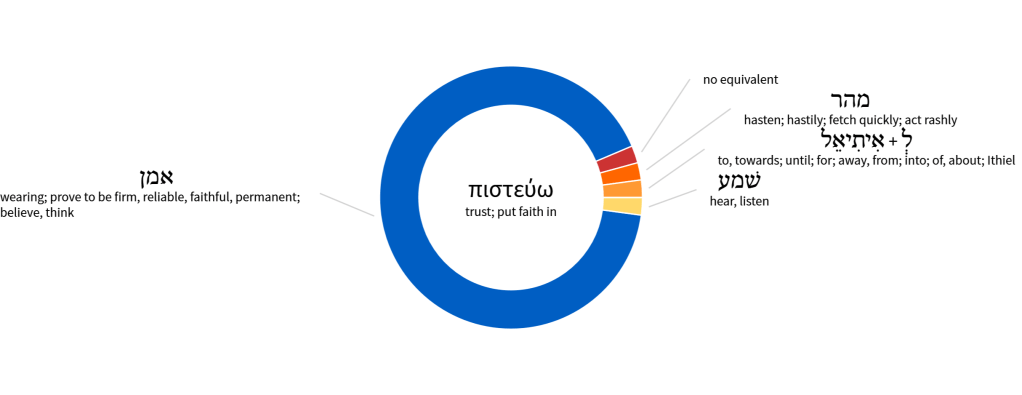
The first Hebrew word that aligns with “pisteuo” is “Aman”. We see the essence of the meaning of this word is trustworthy, confirmed, reliable and trust to do a thing.
I. [אָמַן] vb. confirm, support — Qal 1. as vb. support, nourish. 2. as subst. foster-father. 3. foster-mother, nurse. 4. pillars, supporters of the door. Niph. 1. carried by a nurse. 2. made firm, sure, lasting. 3. confirmed, established, sure. 4. verified, confirmed. 5. reliable, faithful, trusty. Hiph. 1. stand firm. 2. trust, believe: (a) abs.; (b) with ל of person, trust to, believe; ל of thing; (c) with ב of person, trust in, believe in; with ב of thing; (d) with כִּי trust or believe that; (e) so with infin. (sq. ל); also trust to do a thing, almost = allow.
Richard Whitaker et al., The Abridged Brown-Driver-Briggs Hebrew-English Lexicon of the Old Testament: From A Hebrew and English Lexicon of the Old Testament by Francis Brown, S.R. Driver and Charles Briggs, Based on the Lexicon of Wilhelm Gesenius (Boston; New York: Houghton, Mifflin and Company, 1906).
We often see people post on social media, “I did a thing” along with a picture of a new car, or perhaps a wedding photo indicating they “did something” special or out of the ordinary. Another Hebrew word that aligns with “pisteuo”, which is translated to the English word “believe”, is “Shema”.
שָׁמַע vb. hear — Qal 1. subj. pers. hum. (vel rei personif.): a. hear (perceive by ear), acc. rei, esp. קוֹל, (ים)דבר, etc.; acc. חָכְמָה i.e. wise sayings; any utterance or sound + (obj. om.) (cl. temp.); c. ב; c. obj. cl., כִּי; sq. orat. rect. b. acc. pers. + מְדַבֵּר hear one speaking; acc. pers. only. c. c. לֵאמֹר only, hear say = hear it said; + עַל pers. concerning; אֶל pers. id. d. hear of, concerning: (1) acc. rei; (2) less oft. acc. pers., אֶל pers., pers. om.; c. ב pers. hear exultantly of their fate. e. hear, abs., = have power to hear (c. בְּקוֹל); in si.; c. neg. of idols; fig. (spiritual power). f. hear with attention, interest, listen to; oft. abs. + (neg.) pay no attention. g. understand (language). h. specif. of hearing a (judicial) case; acc. om. בֵּין pers., of ˊי; c. מִשְׁפָּט. i. c. acc. pers. in polite address, hear us (me)! j. listen, give heed, abs.; hear + do; = consent, agree, grant request; c. ל pers. k. c. אֶל pers. + listen to, yield to, עַל pers.; אֶל־דִּבְרֵי etc., עַל־דִּבְרֵי etc.; very rarely acc. rei. l. לְקוֹל ˊשׁ = id., obey. m. very oft., בְּקוֹל ˊשׁ = obey, + ˊבְּקוֹל י ˊשׁ (ˊי’s word, etc.). n. obey, c. acc. (ים)דבר; acc. pers. o. abs. be obedient (esp. to ˊי). 2. ˊי (God) subj.:
Richard Whitaker et al., The Abridged Brown-Driver-Briggs Hebrew-English Lexicon of the Old Testament: From A Hebrew and English Lexicon of the Old Testament by Francis Brown, S.R. Driver and Charles Briggs, Based on the Lexicon of Wilhelm Gesenius (Boston; New York: Houghton, Mifflin and Company, 1906).
Both the words “believe” and “confess” convey the meaning of being in covenant and being faithful to someone. Does confessing that Jesus is Lord simply mean stating this when asked? This is something that the demons are capable of doing, so there must be something more to set apart those who claim to follow Yeshua.
Romans 10:6–10 (LEB): 6 But the righteousness from faith speaks like this: “Do not say in your heart, ‘Who will ascend into heaven?’ ” (that is, to bring Christ down), 7 or “Who will descend into the abyss?” (that is, to bring Christ up from the dead). 8 But what does it say? “The word is near to you, in your mouth and in your heart” (that is, the word of faith that we proclaim), 9 that if you confess with your mouth “Jesus is Lord” and believe in your heart that God raised him from the dead, you will be saved. 10 For with the heart one believes, resulting in righteousness, and with the mouth one confesses, resulting in salvation.
Paul is quoting Deuteronomy here. Many will look past, “For with the heart one believes, resulting in righteousness” and dumb down the word “confess” to mean to simply state a fact.
Deuteronomy 30:10–16 (LEB): 10 He will do this if you listen to the voice of Yahweh your God by keeping his commandment and his statutes written in the scroll of this law and if you return to Yahweh your God with all your heart and with all your inner self.
11 “For this commandment that I am commanding you today is not too wonderful for you, and it is not too far from you. 12 It is not in the heavens so that you might say, ‘Who will go up for us to the heavens and get it for us and cause us to hear it, so that we may do it?’ 13 And it is not beyond the sea, so that you might say, ‘Who will cross for us to the other side of the sea and take it for us and cause us to hear it, so that we may do it?’ 14 But the word is very near you, even in your mouth and in your heart, so that you may do it. 15 “See, I am setting before you today life and prosperity and death and disaster; 16 what I am commanding you today is to love Yahweh your God by going in his ways and by keeping his commandments and his statutes and his regulations, and then you will live, and you will become numerous, and Yahweh your God will bless you in the land where you are going.
The New International Dictionary of New Testament Theology gives us a great first century definition of the Greek word “homologeo”, used for the English word “confess”.
ὁμολογέω G3933 (homologeō), promise, confess, declare, praise; ἐξομολογέω G2018 (exomologeō), promise, confess, praise; ὁμολογία G3934 (homologia), confession.
CL homologeō (Soph. onwards) and homologia (Hdt. onwards) are compounds of homos, the same, similar, and legō, say, or logos, word, speech. Hence homologeō means to say the same, i.e. agree in one’s statements, and homologia means agreement, consent.
The legal connotation is dominant. A man agrees with another’s statement, concedes or confesses something (e.g. his guilt before a judge), agrees to something (e.g. another’s wish) and so promises. This agreement expresses itself in an act of commitment, promise, or confession in a court or legal contract.
The religious use of the words is probably derived primarily from their use in the language of treaties and the law-courts. The man who binds himself by an oath (homologeō) enters into a treaty relationship with the deity. This concept was then transferred from the solemn confession of wrong-doing before a court of law to the confession of sin to the deity. These concepts were used especially in the oriental cults, as may be seen from Lydian and Phrygian expiatory inscriptions. In modern Gk. the concept has come to mean sacramental confession to a priest: exomologeomai, I make my confession; exomologeō, I hear a confession.
D. Fürst, “Confess,” ed. Lothar Coenen, Erich Beyreuther, and Hans Bietenhard, New International Dictionary of New Testament Theology (Grand Rapids, MI: Zondervan Publishing House, 1986), 344.
It should not be a surprise that being in covenant with God is the result of believing and confessing Yeshua. He is the way to the Father. The idea that believing and confessing is only lip service, defined by a church denomination, or from our imagination, is problematic.
Matthew 26:26–28 (LEB): 26 Now while they were eating Jesus took bread and, after giving thanks, he broke it, and giving it to the disciples, he said, “Take, eat, this is my body.” 27 And after taking the cup and giving thanks he gave it to them, saying, “Drink from it, all of you, 28 for this is my blood of the covenant which is poured out for many for the forgiveness of sins.
What is the new covenant promised through the prophet Jeremiah and delivered by Yeshua? It is only for the house of Israel and the house of Judah, so one must learn what that means. In this new covenant delivered by Yeshua, God will write His laws on our hearts. This sounds like the verses in Deuteronomy.
Deuteronomy 30:4–8 (LEB): 4 “Even if you are outcasts at the end of the heavens, even from there Yahweh your God shall gather you, and from there he shall bring you back. 5 And Yahweh your God will bring you to the land that your ancestors had taken possession of, and he will make you successful, and he will make you more numerous than your ancestors.
6 “And Yahweh your God will circumcise your heart and the heart of your offspring to love Yahweh your God with all your heart and with all your inner self so that you may live. 7 And Yahweh your God will put all these curses on your enemies and on those who hate you, on those who harassed you. 8 And you will again listen to the voice of Yahweh, and you will do all his commandments that I am commanding you today.
For the New Testament only crowd, we are taught this in the book of Hebrews.
Hebrews 8:8–10 (LEB): 8 For in finding fault with them he says, “Behold, days are coming, says the Lord, when I will complete a new covenant with the house of Israel and with the house of Judah, 9 not like the covenant which I made with their fathers on the day I took hold of them by my hand to lead them out of the land of Egypt, because they did not continue in my covenant and I disregarded them, says the Lord. 10 For this is the covenant that I will decree with the house of Israel after those days, says the Lord: I am putting my laws in their minds and I will write them on their hearts, and I will be their God and they will be my people.
Does anyone believe God has a new set of laws that He will put in people’s minds and hearts? It is apparent that the answer is “yes” based on the total disregard of God’s laws that exists in the Church today. There is only one set of laws. God gave them through Moses and Israel. He sent Yeshua to do a reset and get the people back on track, and at the same time make it clear that the whole world could be part of the covenant if they repent and “believe”.
Featured photo was provided by Emma Vail Photography.
Blog Videos:
Latest blog posts:

Jesus: The Prophet Like Moses
Moses said, ‘The Lord God will raise up for you a prophet like me from your brothers. You will listen to him in everything that he says to you. And it will be that every…


Reasons for Christians to Celebrate Hanukkah
They sacrificed to the demons, not God,to gods whom they had not known,new gods who came from recent times;their ancestors had not known them. Deuteronomy 32:17 (LEB) The Greeks set up Asherah poles and sacrificed…

Dispensationalism Theology, Israel and You
And you will say, ‘I will go up against a land of open country; I will come to the people being at rest in safety, all of them dwelling without a wall and crossbars and…

Prophecy Fulfilled; And It’s Not Good
“Beware of false prophets who come to you in sheep’s clothing, but inside are ravenous wolves. You will recognize them by their fruits: they do not gather grapes from thorn bushes or figs from thistles,…

Testing the Spirits
And while he was still approaching, the demon threw him down and convulsed him. But Jesus rebuked the unclean spirit and healed the boy, and gave him back to his father. Luke 9:42 (LEB) What…

Did Jesus Hate the Pharisees?
But as for the cowards and unbelievers and detestable persons and murderers and sexually immoral people and sorcerers and idolaters and all liars, their share is in the lake that burns with fire and sulphur,…

Are We Really Robbing God or Just Getting Robbed?
All scripture is inspired by God and profitable for teaching, for reproof, for correction, for training in righteousness, in order that the person of God may be competent, equipped for every good work. 2 Timothy…

I was Raised a Christian-Zionist Nationalist- and Left
And then many will be led into sin and will betray one another and will hate one another, and many false prophets will appear and will deceive many, and because lawlessness will increase, the love…

Choosing Your Sins Carefully in 2025
And I brought them out from the land of Egypt, and I brought them to the desert, and I gave my statutes to them, and my regulations I made known to them, which, if a…

This is How it Works
Then Jesus said to him, “Put your sword back into its place! For all who take up the sword will die by the sword. Or do you think that I cannot call upon my Father,…

Today is the Day of Pentecost
Pentecost is a Greek term meaning “fifty”. Many churches are celebrating the day of Pentecost today, which in most cases is viewed as the start of the Church and the giving of the “Holy Ghost”.…

Imaginary Jesuses
Blessed are the ones who hunger and thirst for righteousness,because they will be satisfied. Matthew 5:6 (LEB) When Jesus delivered his famous sermon on the mount, one of his statements was “Blessed are the ones…
 Hear the Matter Proverbs 18:13